

Curative Title Risk as a Valuation Adjustment
A defensible title-risk adjustment identifies the issue, affected interest, cure path, timing, cost evidence, payment effect, and residual uncertainty before changing value.
Read the post →How mineral rights are valued, the limits of any single number, and the assumptions behind an offer.
96 published articles · Page 4 of 4
A defensible title-risk adjustment identifies the issue, affected interest, cure path, timing, cost evidence, payment effect, and residual uncertainty before changing value.
Read the post →
A useful royalty-history baseline preserves each production month, property, product, decimal, price, tax, deduction, adjustment, and net payment before summarizing cash flow.
Read the post →
A comparable mineral sale is relevant only when the interest conveyed, property evidence, market timing, and transaction terms are sufficiently similar and verifiable.
Read the post →
A basis differential is the location-related difference between a benchmark and a regional market price. It can affect royalty cash flow, but it is not the same thing as a post-production deduction.
Read the post →
Acreage contiguity can make a tract easier to evaluate as part of a connected development area, but it does not establish title, pooling authority, a permit, a drilling schedule, or a specific value.
Read the post →
Horizontal drilling is a well-completion technique that public RRC well records document. Learn what those records show and how MRX uses them in its reviews.
Read the post →
Oil prices can change royalty revenue quickly, but owners still need production, lease, and ownership records before drawing value conclusions.
Read the post →
Producing interests can be reviewed from payment and production history, while non-producing interests usually depend more on acreage, location, lease terms, and development uncertainty.
Read the post →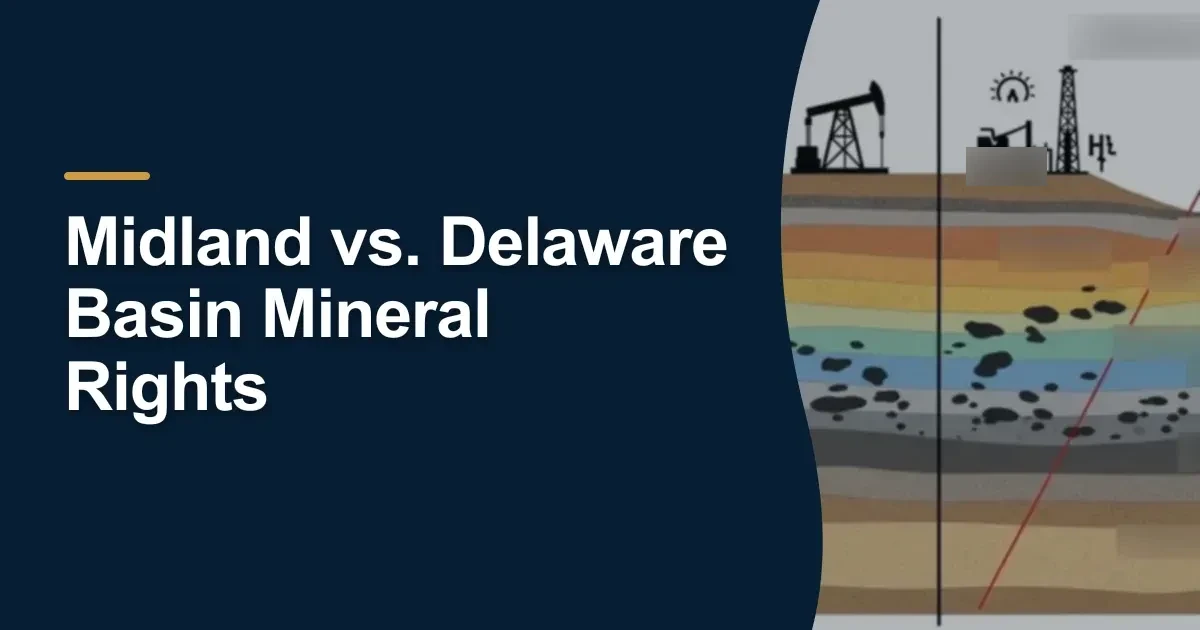
Midland and Delaware are both Permian Basin sub-basins, but owners should compare formations, well results, operator activity, and tract records before treating them as interchangeable.
Read the post →
Oil and gas interests can behave differently on a statement and in a review because products, pricing, decline patterns, and deductions are not always the same.
Read the post →
Net royalty acres normalize acreage and royalty burden for comparison. NRI describes the decimal share of production revenue credited to an owner.
Read the post →
A lower royalty check can reflect production, price, timing, deductions, or ownership changes. Learn which signals may also affect mineral rights value.
Read the post →
Mineral rights are valued by defining the economic interest, modeling conditional royalty cash flows, discounting them to present value, and checking the result against relevant market evidence.
Read the post →
A value-review article that explains what owners miss when they skip an independent assessment before acting on an offer or assumption.
Read the post →
A transaction price reflects inputs, assumptions, risk, timing, and contract terms, not one universal price-per-acre formula.
Read the post →
A Texas mineral-rights value range begins with the exact interest owned, then separates producing cash flow, undeveloped potential, market assumptions, and deed scope.
Read the post →
Mineral-rights value depends on what is owned, the evidence supporting current cash flow and future development, the effective date, uncertainty, market terms, and the rights actually conveyed.
Read the post →
Mineral-rights value depends on the exact interest, tract-level evidence, production or development context, assumptions, and the terms of a real transaction.
Read the post →
Texas mineral owners can preserve optionality by making the interest easier to verify, reconciling records, documenting unresolved issues, and requiring comparable written offers.
Read the post →
A neutral comparison checklist for mineral-rights review services based on process transparency, not competitor-performance claims.
Read the post →
A plain-language explanation of what the MRX AI-first workflow does, what remains for human review, and which limitations owners should understand.
Read the post →
A fairness-and-trust article that explains what a transparent mineral-rights valuation can and cannot prove.
Read the post →
A source-bounded explanation of the production, ownership, lease, commodity, development, and risk assumptions behind a mineral-rights review range.
Read the post →
A Texas value primer that explains what value depends on without promising a universal formula or appraisal-grade certainty.
Read the post →A free, confidential underwriter review. The output is a directional range with the assumptions stated. No card. No obligation.
No card required. No obligation. Confidential review.