

Does a Texas RRC P-4 Purchaser Have to Be My Royalty Payor?
A P-4 purchaser is a designated first buyer, not a public ruling on an owner’s payor. Texas law has a first-purchaser default and a stated arrangement exception.
Read the post →Foundational explainers on mineral rights ownership, royalties, and lease structures in Texas.
30 published articles · Page 1 of 2
A P-4 purchaser is a designated first buyer, not a public ruling on an owner’s payor. Texas law has a first-purchaser default and a stated arrangement exception.
Read the post →
A Wyoming state-trust or federal lease notice does not set a private mineral lease rate. Identify the lessor and agreement before comparing a public percentage with a payment decimal.
Read the post →
Texas mineral-appraisal sources use RI for royalty interest, but a displayed RI code and decimal are different fields and do not prove an owner’s private title or payable share.
Read the post →
The COGIS owner-same flag and matching category labels are not a person-specific title finding. Save the exact card, then review the relevant instruments separately.
Read the post →
Use Ohio’s county recorder records to collect deeds, leases, and relevant notices for a title review, without treating an index result as ownership proof.
Read the post →
Use the OCC case number and the correct older or newer records route to find the actual pooling order. A notice or case listing is not the issued order.
Read the post →
DEP well production is an operator-reported public record, not an owner payment ledger. Match the well, product and period before treating a difference as a payor question.
Read the post →
A state mineral-lease file is a different record source from a private owner’s parish-record question. Keep the actual instrument and source locator separate from a title conclusion.
Read the post →
An RRC permit is a regulatory record. Compare it with private instruments before asking whether a particular mineral lease covers a well.
Read the post →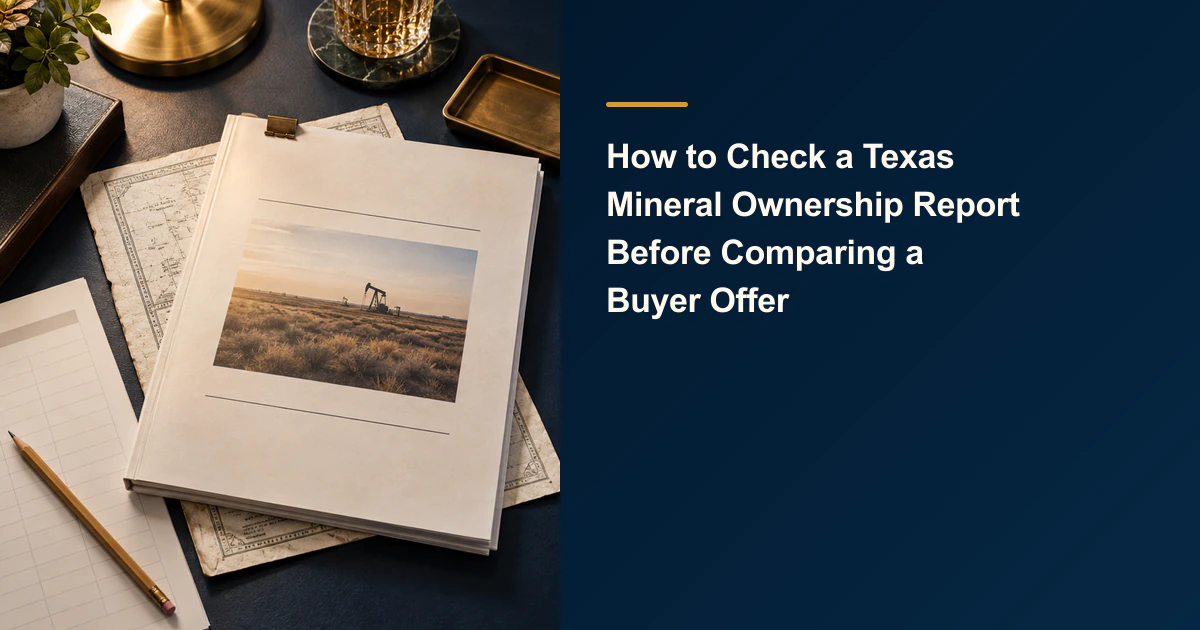
Check a private Texas mineral ownership report against its stated sources without treating it as proof of title or offer value.
Read the post →
Compare a West Virginia tax account and mineral buyer letter without treating a document match as proof of title, acreage, royalty decimal, or value.
Read the post →
Find the right BLM records for a Wyoming federal mineral reservation question without treating a GIS layer as a private-title answer.
Read the post →
Use North Dakota Courts Form 11 and Form 12 labels to frame a county-record question without assuming a deed, an heir, or a title outcome.
Read the post →
Use North Dakota county records, DMR well context, and the royalty ombudsman for different inherited-interest questions without treating a match as a title or payment finding.
Read the post →
Use two official Oklahoma searches to document possible mineral-payment leads without treating a name match as proof of ownership or entitlement.
Read the post →
An old royalty statement can supply clues for locating a Texas county record path, but it cannot establish an heir’s ownership or title.
Read the post →
Royalty payments for Texas mineral owners depend on the lease, the division order, and the operator-reported production. This article explains those inputs.
Read the post →
A process-transparency article that frames MRX review as educational and inspectable, not as a superiority promise or appraisal claim.
Read the post →
A source-bounded MRX process article about transparent reviews, owner questions, written terms, and no-obligation decision control.
Read the post →
A useful mineral-rights assessment is an evidence file with explicit assumptions, not a single online estimate or universal royalty multiple.
Read the post →
A source-bounded explanation of how ownership, production, lease economics, commodity assumptions, development evidence, risk, and deal terms shape an offer range.
Read the post →
A source-bounded overview of the no-obligation review, stated assumptions, document review, and professional boundaries MRX describes on its public pages.
Read the post →
A written-fee checklist that separates review costs, optional services, transaction deductions, title adjustments, and expected net proceeds.
Read the post →
A neutral MRX process article about using a no-obligation review as an organized first step before a mineral-rights decision.
Read the post →A free, confidential underwriter review. The output is a directional range with the assumptions stated. No card. No obligation.
No card required. No obligation. Confidential review.