
Inheritance and estate
- Will, trust, or probate order
- Affidavit of heirship or estate records
- Prior owner’s full legal name
Inherited mineral rights
You do not need every document on day one. Begin with who owned the interest, how it passed to you, where it is located, and any lease, operator, production, or royalty information already in the family files.
Build the paper trail
Start with what is available. Missing records can often be identified after the owner, county, operator, and property details are organized.
A practical first pass
An offer can be a reason to investigate, but it does not establish ownership or value by itself. First connect the prior owner to the current heirs and identify the property that may be involved.
Record the full legal name and how the interest passed through the estate.
Start with the state, county, legal description, operator, lease, or well.
Compare the written records, payment history, and complete offer terms.
Choose the next record question
The starting checklist organizes what you have. These guides take the next question further without assuming the records prove ownership or value.
Separate estate authority and recorded property documents from an offer to buy.
Identify the payor, owner number, property, statement periods, and transfer questions.
Prepare a useful review packet without exposing unnecessary private details.
Have an old royalty statement but no reliable county or tract? Start with the Texas statement-to-record location guide. It explains how to track clues and unresolved links without treating a payor or production match as proof of ownership.
For a Texas property, the Texas State Library's land-record guide points researchers to the county where the land is located for recorded transfers. Other jurisdictions need their own local record path; the legal effect of any document requires qualified review.
MRX provides general educational information. Ownership, title, probate, tax, and legal conclusions may require a qualified professional in the state where the minerals are located.
Inherited Mineral Rights articles
Showing 1 through 12 of 19 published articles

Inherited-mineral review requires separate answers for authority, ownership, date-of-death tax basis, current value, and transaction terms.
Use North Dakota Courts Form 11 and Form 12 labels to frame a county-record question without assuming a deed, an heir, or a title outcome.
Use North Dakota county records, DMR well context, and the royalty ombudsman for different inherited-interest questions without treating a match as a title or payment finding.
Use two official Oklahoma searches to document possible mineral-payment leads without treating a name match as proof of ownership or entitlement.
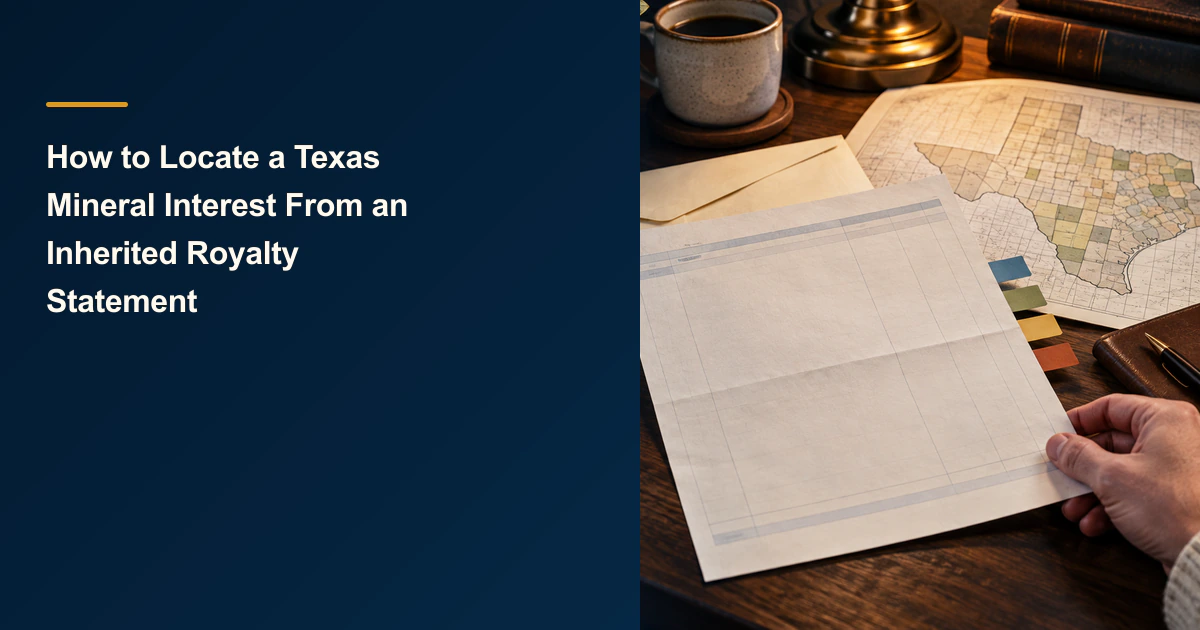
An old royalty statement can supply clues for locating a Texas county record path, but it cannot establish an heir’s ownership or title.
Create one blank provenance record for one authorized manual attempt to preserve only the official Texas Comptroller county-page Tax Assessor/Collector directory section.
Create one blank provenance record for one authorized manual attempt through the official Texas Comptroller county directory without expanding into property or tax-record research.
Create one blank provenance record for one authorized manual search through one official Texas court or county route without interpreting appointment, authority, or legal effect.

An inherited-mineral estate plan should connect the legal structure to recorded title, tract records, income administration, decision authority, and practical successor instructions.
Probate mineral work connects estate authority, title, inventory, lease and production administration, payor records, and the final recorded distribution.

A mineral estate plan needs an operating file that tells successors what is owned, who may act, where records live, and how income and decisions are administered.
Texas mineral interests do not disappear at death; heirs and fiduciaries must connect the governing estate path to county title, leases, payors, income, and basis records.