
MRX Learning Center
Understanding the Value of Your Mineral Rights
Mineral-rights value depends on what is owned, the evidence supporting current cash flow and future development, the effective date, uncertainty, market terms, and the rights actually conveyed.

Direct answer for mineral owners
Mineral-rights value is a dated range based on the exact interest owned, lease and title terms, attributable production and payments, commodity and development scenarios, comparable market evidence, and the rights and conditions in a proposed conveyance. A defensible review distinguishes source facts from assumptions and does not use a universal price-per-acre or royalty-check multiple.
Key takeaways for mineral owners
- Value cannot be assessed until the owner, property, interest type, net fraction, depths, and effective date are defined.
- Current cash flow, undeveloped potential, and market evidence should be analyzed separately before they are combined.
- Public records, royalty statements, title instruments, and offers answer different questions and may conflict.
- Every value conclusion should show assumptions, uncertainty, sensitivities, exclusions, and the scope of any deed or assignment.
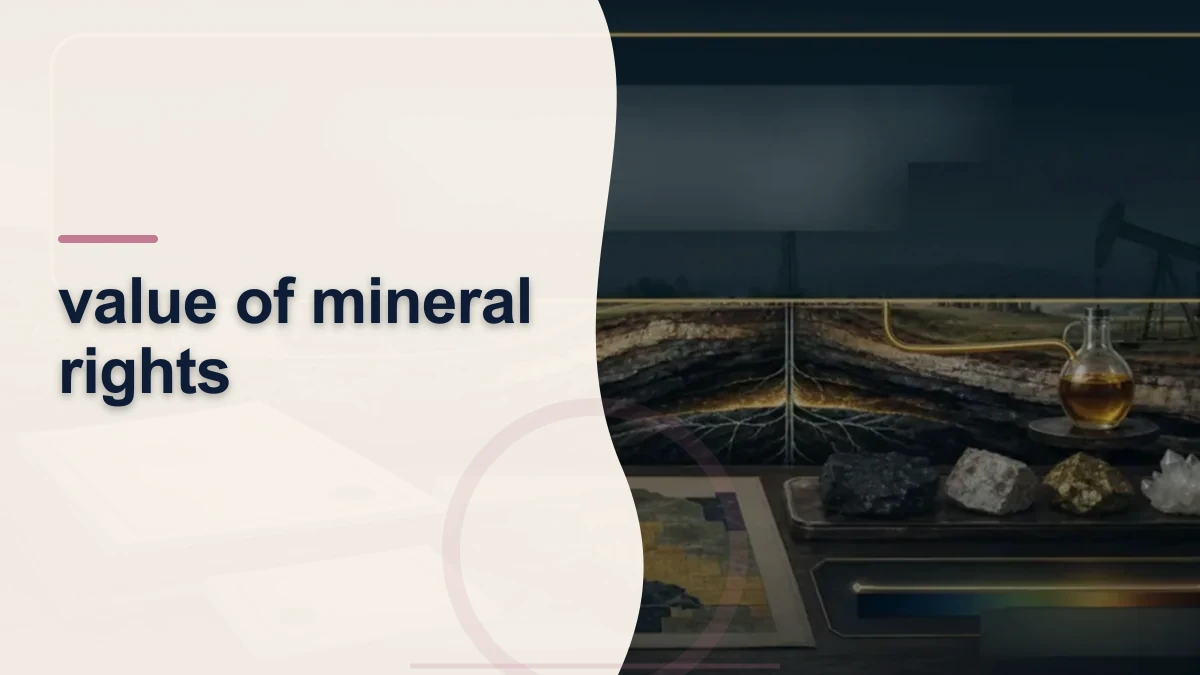
This article provides general owner education. It is not a title opinion, reserve report, engineering forecast, or credentialed appraisal. It does not provide owner-specific legal, tax, or investment guidance or guarantee production, an offer, or a sale price.
Direct answer for mineral owners
The value of mineral rights is a dated range for a specifically defined interest, not a universal number per acre or a fixed multiple of one royalty check. A defensible review explains what is owned, which facts support current cash flow and future potential, what remains uncertain, and what a proposed deed would actually convey.Reasonable reviewers can reach different ranges because they use different assumptions about ownership, production, decline, prices, development, risk, timing, and market terms. The useful question is not only “What is the number?” but “Which evidence and assumptions produced it?”
Define the interest before the value
Start with an ownership statement:
- owner and legal capacity;
- state, county, tract, and legal description;
- interest type;
- gross acreage and claimed net ownership;
- depths, formations, leases, units, and wells;
- producing and nonproducing portions; and
- effective date of the review.
Support the statement with deeds, reservations, assignments, probate or trust instruments, leases, amendments, division orders, and other relevant records. A tax record or royalty statement can help identify property, but neither automatically proves complete title.
An owner who controls one depth or a fractional royalty owns a different asset from an owner who controls all minerals in the same tract. Value conclusions must preserve that distinction.
Understand the main value categories
Current cash flow
Producing interests provide statements showing product, volume, realized price, ownership decimal, taxes, deductions, adjustments, suspense, and net payment. Reconcile multiple periods and separate new-well flush production, downtime, catch-up payments, and revisions from a normal trend.
Historical cash flow is evidence, not a promise. A forward view needs explicit assumptions about decline, price, downtime, lease burdens, title, and operating or market risk.
Undeveloped potential
Nonproducing value may depend on lease status, depths, formations, nearby wells, permits, unit boundaries, operator position, spacing, infrastructure, credible development plans, and timing. A permit or offset well can inform a scenario but does not guarantee drilling or production on the subject interest.
Use conservative, documented-base, and conditional-upside cases. Apply probability and timing rather than treating every possible well as current value.
Market evidence
Written offers and comparable transactions can reveal market interest. They become useful only after adjusting for location, interest type, net ownership, lease terms, title condition, production, development status, depths, retained rights, price adjustments, and closing terms.
An offer is one counterparty’s proposal. It is not automatically an appraisal, and a higher headline can convey more property or allow broader reductions.
Know what each record can prove
The Railroad Commission of Texas provides online research queries and production data for reported regulatory and production information. These sources can help identify wells, permits, operators, fields, and production context.
RRC data do not prove private title, a royalty decimal, a lease interpretation, a payor error, or future development. The RRC’s royalty FAQ explains important limits on the agency’s role.
County instruments support the ownership chain. Leases and amendments define contractual rights. Division orders and statements show payor setup and payments. Tax records support their stated tax purpose. Offers show market proposals. Keep those sources in separate columns and investigate conflicts.
Use commodity prices as dated context
EIA publishes monthly crude-oil spot prices and Texas natural-gas price series. Use them to document market scenarios and the effective date.
A specific property may realize a different price because of location, quality, product mix, transport, contract provisions, deductions, and sales timing. Do not use a benchmark as a guaranteed wellhead or royalty price.
Show how the value range changes under more than one price case. Avoid presenting a current commodity cycle as permanent.
Treat the effective date as part of the answer
Mineral value can change when production declines or a new well begins, a lease is signed or expires, title is cured, a unit changes, development evidence improves or weakens, prices move, a buyer changes terms, or the owner decides to convey a different scope.
Date the records and assumptions. A conclusion prepared for an estate, tax, lending, financial-reporting, or transaction purpose may use a different standard and date from a directional owner review.
The Texas Comptroller’s market-value overview provides general open-market context; it is not a mineral-sale formula or a substitute for the rules governing another purpose.
Build a transparent range
A useful review shows:
- the exact interest and effective date;
- the source record for each material fact;
- current attributable cash flow by property;
- decline, price, expense, and downtime assumptions;
- undeveloped scenarios with probability and timing;
- market evidence and comparability adjustments;
- title, lease, tax, and transaction uncertainties;
- sensitivities and excluded possibilities; and
- the professional conclusions still required.
Precision should match the evidence. A missing ownership fraction or unresolved depth reservation can matter more than adding decimal places to a cash-flow model.
Compare value with the proposed conveyance
Before acting on an offer, compare the model’s property statement with the purchase agreement, deed or assignment, and exhibits. Confirm the county, tract, interest, depths, formations, leases, wells, effective date, royalties, receivables, after-acquired title, warranties, and retained rights.
Also compare the title standard, price-adjustment power, diligence period, termination rights, payment method, closing date, and recording sequence. A value conclusion for one asset cannot justify a deed conveying a broader asset without a new comparison.
MRX provides educational information and resources only and does not buy mineral rights. This educational role does not establish an independent appraisal or professional-advice relationship; use appropriately qualified professionals for property-specific questions.
Source notes and research limitations
- RRC research queries and production data support bounded public well, permit, operator, and production context.
- RRC royalty FAQ supports the boundary between public regulatory information and private royalty or title questions.
- EIA crude-oil and Texas natural-gas series support dated commodity scenarios only.
- Texas Comptroller valuation guidance supports general market-value context, not a mineral-sale formula.
Review the factors that affect mineral-rights value or organize a directional value file.
Frequently asked questions
Is there a standard mineral-rights price per acre?
No universal price fits every location, formation, interest type, net ownership, lease, title condition, production history, development outlook, commodity market, and transaction term.
Are producing minerals always worth more than nonproducing minerals?
Producing interests provide observable cash-flow evidence, while nonproducing interests can still have significant or limited potential. The result depends on the specific property, rights, development evidence, risks, and market.
Can one royalty check establish value?
No. A single payment may reflect unusual volume, price, deductions, taxes, adjustments, suspense, or timing. Review a reconciled history and keep forward assumptions separate.
Why do two mineral-rights offers differ?
Buyers may assume different ownership, production, decline, prices, future wells, risk, timing, return requirements, deed scope, title standards, adjustments, and closing costs.
When should I update a mineral value review?
Update it when the effective date matters or material facts change, such as title, lease status, production, development, commodity conditions, offers, estate ownership, or transaction scope.
Sources reviewed for this article
- Railroad Commission of Texas online research queries (accessed 2026-08-06)
- Railroad Commission of Texas production data (accessed 2026-08-06)
- Railroad Commission of Texas royalty FAQ (accessed 2026-08-06)
- U.S. EIA monthly crude-oil spot prices (accessed 2026-08-06)
- U.S. EIA Texas natural-gas prices (accessed 2026-08-06)
- Texas Comptroller, Valuing Property (accessed 2026-08-06)
Related mineral-rights articles

How Are Mineral Rights Valued?
Mineral rights are valued by defining the economic interest, modeling conditional royalty cash flows, discounting them to present value, and checking the result against relevant market evidence.
Read the post →
What Determines the Value of Your Mineral Rights?
Mineral-rights value depends on the exact interest, tract-level evidence, production or development context, assumptions, and the terms of a real transaction.
Read the post →
How Lease Royalty Rates Influence Mineral Value
A lease royalty rate changes the owner revenue share used in a valuation model, but ownership, allocation, lease language, production, price, costs, timing, and risk still control the result.
Read the post →
Essential Steps to Assess the Value of Your Mineral Rights Accurately and Confidently
A confident mineral-rights value assessment starts with a dated evidence file, not a price shortcut. Identify the interest, reconcile records, separate facts from assumptions, and document what could change the range.
Read the post →A practical next step
Put your mineral rights in context.
Every mineral interest, royalty history, and written offer is different. Start with a question, or share what you have for a free underwriter review.
- Free
- Confidential
- No obligation to sell
Ready for a closer look?
Organize a Mineral Value ReviewGet a directional range with the assumptions clearly stated.