
MRX Learning Center
Does a Texas RRC Drilling Permit Prove Your Lease Covers a Well?
An RRC permit is a regulatory record. Compare it with private instruments before asking whether a particular mineral lease covers a well.

Direct answer for mineral owners
No. A Texas RRC drilling permit records a regulatory filing and its status; its displayed “Lease” name is a regulatory label, not a title opinion about your private contract. Keep the W-1, permit, and plat separate from your recorded instruments, lease and amendments, and any relevant pooling or unit papers. Mark unmatched documents for qualified Texas land or title review rather than concluding that a specific lease covers a well.
Key takeaways for mineral owners
- The RRC says it does not determine the validity of private mineral leases.
- A result-row “Lease” name can refer to regulatory lease, pooled, or unitized acreage, not an owner-specific title conclusion.
- Compare permit identifiers, status, operator, plat, and planned wellbore with private instruments as separate record sets.
- A horizontal well’s surface site outside a named lease does not by itself resolve private coverage.
- An application, approved permit, drilled well, and production are different events.
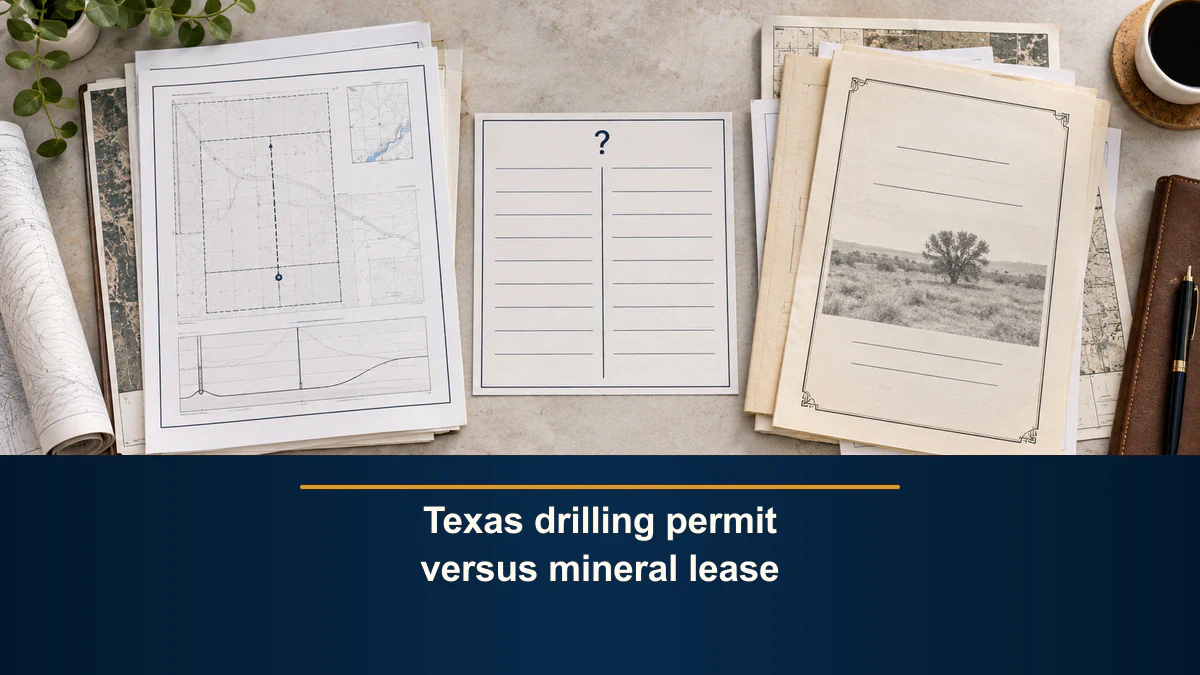
No. A Texas Railroad Commission (RRC) drilling permit records regulatory permission and related filing details for a proposed well. It does not establish that your private mineral lease is valid, covers the relevant tract or depth, includes the proposed wellbore, or entitles you to royalties. The RRC expressly says it has no jurisdiction over the validity of private mineral leases. Its public permit result uses “Lease” as a regulatory label for lease, pooled, or unitized acreage, not as a title opinion about your contract. RRC Permian Basin FAQs · RRC permit-query results help
This is a public-record comparison, not an interpretation of any owner’s lease, title, pooling arrangement, acreage, wellbore, royalties, or legal rights. A qualified Texas land or title professional should review disputed private rights. Do not send a full unredacted lease or personal records through an untrusted channel. MRX provides educational information and resources only and does not buy mineral rights.
That distinction does not mean an operator can drill without private rights. The RRC FAQ says an operator must have a legal mineral lease for extraction, but that requirement is different from the agency determining whether your specific lease covers this specific well. Treat a permit as a record to compare with private documents, not as proof of owner-specific coverage.
What a permit can tell you
The RRC’s drilling-permit result guide identifies fields such as API number, county of the surface hole, regulatory lease name, well number, permitted operator, status and status date, filing purpose, and planned wellbore profile. A result can link to the current W-1 application, current permit, attachments listed on the W-1 screen, and a plat. Record the exact identifier and date from the document you actually open; the result row and its attachments are not interchangeable.
The guide explains that the displayed “Lease” name describes acreage for RRC regulatory purposes and may change at completion. The displayed operator is the applicant or permit holder for Commission purposes. Neither label substitutes for a recorded lease, a chain of title, or professional interpretation of a private agreement.
If you need a reproducible search trail, use the separate Texas RRC drilling-permit query retrieval provenance worksheet. That worksheet records how a query was run; this article explains why a result cannot answer a private-lease question by itself.
Compare the two record sets without merging them
Use a short exception list rather than deciding from a matching name. Keep these comparisons separate:
- Record the W-1, permit number, API, and status date. Locate the owner’s recorded deed or assignment and lease separately. Ask whether they describe the same interest and time period.
- Preserve the regulatory lease name, operator, and filed plat. Then inspect the private lease parties, legal description, and any amendments. Ask whether similar names are merely labels or the instruments connect the tract.
- Preserve the planned wellbore profile and locations shown in the filing. Locate any relevant pooling or unit documents and tract or depth language. Ask which instruments, if any, address this tract and interval.
Write not matched, document missing, or professional review needed for a gap. Do not write covered or not covered from a public search alone. The RRC’s well-records guide identifies W-1 applications and location plats as agency well records and says the agency lacks authority over lease, royalty, and property-rights matters. For the private-record side, start with the county of the property and the recorded instruments; the Texas GLO mineral-rights FAQ explains why deed and lease examination matters. A qualified professional may need additional records not apparent from these public indexes.
A surface-location mismatch is not the answer
A horizontal well can be drilled from a surface site outside the lease designated on its permit. The RRC describes this possibility in its Permian Basin FAQ. A surface pin outside your tract therefore neither proves exclusion nor inclusion. The well path, filed plat, relevant private instruments, and any unit documents need their own review. Do not infer a royalty share, trespass, or a remedy from a map pin.
An application is not the same event as an issued permit, a drilled well, a completed well, or reported production. The RRC result guide explains status and approval dates. Preserve the actual status shown when checked rather than assuming activity progressed.
The useful next step
If the RRC record and your private documents appear to concern the same place, assemble the exact W-1 or permit and plat reference, the recorded deed or assignment, your lease and amendments, and any identified pooling or unit papers. Note what you could not match. A Texas land or title professional can assess that defined question; this public article cannot. The title, lease, and ownership learning center explains how the record classes fit together, while What Is an Oil and Gas Lease and How Does It Affect Your Mineral Rights? covers the private agreement itself.
You may request an MRX record-organizing review if you want help organizing records for a potential transaction. MRX does not determine lease coverage, title, ownership, royalty entitlement, trespass, remedies, or legal rights, and its review is not a substitute for an independent title or legal opinion. Share only records you are authorized to provide. MRX provides educational information and resources only and does not buy mineral rights.
Frequently asked questions
Does the RRC “Lease” field identify my signed mineral lease?
Not necessarily. The RRC defines the result field as a regulatory name for lease, pooled, or unitized acreage. Compare the label with recorded instruments and the actual private lease; a name match alone is not a title conclusion.
If the permit was approved, did the RRC verify my lease?
No owner-specific lease verification follows from permit approval. The RRC says it lacks jurisdiction over the validity of private mineral leases. Approval is a regulatory event, not an adjudication of your contract.
Does a surface location outside my tract exclude my minerals?
No conclusion follows from the surface site alone. The RRC notes that a horizontal well can have a surface location outside the lease named on its permit. The filed well path and relevant private documents need separate review.
What documents should I compare with a Texas W-1 and permit?
Preserve the specific W-1, permit number, status, plat, operator, and planned wellbore fields. Separately locate the deed or assignment, private lease and amendments, and any identified pooling or unit papers. A qualified Texas land or title professional can assess unresolved connections.
Does an approved drilling permit mean a well was drilled or produced?
No. A permit status does not by itself document drilling, completion, or reported production. Preserve the displayed status and date, then check the relevant later records separately.
Sources reviewed for this article
- Railroad Commission of Texas, Permian Basin FAQs (reviewed 2026-09-24)
- Railroad Commission of Texas, Drilling Permit Query Results Help (reviewed 2026-09-24)
- Railroad Commission of Texas, Oil and Gas Well Records (reviewed 2026-09-24)
- Texas General Land Office, Mineral Rights FAQ (reviewed 2026-09-24)
Related mineral-rights articles

What Is an Oil and Gas Lease and How Does It Affect Your Mineral Rights?
An oil and gas lease grants development rights under negotiated terms; it does not ordinarily transfer the owner’s entire mineral estate.
Read the post →
Texas RRC Drilling-Permit Query Retrieval Provenance Worksheet
A drilling-permit query provenance worksheet preserves the exact official route, criteria, displayed result fields, source limits, retained reference, and bounded retrieval status without interpreting a permit.
Read the post →
Does “Surface Mineral Owner Same” on a Colorado Well Card Prove Title?
The COGIS owner-same flag and matching category labels are not a person-specific title finding. Save the exact card, then review the relevant instruments separately.
Read the post →
Can Louisiana OMR Records Prove My Private Mineral Lease?
A state mineral-lease file is a different record source from a private owner’s parish-record question. Keep the actual instrument and source locator separate from a title conclusion.
Read the post →A practical next step
Put your mineral rights in context.
Every mineral interest, royalty history, and written offer is different. Start with a question, or share what you have for a free underwriter review.
- Free
- Confidential
- No obligation to sell
Ready for a closer look?
Explore Title, Lease, and Ownership RecordsGet a directional range with the assumptions clearly stated.
