
MRX Learning Center
How to Locate a Texas Mineral Interest From an Inherited Royalty Statement
An old royalty statement can supply clues for locating a Texas county record path, but it cannot establish an heir’s ownership or title.

Direct answer for mineral owners
If an heir has an old Texas royalty statement but does not know the county or tract, preserve the statement, copy only the identifiers it actually shows, and ask the verified payor how its property reference maps to a Railroad Commission identifier and county. Public production records may then provide context for a county-record search. A match does not prove the heir owns the interest.
Key takeaways for mineral owners
- Start with the exact identifiers printed on the inherited statement, without assuming every payor uses the same format.
- A payor property or account number may differ from a Texas Railroad Commission lease or well identifier.
- Ask the verified payor for a documented identifier-to-property crosswalk before choosing a county record path.
- A field or lease may span more than one Texas county; an RRC result is not title evidence.
- County deed and probate records serve different roles, and missing links require qualified review.
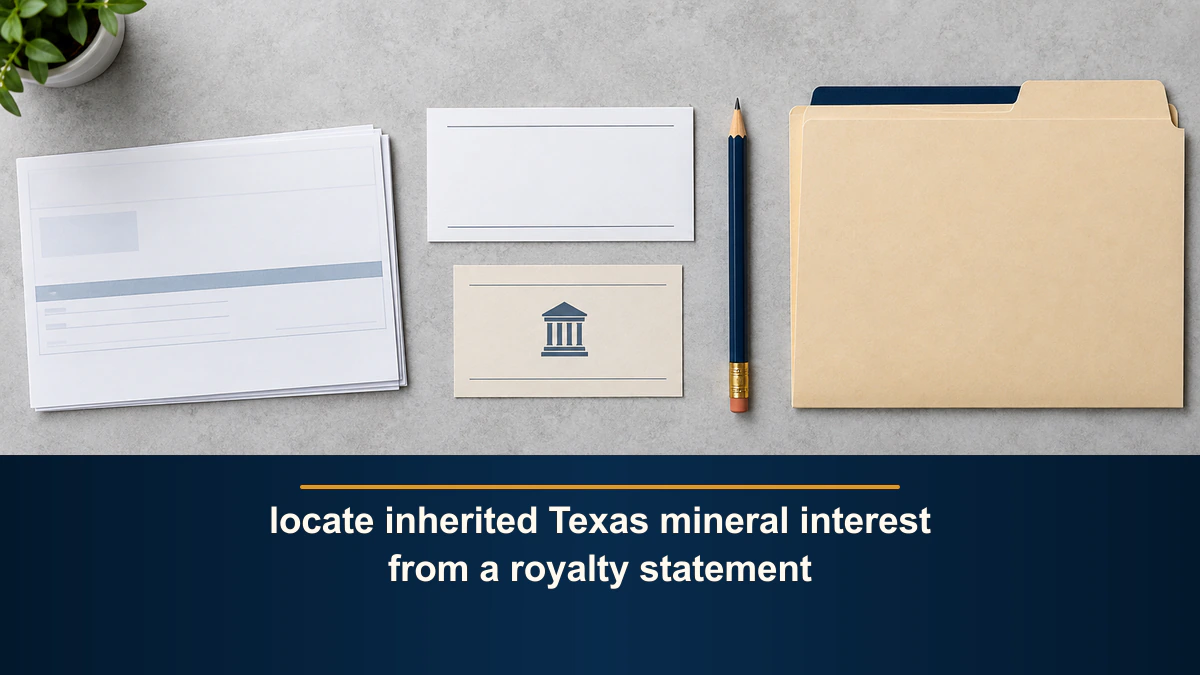
Location clues, not proof of ownership. This guide helps an heir organize identifiers from an old Texas royalty statement and identify a possible county-record search path. It does not determine the property, heirship, title, payment entitlement, royalty decimal, value, or whether to sell. MRX provides educational information and resources only and does not buy mineral rights; its educational review is directional and is not a certified appraisal or legal, tax, title, accounting, engineering, investment, or financial advice.
If you inherited a Texas royalty statement but do not know which county or tract it concerns, start with the payor and property clues actually printed on it. Using a contact route you verify independently, ask the payor to explain how its internal reference connects to a lease, well, Railroad Commission identifier, and county. Use the resulting public-record clues to choose a county deed and probate research path, but leave ownership unresolved until the record chain is reviewed.
That is a location workflow; it does not prove you own an interest. The Railroad Commission of Texas (RRC) royalties FAQ warns that the identifier on a payment stub may not be the RRC identification number needed for production research.
First, preserve the statement without exposing it
Save a complete copy of the inherited check stub or royalty statement and note its statement date, the person or estate named, and how you obtained it. On a private worksheet, transcribe only fields the document actually shows. Texas’s RRC royalty-statement guidance identifies property name or number and county/state among information an owner may receive, but statement layouts vary and an old copy may omit a field.
| Clue to look for, if printed | What to record privately | What it does not settle |
|---|---|---|
| Payor name and contact information | Exact payor label, statement date, and verified contact route | Whether the payor is the current operator or the heir’s title is clear |
| Prior owner’s name or owner/account number | The printed name and a controlled reference to the number | Whether that number is an RRC lease or well ID |
| Property, lease, unit, or well label | Exact spelling and any printed property reference | Whether a similarly named public record is the same tract |
| County or state, if shown | The printed jurisdiction and source line | Whether one field or lease lies wholly in that county |
| Production or sales month | The period printed on the statement | Whether the statement date is the production month |
Keep the full account number, mailing address, tax identifier, bank information, check image, and estate documents out of public searches, screenshots, and AI chats. If you need to show a question to someone, redact these details and share sensitive records only through a verified private channel. This is a privacy practice, not a claim that a redacted image establishes the property.
Ask the verified payor for the missing crosswalk
Find the payor’s current owner-relations contact from its own official website or an independently confirmed prior communication. Do not reply to a new address merely because it appears on an unsolicited offer. With the relevant authorization or estate representative, ask the payor which property its statement reference denotes, whether its number differs from the RRC identifier, and which lease, well, county or counties, and state it has recorded. Ask for the source and date of each answer and whether multiple properties share the account.
The RRC royalties FAQ explains that a Texas royalty owner may request the RRC identification number for a lease, property, or well from the payor under Texas Natural Resources Code § 91.504. The legal request process and who is authorized to make it depend on the facts; an heir who has not completed the estate or payor transfer should ask the payor or qualified adviser what proof of authority is needed. Do not promise that the payor can provide a perfect historical crosswalk.
If the payor cannot confirm what an old number meant, record that answer as unresolved. Do not silently substitute a nearby well, similar lease name, buyer letter, or county-tax hit.
Use RRC production records as context, not title
Once you have a plausible RRC identifier or lease name, the RRC Production Data Query FAQ explains the system’s lease, field, operator, district, and county search paths. Its guidance also says a field or lease can be in more than one county. A matching name or number may help locate candidate records; it does not connect the statement to a particular private mineral interest.
Use the official RRC Research Queries directory and follow the site’s own access rules. Its online-query notice warns against automated retrieval that burdens the system; this guide does not instruct readers or software to scrape it. Record the query route, exact criteria, access date, displayed result, and any ambiguity. For a detailed provenance template after an identifier is known, use the separate RRC retrieval worksheet.
Operator-reported production may lag or be revised; the RRC PDQ FAQ describes those timing limits. Separately, treat RRC production data as contextual information, not as a private payor ledger, property match, or legal title determination.
Then choose the correct county record sources
With a county candidate, look for recorded deeds, reservations, assignments, and other conveyances in the county where the land lies. The Texas State Library’s property-research guide says divisions and transfers of property ownership are filed in those counties. Research estate or probate papers as a separate source class; the Texas State Library county-record guide explains that county records may include deeds, probate files, and wills, with availability and older record formats varying by county.
Do not treat a county search result, a single deed, a probate index entry, or an RRC match as proof of the heir’s current title. The known-county Texas ownership guide starts at the recorded instrument chain and explains why gaps, reservations, and later transfers may require a qualified title professional or Texas attorney.
Fictional example: preserve the unresolved link
This example is fictional. It illustrates a research record, not a real statement, payor, property, county, or title conclusion.
| Register field | Fictional entry |
|---|---|
| Starting artifact | Old statement retained privately; prior-owner name and payment period visible |
| Printed property reference | [private payor reference]; no county or legal description shown |
| Payor question | “Which lease or well and RRC identifier did this reference denote for the stated period, and which county or counties were in your records?” |
| Public record candidate | None until a verified payor answer gives a source-linked identifier |
| Status | Unresolved: no county, tract, heirship, or title conclusion |
| Next step | Verify authority and payor contact; request the crosswalk; preserve the dated reply |
A later RRC hit with a similar lease name would be another clue, not permission to fill the county cell without confirming the match. If the evidence points to two counties, keep both candidates and ask for a narrower source rather than choosing one.
Stop when the linkage is uncertain
Stop self-service matching when the statement cannot be tied to a verified payor record; when an identifier yields several properties or counties; when a prior owner’s name differs from the recorded chain; or when estate, trust, or deed records conflict. Ask the payor to clarify its own account record. Ask the appropriate county office how to retrieve the record you have identified, and use a qualified land or Texas legal professional for owner-specific title, probate, or conveyance analysis.
If the county and tract become credible starting points, continue to how to find out if you own mineral rights in Texas. For a payor-account transfer after inheritance, use the inherited royalty-check guide. The inherited mineral rights hub keeps a research-only path open; requesting an MRX review is optional, and documents do not themselves prove ownership or value.
Frequently asked questions
What if the statement has only a payor account number?
Treat it as a private payor reference. Contact the payor through an independently verified channel and ask which property, lease, well, and county that number identifies in its records. Do not assume it is a Texas Railroad Commission number.
Can the Texas Railroad Commission tell me which minerals I own?
No. Its production systems can provide operator-reported lease or well context, but a matching result does not establish private ownership, heirship, title, or an owner payment decimal.
What if the clues point to two counties or no reliable match?
Keep both possibilities or the missing link marked unresolved. Ask the verified payor for clarification and use qualified county-record, land, or Texas legal help before treating either location as the inherited property.
Should I search every Texas county when the statement omits the county?
First ask the independently verified payor to explain its property reference and any county or counties in its records. A broad name match in another county is only a lead, not a confirmed link to this statement or proof of ownership.
Do I need to post a copy of the royalty statement to ask a research question?
No. You can ask a general records question without posting account numbers, addresses, tax details, check images, or estate papers. Use a verified private channel if a payor or qualified professional needs the actual document.
Sources reviewed for this article
- Railroad Commission of Texas, Royalties FAQ (accessed 2026-09-17)
- Railroad Commission of Texas, Production Data Query System FAQ (accessed 2026-09-17)
- Railroad Commission of Texas, Research Queries and automated-access boundary (accessed 2026-09-17)
- Texas State Library and Archives Commission, Land and Property History Research (accessed 2026-09-17)
- Texas State Library and Archives Commission, County Records on Microfilm (accessed 2026-09-17)
Related mineral-rights articles
Understanding Royalty Checks After Inheriting Mineral Rights
Inherited royalties require estate and title records to be matched with each payor before division orders, suspense balances, and statements can be reconciled.
Read the post →
Texas RRC Production Data Query Retrieval Provenance Worksheet
A PDQ retrieval provenance worksheet preserves one official path, controlled criteria, displayed state, retained reference, and bounded result without interpreting production data.
Read the post →
How to Find Out If You Own Mineral Rights in Texas
A county-record-first guide to verifying Texas mineral-rights ownership and separating title proof from production research.
Read the post →
Oklahoma Mineral Escrow and Unclaimed Property: Two Search Routes
Use two official Oklahoma searches to document possible mineral-payment leads without treating a name match as proof of ownership or entitlement.
Read the post →A practical next step
Put your mineral rights in context.
Every mineral interest, royalty history, and written offer is different. Start with a question, or share what you have for a free underwriter review.
- Free
- Confidential
- No obligation to sell
Ready for a closer look?
Explore Inherited Mineral RightsGet a directional range with the assumptions clearly stated.
