
Mineral Rights Value archive
Page 5 of 6 · Mineral Rights Value
The full mineral rights value archive across 71 reviewed articles. Use the pagination below to move between pages; the canonical hub at /mineral-rights-value/ returns to topic-organized browsing.
Page 5 of 6
Reviewed mineral rights value articles
Showing 49 through 60 of 71 published articles
-

How Mineral Rights Valuation Affects Your Asset Decisions
A directional mineral-rights valuation can compare asset options only when its date, scope, scenarios, confidence, and owner-specific decision criteria remain visible.
-
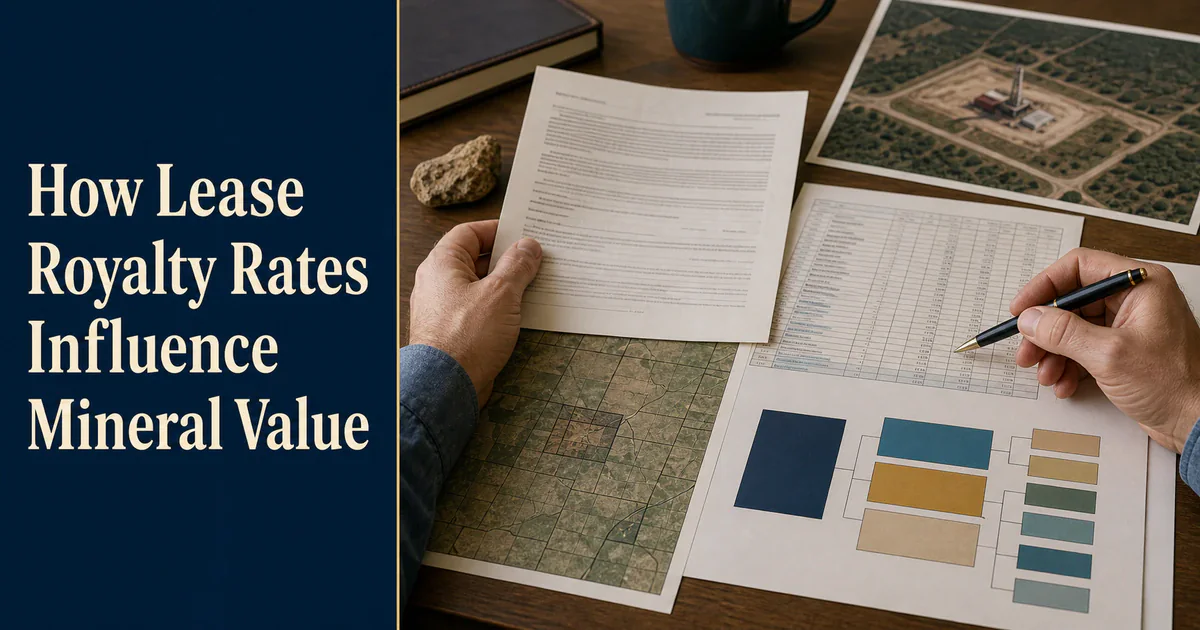
How Lease Royalty Rates Influence Mineral Value
A lease royalty rate changes the owner revenue share used in a valuation model, but ownership, allocation, lease language, production, price, costs, timing, and risk still control the result.
-

Get a Free Mineral Rights Valuation Review Today
A free MRX valuation review organizes property, ownership, production, royalty, and offer evidence into a directional range with explicit assumptions and limits.
-

Five Key Indicators That Show Your Mineral Rights Are Ready for Evaluation
A mineral-rights evaluation can begin when the property, ownership trail, operating context, economic evidence, and unresolved questions are identifiable, even if every record is not yet complete.
-

Existing Wells vs. Future Locations in a DCF Model
A mineral-rights DCF should keep observed producing-well cash flow separate from uncertain future-location scenarios until their evidence, timing, and risks are explicit.
-

Essential Steps to Assess the Value of Your Mineral Rights Accurately and Confidently
A confident mineral-rights value assessment starts with a dated evidence file, not a price shortcut. Identify the interest, reconcile records, separate facts from assumptions, and document what could change the range.
-

Discount Rates in Mineral Rights DCF: A Plain-Language Guide
A mineral-rights DCF converts a forecast of future owner cash flows into a present-value indication. The discount rate matters, but it must match the cash-flow definition and the risks not already modeled elsewhere.
-

Depth Severances and Formation Rights in Mineral Valuation
A depth severance can divide one surface tract into different vertical mineral interests. Valuation starts by defining the exact interval and formation rights that the records support.
-

Decline Curves and Future Royalty Cash Flow
A decline curve estimates a future production path. A royalty cash-flow scenario adds separately documented price, ownership, deduction, tax, timing, and discounting assumptions.
-

Curative Title Risk as a Valuation Adjustment
A defensible title-risk adjustment identifies the issue, affected interest, cure path, timing, cost evidence, payment effect, and residual uncertainty before changing value.
-

Basis Differentials and Mineral Rights Cash Flow
A basis differential is the location-related difference between a benchmark and a regional market price. It can affect royalty cash flow, but it is not the same thing as a post-production deduction.
-

Acreage Contiguity and Its Role in Development Potential
Acreage contiguity can make a tract easier to evaluate as part of a connected development area, but it does not establish title, pooling authority, a permit, a drilling schedule, or a specific value.