
MRX Learning Center
How Lease Royalty Rates Influence Mineral Value
A lease royalty rate changes the owner revenue share used in a valuation model, but ownership, allocation, lease language, production, price, costs, timing, and risk still control the result.
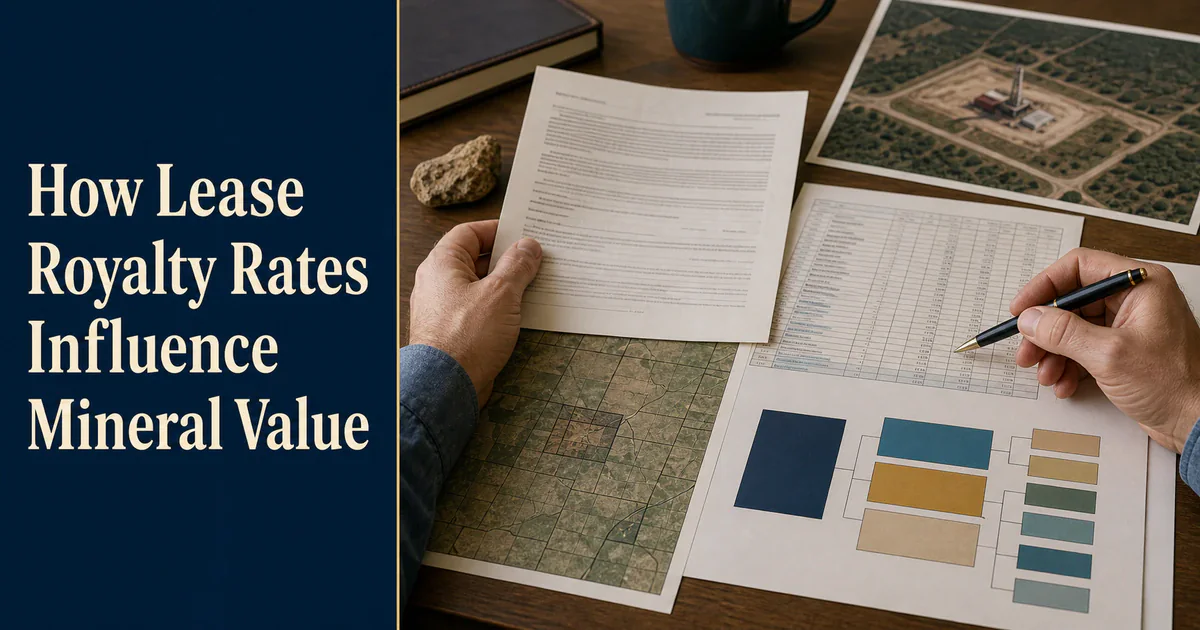
Direct answer for mineral owners
The lease royalty rate is one multiplier in the owner revenue share used for mineral valuation. Holding ownership, tract or unit participation, production, price, royalty valuation basis, deductions, timing, and risk constant, a larger royalty fraction produces a larger modeled royalty cash flow. It does not prove that the mineral interest is worth the same percentage more because the governing lease language and every other valuation input still matter.
Key takeaways for mineral owners
- A lease royalty rate is not the same thing as mineral ownership, net revenue interest, a division-order decimal, net royalty acres, or a DCF discount rate.
- Rate sensitivity is meaningful only when ownership, participation, production, price, royalty basis, deductions, timing, and risk are held constant.
- The royalty clause can change more than the fraction: valuation language, deduction treatment, product coverage, free-use provisions, and amendments can change modeled cash flow.
- A lease, amendment, division order, royalty statement, title evidence, and matched production record should be reconciled before a directional value relies on the stated rate.

Educational and commercial-role scope. This guide explains a lease-rate sensitivity framework for a directional mineral-rights review. It does not interpret an owner’s lease, determine title, establish a decimal interest, audit royalty payments, predict production or prices, calculate tax consequences, provide a reserve report, or produce a certified value. MRX provides educational information and resources only and does not buy mineral rights. Owner-specific legal, title, tax, accounting, engineering, appraisal, investment, or brokerage questions require the appropriate qualified professional.
The short answer is that a lease royalty rate influences mineral value by changing the owner revenue share used in the cash-flow model. If ownership, tract or unit participation, production, commodity price, royalty valuation basis, deductions, timing, and risk are all held constant, a larger royalty fraction produces larger modeled royalty cash flow.
That is a sensitivity statement, not a market-value rule. Two interests with different lease rates may also have different acreage, depths, formations, pooling terms, deduction language, production histories, development timing, title confidence, and buyer demand. A higher stated fraction does not prove that one interest is worth a fixed percentage more than another.
The clean analytical job is to isolate the lease rate, show how it enters the revenue decimal, and then put the rest of the lease and valuation evidence back around it.
The lease royalty rate is one multiplier
An oil and gas lease can reserve a royalty fraction for the lessor. That fraction is important because it helps determine the portion of production revenue attributed to the royalty side of the interest. It is not the same as the owner’s complete net revenue interest.
In a simplified pooled-interest model, an analyst may organize the arithmetic as:
mineral ownership fraction × tract or unit participation × lease royalty fraction = modeled net revenue interest
This is an organizing equation, not a universal title formula. The applicable documents may add depth severances, formation limits, nonparticipating royalty interests, overriding royalties, pooling or allocation provisions, amendments, ratifications, proportionate-reduction language, or other burdens. A division order may show the decimal a payor currently uses, but that decimal still needs to be tied to the governing records.
The Texas Natural Resources Code defines a division order as an agreement directing distribution of oil-and-gas sale proceeds. That statutory payment function does not turn the division order into a substitute for the lease or a title opinion.
Keep five percentages separate
Owners often see several fractions across a deed, lease, unit document, division order, royalty statement, and valuation worksheet. They should not be blended into one number without labels.
1. Mineral ownership fraction
This is the share of the mineral estate attributed to the owner in the relevant tract, depths, and formations, subject to the title evidence. Owning one-half of the minerals is not the same as having a one-half royalty.
2. Lease royalty fraction
This is the fraction or calculation method stated in the governing lease and any controlling amendment. It describes one contractual part of the revenue calculation. It does not by itself establish the owner’s acreage, tract participation, or final payment decimal.
3. Tract, unit, or allocation participation
When production is shared across a pooled unit, production-sharing area, allocation arrangement, or another participation structure, the interest may be scaled to the tract’s participation under the governing documents and facts. A simple acreage ratio may be an analytical starting point in some contexts, but it should not be assumed to control every arrangement.
4. Net revenue interest or division-order decimal
This is the resulting share used to distribute revenue for the identified production. It may reflect multiple ownership and lease inputs. If the decimal changes across wells, products, depths, or statement periods, treat the change as a reconciliation question rather than automatically copying one decimal across the property.
5. DCF discount rate
The discount rate is a valuation input used to translate expected future cash flow into present value while reflecting time and risk. It is not a royalty rate. Increasing a lease royalty fraction increases the modeled revenue share when other inputs are constant; increasing a DCF discount rate generally reduces the present value of the same forecast cash flow. Confusing the two reverses the logic.
For a deeper definition of NRI and royalty-acre conventions, see What Is a Net Royalty Acre?. For time-value and risk mechanics, see Discount Rates in Mineral Rights DCF.
A rate-sensitivity example
The following comparison is hypothetical. It does not claim that any listed rate is standard, current, fair, or applicable to a particular Texas lease.
Assume every input except the lease royalty fraction stays unchanged. Use a 20% lease royalty as the reference case.
- 12.5% hypothetical rate, 0.625× multiplier: the isolated royalty share is 62.5% of the 20% reference share.
- 20% hypothetical rate, 1.000× multiplier: this is the reference case for the sensitivity test.
- 25% hypothetical rate, 1.250× multiplier: the isolated royalty share is 25% larger than the 20% reference share.
The multiplier is calculated as candidate rate ÷ reference rate. It can be applied to the royalty-share portion of a model only when all other inputs remain constant.
It does not mean that a real 25% lease is automatically worth 25% more than a real 20% lease. The two properties may not have the same mineral ownership, participation, production, price realization, deduction treatment, title status, development inventory, timing, or risk. The sensitivity table isolates one variable precisely so those other variables cannot hide inside it.
Why the fraction alone does not determine value
The lease royalty fraction answers “what share?” only in combination with the clause that explains “a share of what, measured where, and subject to which terms?”
Royalty valuation basis
A lease may refer to proceeds, amount realized, market value, market price, value at the well, delivery in kind, or another defined basis. Those phrases can carry legal consequences that depend on the exact wording, amendments, facts, and governing law.
The Texas General Land Office’s royalty-audit guide says the terms of a state lease specify the valuation method for calculating oil and gas royalty and illustrates different provisions for oil, non-processed gas, and processed gas. That state-program guide is useful evidence that the fraction cannot be separated from its calculation language. It is not a legal interpretation of a private lease.
Deductions and post-production treatment
Gathering, compression, dehydration, processing, treating, transportation, marketing, and other charges may appear in the revenue path. Whether a charge is permitted, how it is allocated, and where value is measured depend on the governing language and facts. Do not decide that question from the royalty fraction alone.
Products and dispositions
Oil, condensate, residue gas, natural-gas liquids, plant products, fuel, flared or vented gas, and other dispositions may be addressed differently. A lease-rate comparison that includes one product but silently omits another is not an apples-to-apples comparison.
Amendments and special clauses
An amendment, ratification, pooling agreement, division-order stipulation, depth severance, retained-acreage provision, proportionate-reduction clause, or other instrument may change the relevant scope or arithmetic. Read the document chain by tract, depth, formation, product, and effective date.
Ownership and title confidence
A favorable lease fraction cannot compensate for uncertainty about whether the owner holds the modeled acres or depths. A directional review should label verified title evidence, owner-provided statements, conflicts, assumptions, and missing records separately.
How the rate enters a producing-interest review
For a producing interest, the lease rate usually enters after the property and ownership scope have been defined and before the owner cash-flow history or forecast is finalized.
A practical sequence is:
- identify the tract, lease, unit, wells, products, depths, formations, and effective dates;
- establish the mineral ownership fraction supported for the review;
- identify the governing lease royalty language and amendments;
- calculate or reconcile tract or unit participation;
- compare the resulting modeled NRI with the division-order decimal and statement decimal;
- reconcile reported production, price, taxes, deductions, adjustments, and net payment; and
- apply the production, price, timing, and risk assumptions used in the directional valuation.
The Railroad Commission’s Production Data Query can provide reported Texas production by its available lease, well, field, operator, county, and time-period identifiers. Public production data can support a production-history or reasonableness check. It does not prove ownership, interpret a private lease, establish the owner decimal, or determine whether a particular deduction or payment is correct.
For the payment path itself, use How Royalty Payments Work for Texas Mineral Owners. For normalizing statement history, use Converting Monthly Royalty History Into a Valuation Baseline.
How the rate enters a nonproducing-interest review
For a nonproducing interest, the stated royalty fraction may be known even when future cash flow is highly uncertain. That does not justify assigning production that has not been supported.
The review should separate:
- contract evidence: the lease fraction and controlling royalty language;
- interest evidence: ownership, acreage, depths, formations, and participation;
- development evidence: permits, nearby wells, operator activity, geology, spacing, access, and other public context;
- scenario assumptions: whether a future well, start date, production profile, product mix, price path, and cost treatment are modeled at all; and
- risk treatment: the probability, timing, uncertainty, and discount assumptions applied to the scenario.
A higher lease rate can raise the royalty share inside a future-development scenario. It cannot make the scenario itself certain. A lease on an undeveloped tract with a higher fraction may still have a lower directional value than a lower-rate interest with established production, stronger title evidence, or nearer development, depending on the full facts and assumptions.
Compare two interests with a controlled worksheet
When comparing two mineral interests, create one row per variable instead of starting with the headline royalty rate.
Create separate Interest A and Interest B columns for each of these evidence fields:
- Property, tract, depths, and formations: cite the deed, lease, map, or public record used.
- Mineral ownership fraction: cite title evidence or label the number as an assumption.
- Lease royalty fraction: cite the lease and controlling amendments.
- Royalty valuation language: preserve the exact clause for professional review when needed.
- Pooling or allocation participation: cite the unit, pooling, PSA, allocation, or other record.
- Division-order or statement decimal: cite the payor record and reconcile it to the governing inputs.
- Production and product mix: use statements plus matched regulatory context.
- Price basis and deductions: cite statements, lease language, and available sales evidence.
- Development and decline assumptions: date each scenario and avoid presenting it as guaranteed fact.
- Title, timing, and risk adjustments: disclose the rationale and evidence status.
Then run two views:
- Controlled rate sensitivity: make the lease royalty fraction the only changing input. This measures the isolated effect of the rate.
- Full-interest comparison: restore the actual evidence and assumptions for each interest. This is the view relevant to a directional valuation.
The gap between those views shows how much of the difference comes from the lease rate and how much comes from everything else.
Documents to gather before relying on the rate
A strong review starts with the governing documents rather than a rate copied from an email or spreadsheet.
Gather, as applicable:
- the recorded oil and gas lease and all exhibits;
- amendments, extensions, ratifications, memoranda, and retained-acreage or depth documents;
- deeds, reservations, probate, trust, and distribution records relevant to ownership;
- pooling declarations, unit designations, production-sharing agreements, or allocation records;
- division orders and later transfer or decimal-change notices;
- consecutive royalty statements covering the relevant production period;
- payor or operator correspondence about ownership, suspense, adjustments, or deductions; and
- the property and well identifiers needed to match public records.
The Texas GLO’s leasing page illustrates that lease effectiveness, approval, filing, and revenue allocation can depend on the type of state-managed interest. Private interests follow their own controlling documents and law, but the broader lesson is the same: identify the estate, authority, instrument, and effective scope before using the rate.
Common rate-comparison errors
Avoid these shortcuts:
- comparing gross acres while ignoring the owned mineral fraction;
- treating the lease rate as the division-order decimal;
- using one well’s decimal for every well, product, depth, or unit;
- comparing fractions without comparing the royalty valuation basis;
- assuming “cost free” or “no deductions” from a summary instead of the full clause;
- reading a public production record as proof of private payment entitlement;
- applying a producing-interest multiple to an unsupported future-development scenario;
- confusing the lease royalty rate with the DCF discount rate;
- doubling a market value merely because an isolated rate doubled; or
- calling a rate customary, standard, or fair without a dated, relevant market and document analysis.
These errors can produce a clean spreadsheet that answers the wrong question.
When another professional is needed
A directional review can organize evidence, reproduce arithmetic, and show sensitivity. It should stop short of conclusions reserved for qualified professionals.
Consider an appropriately qualified Texas attorney or land professional for lease interpretation, ownership, pooling, allocation, depth, formation, amendment, curative, or title questions. Consider a qualified accountant or royalty auditor for detailed payment and deduction analysis. Engineering, geology, appraisal, tax, fiduciary, or transaction-representation questions may require their own specialists.
MRX’s published methodology describes a directional discounted-cash-flow review with stated inputs, assumptions, and limitations. It is not a formal credentialed appraisal, title opinion, legal or tax opinion, reserve report, payment audit, or guarantee.
Use the rate as a transparent input
The lease royalty fraction matters. The defensible way to use it is to show where it came from, how it combines with ownership and participation, what royalty basis surrounds it, and what happens when that one variable changes.
If you want help organizing those inputs, request a free mineral-rights review. Provide the lease and amendments you have, the property and well identifiers, the division order or statements, and the decision you are trying to make. Missing records should be labeled as missing rather than replaced with a confident guess.
The output should let you distinguish three statements:
- document fact: the identified lease states a particular fraction or method;
- calculated result: disclosed ownership and participation inputs produce a reproducible modeled decimal; and
- valuation scenario: that decimal is applied to dated production, price, timing, and risk assumptions.
Keeping those statements separate is what makes the royalty rate useful without letting it masquerade as the whole value.
Source notes and research limitations
- MRX’s published methodology supports the directional DCF, stated-input, stated-assumption, professional-boundary, and no-guarantee framework used here.
- MRX’s net royalty acre guide supports the distinction among mineral ownership, lease royalty fraction, NRI, and royalty-acre conventions.
- MRX’s royalty payment guide supports the payment-path distinction and the warning that lease rates are contract-specific.
- Texas Natural Resources Code Chapter 91 supports the payee, payor, division-order, and payment-timing descriptions; it does not establish an owner-specific lease rate or decimal.
- The Texas GLO royalty-audit guide supports the point that the governing state lease specifies the royalty valuation method and that product and disposition provisions can affect the calculation. It is not a private-lease opinion.
- The Texas GLO mineral-leasing page supports the state-interest examples concerning lease approval, filing, and revenue allocation.
- The RRC Production Data Query supports the use of reported production as regulatory context while leaving title, lease interpretation, owner decimals, and payment entitlement to other evidence.
Frequently asked questions
Does a higher lease royalty rate always mean higher mineral value?
Not automatically. Holding every other input constant, a higher royalty fraction increases the modeled owner revenue share. Actual directional or market value can still differ because ownership, tract or unit participation, lease language, production, price, deductions, timing, development expectations, title confidence, and risk are not necessarily equal.
Is the lease royalty rate the same as my division-order decimal?
No. The lease royalty rate is one contractual fraction. A division-order or net-revenue decimal may also reflect mineral ownership, tract or unit participation, pooling or allocation, depth or formation rights, and other burdens or interests. The governing records must be reconciled.
Is a 25% lease royalty worth twice as much as a 12.5% lease royalty?
Only the isolated royalty-rate multiplier is twice as large. That comparison does not establish that two real mineral interests or sale prices are in a two-to-one relationship because their ownership, lease terms, production, location, timing, costs, title, and risk may differ.
Can public Railroad Commission records confirm my royalty rate?
No. RRC production data can help identify reported production and operating context. It does not interpret a private lease, prove title, establish an owner decimal, determine deduction rights, or confirm payment entitlement.
Who should interpret a disputed royalty clause or decimal?
An owner-specific legal or title question belongs with an appropriately qualified Texas attorney or land professional. Accounting or payment-audit questions may also require a qualified accountant or royalty auditor. MRX can organize evidence for a directional review but does not provide those professional conclusions.
Sources reviewed for this article
- Mineral Rights Xchange, Published DCF Methodology (accessed 2026-08-11)
- Mineral Rights Xchange, What Is a Net Royalty Acre? (accessed 2026-08-11)
- Mineral Rights Xchange, How Royalty Payments Work for Texas Mineral Owners (accessed 2026-08-11)
- Texas Natural Resources Code, Chapter 91 (accessed 2026-08-11)
- Texas General Land Office, Oil and Gas Royalty Audit General Information (accessed 2026-08-11)
- Texas General Land Office, Mineral Leasing (accessed 2026-08-11)
- Railroad Commission of Texas, Production Data Query (accessed 2026-08-11)
Related mineral-rights articles
What Is a Net Royalty Acre? NRI and Mineral Rights Value
Net royalty acres normalize acreage and royalty burden for comparison. NRI describes the decimal share of production revenue credited to an owner.
Read the post →
Discount Rates in Mineral Rights DCF: A Plain-Language Guide
A mineral-rights DCF converts a forecast of future owner cash flows into a present-value indication. The discount rate matters, but it must match the cash-flow definition and the risks not already modeled elsewhere.
Read the post →
How Royalty Payments Work for Texas Mineral Owners
Royalty payments for Texas mineral owners depend on the lease, the division order, and the operator-reported production. This article explains those inputs.
Read the post →
Decline Curves and Future Royalty Cash Flow
A decline curve estimates a future production path. A royalty cash-flow scenario adds separately documented price, ownership, deduction, tax, timing, and discounting assumptions.
Read the post →A practical next step
Put your mineral rights in context.
Every mineral interest, royalty history, and written offer is different. Start with a question, or share what you have for a free underwriter review.
- Free
- Confidential
- No obligation to sell
Ready for a closer look?
Request a free mineral-rights reviewGet a directional range with the assumptions clearly stated.