
MRX Learning Center
Five Key Indicators That Show Your Mineral Rights Are Ready for Evaluation
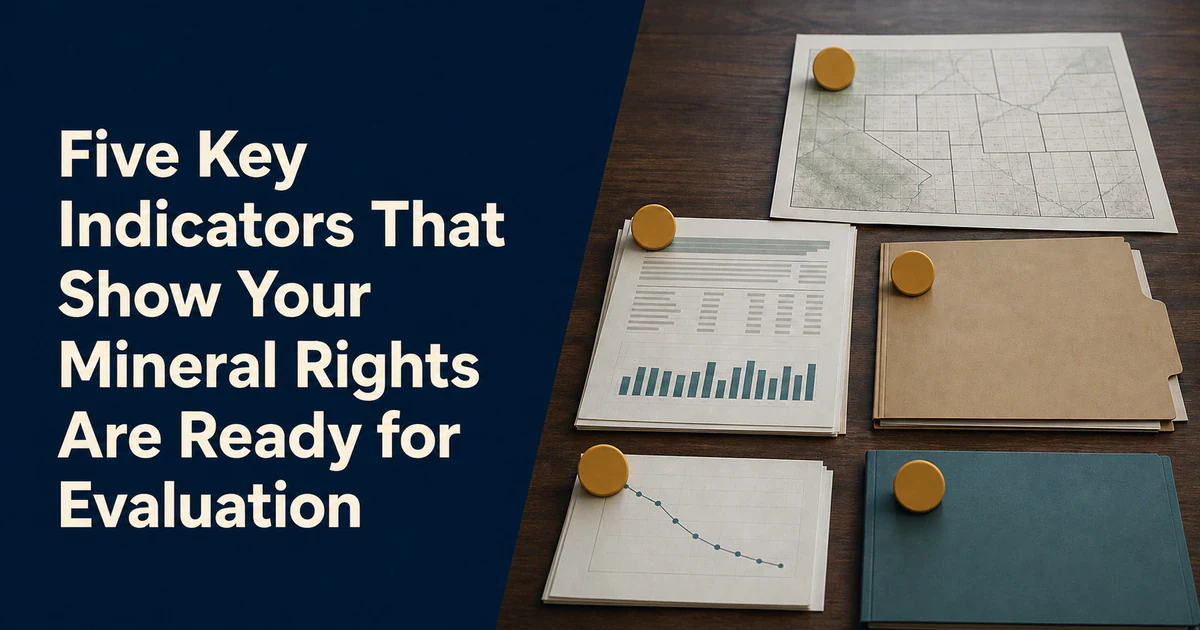
A mineral-rights evaluation can begin when the property, ownership trail, operating context, economic evidence, and unresolved questions are identifiable, even if every record is not yet complete.
Direct answer for mineral owners
Your mineral rights are ready for an initial evaluation when five things are identifiable: the property, a plausible ownership trail, the relevant well or development context, available economic evidence, and the specific question or uncertainty the review should address. Perfect title, active production, and a current offer are not universal prerequisites. Missing records should be labeled and pursued rather than replaced with assumptions.
Key takeaways for mineral owners
- Readiness means the evidence can be organized and tested; it does not mean ownership, value, production, or transaction eligibility has already been proven.
- A county and legal-description clue, an ownership document or inheritance trail, and identifiable well or lease context usually provide a stronger starting point than an estimated acreage or family story alone.
- Royalty statements, division orders, tax forms, offers, and suspense or unclaimed-property clues can add economic context, but none independently proves title or current value.
- An evaluation can expose missing evidence and define next steps; owner-specific legal, title, tax, engineering, surveying, appraisal, or accounting conclusions require the appropriate qualified professional.
Educational scope. This guide explains when available records may support an initial, directional mineral-rights evaluation and how to organize the evidence. It does not determine ownership, acreage, title, lease rights, value, tax treatment, reserve status, production potential, transaction suitability, or whether any person must receive an offer. It is not legal, tax, accounting, engineering, investment, surveying, brokerage, or professional appraisal advice. MRX provides educational information and resources only and does not buy mineral rights. Owner-specific conclusions require controlling records and the appropriate qualified professional.
The short answer to “How do I know if my mineral rights qualify for evaluation?” is that an initial evaluation can usually begin once the property, ownership trail, operating context, economic evidence, and unresolved questions are identifiable. Every item does not need to be complete. What matters is that known facts, missing records, and assumptions are kept separate.
Readiness is not the same as value. It is also not proof that the interest is marketable, producing, correctly paid, free of title defects, or appropriate to sell. A good initial review tests the evidence, exposes gaps, and tells the owner what should be verified next.
The five-indicator readiness test
Use these five indicators as a practical screen:
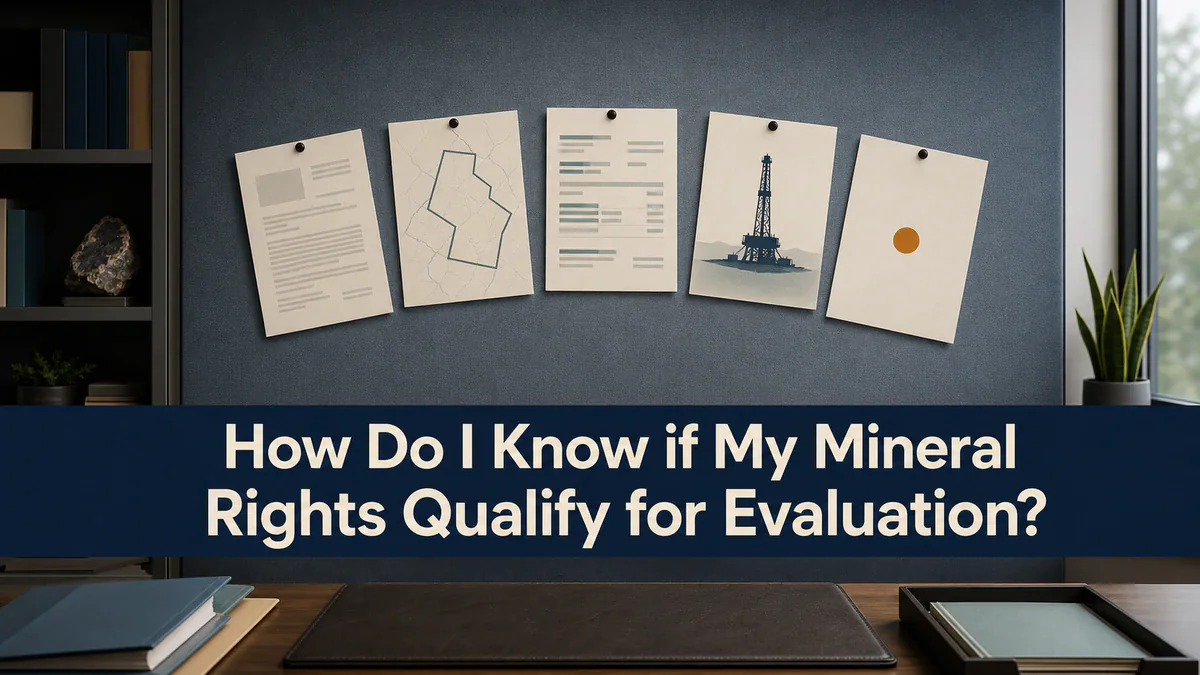
- The property can be identified. You have a county plus a tract, survey, abstract, section, block, lease, unit, API number, operator reference, legal description, or another reliable location clue.
- The ownership trail has a documentable starting point. You have a deed, reservation, mineral conveyance, probate document, trust record, lease, division order, royalty statement, prior owner name, or a sufficiently specific inheritance trail.
- The well or development context can be connected to the property. Producing wells, historical wells, leases, permits, fields, formations, operators, or nearby development can be identified without treating proximity as ownership proof.
- Some economic evidence is available or its absence is meaningful. Royalty statements, check details, tax forms, offers, division-order decimals, suspense notices, or unclaimed-property clues can be preserved and reconciled.
- The review question and uncertainties are explicit. You can state what you want to understand and which facts remain unknown, disputed, estimated, or missing.
An interest can still be ready when only part of an indicator is present. The reviewer should lower confidence, define the missing-evidence request, and avoid inventing a precise conclusion.
Indicator 1: the property is identifiable
A family name and a statement such as “somewhere in West Texas” are useful leads, but they are not yet a stable property identity. A stronger starting point includes at least one geographic or regulatory anchor, such as:
- county and legal description;
- survey, abstract, section, block, township, or original grantee;
- lease or unit name and number;
- operator and well name;
- API number;
- field or formation where supported; or
- a recorded instrument reference.
The Texas General Land Office Land Grant Database can be searched using fields that include county, abstract number, original grantee, survey, block, township, and related grant identifiers. That can help connect historical land descriptions to a research path. It is not a complete present-day chain of title.
The GLO’s Minerals FAQ draws the boundary clearly: the agency holds original land-grant records, while later conveyances are generally found in the county deed records kept by the county clerk. The FAQ also explains that determining mineral ownership requires examination of the deeds and leases affecting the claim.
That means a land-grant result can identify a historical root without proving that the current owner holds the mineral estate. Preserve the exact search terms, record references, county, and document images so a qualified reviewer can trace the correct chain.
Indicator 2: the ownership trail has a documentable starting point
You do not need to arrive with a completed title opinion. You do need enough information to distinguish a supportable ownership lead from an unsupported assumption.
Useful starting records include:
- a deed that grants or reserves minerals;
- a mineral or royalty conveyance;
- a will, probate order, affidavit of heirship, trust instrument, or distribution record;
- an oil and gas lease or lease memorandum;
- a division order or transfer order;
- royalty statements naming an owner and property;
- correspondence from an operator, purchaser, landman, or revenue department; and
- names of prior owners, including spelling variations and approximate dates.
Each document answers a different question. A deed may define the conveyed interest. A probate record may show how an estate was administered. A division order may show the decimal used for payment. A royalty statement may show that a payer associated a named owner with a property for a particular period.
None should be silently promoted into a title opinion. If the deed description, reservation language, probate sequence, trust authority, depth rights, or decimal calculation is unclear, label the issue and route it to the appropriate title or legal professional.
Inherited interests are not automatically unready. They often need a clearer bridge between the last documented owner and the current claimant. Start with death certificates, wills, probate filings, heir information, deeds, statements, and operator correspondence that can identify the gap. Do not assume that descent from an original or prior owner proves the current mineral interest.
Indicator 3: the operating context can be connected to the property
For a producing interest, try to match the owner’s records to a stable regulatory identity. The Railroad Commission of Texas describes its Wellbore Query as a way to search by district, lease or gas-well ID, county, field, operator, drilling-permit number, API number, well type, and current or historical status.
The Commission also explains that its online tools are separate slices of a larger oil-and-gas system. A wellbore record, production record, permit, and map point may need to be reconciled rather than assumed to describe the same thing.
Build a simple identity cross-check:
- A royalty statement can capture the owner, payer, property, well, decimal, and period for payment context. It does not prove title, the correct decimal, or future value.
- A wellbore record can capture the API number, operator, lease, field, and status for regulatory well identity. It does not prove owner participation or payment.
- A production query can capture a lease or gas-well ID, reporting period, and reported volumes for production context. It does not prove owner revenue or individual-well allocation in every case.
- A GIS map can display wells, permits, surveys, and leases for spatial research context. It does not prove a legal boundary, title, survey accuracy, or drilling certainty.
The RRC says well records from 1964 forward are available through imaged-record, GIS, and wellbore tools, and that production from 1993 forward is available through online research queries. Its Production Data Query provides general and specific-lease searches. Those records can make an evaluation more evidence-based, but regulatory production is not the same as the owner’s net cash flow.
For a nonproducing interest, the same tools may help identify nearby wells, historical activity, permits, and fields. Nearby activity is context only. It does not prove that the owner’s tract, depths, lease, unit, or future payment interest is included.
Indicator 4: document economic evidence or its gaps
Economic evidence helps a reviewer understand what has been paid, proposed, withheld, or left unresolved. Gather complete statements rather than isolated screenshots when possible.
Preserve:
- several consecutive royalty statements, including zero or adjustment periods;
- check detail showing volumes, prices, taxes, deductions, owner decimal, and net amount;
- division orders and later decimal changes;
- year-end payer forms without treating tax reporting as valuation advice;
- written offers with the property and interest being purchased clearly identified;
- suspense, returned-mail, ownership-change, or missing-document notices; and
- records of unpaid or unclaimed funds.
The Texas Comptroller lists mineral interests among the types of unclaimed property that holders may report and directs individuals to the state’s claim search. A search result can be an important lead when payments stopped or an old owner address was used. It does not establish the full chain of title, the correct decimal, or the reason funds were reported.
If there are no payments and no offers, the interest can still be evaluated directionally. The reviewer should say that there is no property-specific cash-flow evidence and avoid filling the gap with generic nearby numbers.
Indicator 5: the question and uncertainty are explicit
An evaluation is stronger when it has a defined purpose. “What are my minerals worth?” may be the ultimate question, but the first answer often depends on a narrower issue:
- Do these royalty statements appear to refer to the same wells as the public records?
- What ownership documents are missing between a deceased relative and the current heirs?
- Does a written offer identify all acres, depths, counties, and interest types being purchased?
- How much of a directional range comes from current production versus possible future activity?
- Why did payments change, stop, or move into suspense?
- Which facts are verified, estimated, or still unknown?
Write the questions down and assign every important uncertainty a status: verified, supported but incomplete, estimated, disputed, missing, or outside the review’s scope.
This is the main difference between evaluation readiness and valuation inputs. The existing guide to factors that determine an assessment pricing range explains what can affect a range. This guide explains whether the available evidence is organized well enough to begin testing those factors responsibly.
A minimum evidence packet
Before a review, create one folder with the best available copies of:
- owner name and contact details used on the records;
- county and legal-description clues;
- deeds, mineral conveyances, probate or trust records;
- leases, division orders, transfer orders, and operator correspondence;
- recent and historical royalty statements;
- written offers and attached exhibits;
- well, lease, unit, API, operator, field, and permit identifiers;
- unclaimed-property or suspense evidence; and
- a one-page list of known gaps and questions.
Keep original files unchanged. Use descriptive copies for organization, and note where each record came from. Do not crop away page numbers, recording stamps, exhibits, signatures, property descriptions, or surrounding context that a qualified reviewer may need.
If a document contains Social Security numbers, bank details, tax identifiers, or other sensitive information, use a secure approved transfer method and provide only what the recipient actually needs. Do not email or paste sensitive identifiers into an unverified form or chat.
Readiness by common owner situation
Producing interest with royalty statements
This is often ready for an initial review when the statement can be matched to a county, operator, lease, unit, well, or API reference. The review should reconcile reported production, payment periods, decimals, prices, taxes, deductions, and adjustments without assuming that the payer’s decimal is a title opinion.
Inherited interest with incomplete probate records
This may be ready for a gap analysis even when it is not ready for a conclusive ownership determination. Identify the last documented owner, death and probate jurisdictions, known heirs, wills or estate filings, property descriptions, and any operator correspondence. The output should be a missing-document plan, not an invented ownership percentage.
Nonproducing acreage
This can be reviewed when the tract and ownership trail are identifiable. Public well, permit, field, and map context may help explain surrounding activity. A lack of production history should remain visible, and nearby development should not be converted into a guaranteed forecast.
Written offer with a short deadline
An offer can define the immediate review question, but urgency does not cure missing evidence. Capture the buyer identity, price structure, property description, acres or decimal, depths, interest type, reservations, deductions, closing conditions, title-defect provisions, and expiration language. Obtain qualified legal review before signing a binding instrument.
Payments stopped or funds may be in suspense
This is ready for investigation when the last statements, payer correspondence, owner names and addresses, property identifiers, and any unclaimed-property result can be assembled. The cause may involve address problems, transfer requirements, title questions, minimum-payment thresholds, returned checks, or another holder-specific issue. Do not assume one explanation without the payer’s records.
Stop rules for incomplete evidence
Pause a numerical conclusion when:
- the property cannot be distinguished from similarly named tracts, leases, units, or wells;
- the claimed owner cannot be connected to a documentable chain;
- an estimated acreage or decimal is being presented as verified;
- nearby wells are being treated as proof of ownership or future drilling;
- a royalty statement is being treated as a title opinion;
- a map is being used as an authoritative legal boundary or survey;
- an unclaimed-property listing is being treated as complete ownership proof;
- an offer omits or obscures what property, depths, acres, or interest will be conveyed; or
- the requested conclusion requires legal, title, tax, engineering, surveying, accounting, reserve, or professional appraisal work outside the review’s scope.
The appropriate result may be “ready for evidence organization, not ready for a value conclusion.” That is a useful conclusion because it prevents missing records from becoming hidden assumptions.
Practical conclusion for mineral owners
Mineral rights are ready for an initial evaluation when five evidence categories can be identified: property, ownership trail, operating context, economic evidence, and the decision question. Perfect title, active production, exact net mineral acres, or a current offer are not universal prerequisites.Start with what can be documented. Mark every gap. Preserve source boundaries. Use public records to improve identity and context without treating them as title, survey, payment, or drilling proof. A responsible evaluation should make the next question clearer, even when the immediate answer is that more evidence or qualified professional review is required.
Frequently asked questions
Do mineral rights have to be producing before they can be evaluated?
No. Producing interests provide observable production and payment evidence, but a nonproducing interest may still be reviewed using ownership records, location identity, lease or unit information, nearby regulatory context, and clearly stated uncertainty. A nonproducing review should not present possible future drilling as guaranteed production or value.
Can I start an evaluation if I do not know my exact net mineral acres?
Often, yes. A reviewer can begin by organizing the deed, probate, lease, division-order, royalty, county, survey, abstract, and family-history clues that are available. The acreage or decimal should remain unverified until the controlling records and calculations support it; an estimate should never be silently treated as proven ownership.
Is a royalty statement enough to prove mineral ownership?
No. A royalty statement can connect an owner name to a payer, property, well, decimal, volume, price, deductions, and payment period, but it is payment evidence rather than a title opinion. Deeds, reservations, probate records, leases, assignments, and other controlling instruments may still be necessary.
What if my mineral rights are in suspense or listed as unclaimed property?
A suspense notice, returned check, or unclaimed-property result can be an important investigation lead. It does not by itself establish the full ownership interest or resolve the reason payment stopped. Preserve the record, identify the reporting holder or operator, and obtain the documents required by the holder and any qualified title or legal reviewer.
Does being ready for evaluation mean MRX will make an offer or that I should sell?
No. Evaluation readiness means there is enough identifiable evidence to begin a responsible review or to define the missing-evidence plan. It is not a promise of value, an offer, a purchase decision, a recommendation to sell, or a guarantee that a transaction will close.
Sources reviewed for this article
- Texas General Land Office, Minerals FAQ (accessed 2026-08-11)
- Texas General Land Office, Land Grant Database (accessed 2026-08-11)
- Railroad Commission of Texas, About Oil and Gas Data Queries (accessed 2026-08-11)
- Railroad Commission of Texas, Oil and Gas Well Records (accessed 2026-08-11)
- Railroad Commission of Texas, Production Data Query (accessed 2026-08-11)
- Railroad Commission of Texas, Public GIS Viewer (accessed 2026-08-11)
- Texas Comptroller of Public Accounts, Unclaimed Property (accessed 2026-08-11)
Related mineral-rights articles

Key Factors That Determine Your Mineral Rights Assessment Pricing Range
A source-bounded explanation of the production, ownership, lease, commodity, development, and risk assumptions behind a mineral-rights review range.
Read the post →
How to Find Out If You Own Mineral Rights in Texas
A county-record-first guide to verifying Texas mineral-rights ownership and separating title proof from production research.
Read the post →
What to Bring to Your Underwriter Review Call: Essential Documents and Preparation Guide
Bring ownership, lease, division-order, royalty, offer, property, and owner-priority records so a directional review can state its inputs and limits.
Read the post →
Texas RRC EDMS Injection/Disposal Permit Document Retrieval Provenance Worksheet
Use an EDMS retrieval provenance worksheet to preserve one manual permit-document search route, exact labels, displayed state, evidence reference, source coverage, and bounded outcome.
Read the post →A practical next step
Put your mineral rights in context.
Every mineral interest, royalty history, and written offer is different. Start with a question, or share what you have for a free underwriter review.
- Free
- Confidential
- No obligation to sell
Ready for a closer look?
Book a free mineral-rights reviewGet a directional range with the assumptions clearly stated.