
MRX Learning Center
Unlocking the Mystery: Key Details for an Accurate Mineral Rights Review Process
A useful mineral-rights review begins with a scoped question and a property-matched record inventory, not a perfect file or an unsupported ownership, value, or legal conclusion.

Direct answer for mineral owners
Provide the best available decision, owner, property, lease, payment, production, and offer records. A review can often begin with an incomplete file when every item is labeled supported, owner-reported, assumed, conflicted, missing, or professional-review-needed. The packet supports a scoped directional review; it does not prove title, reserves, future production, value, legal effect, tax treatment, an offer, or a suitable decision.
Key takeaways for mineral owners
- Begin with the owner decision, exact interest, effective date, and evidence cutoff; otherwise the reviewer may answer the wrong question about the wrong asset.
- Identifiers matter more than document volume: county, legal-description reference, lease or unit, well or API number, operator, owner account, and covered period let records be matched.
- Label every record and field by support status, preserve conflicts, and distinguish a missing record from evidence that an event did not occur.
- Do not send unneeded Social Security numbers, tax IDs, bank details, passwords, or unredacted sensitive data through ordinary email; use an approved secure channel and confirm necessity.
- An organized packet can support directional screening, but ownership, title, legal, tax, reserves, engineering, appraisal, and transaction decisions may require qualified professionals.

Educational review boundary. This guide organizes information for a scoped mineral-rights review. It is not a title opinion, legal interpretation, reserve report, engineering or geology conclusion, credentialed appraisal, broker price opinion, tax or accounting conclusion, investment recommendation, offer, buyer endorsement, or transaction recommendation. It cannot determine a particular owner’s title, authority, acreage, fraction, royalty decimal, reserves, future development, future production, realized price, value, expected net, agreement effect, tax result, or suitable decision. Use qualified professionals for the property and purpose. MRX provides educational information and resources only and does not buy mineral rights.
Direct answer for mineral owners
For a useful mineral-rights review, provide the best available information in six groups: the decision you want to make, the owner and authority, the property identity, the lease and depth scope, the payment and operating evidence, and any complete written proposal. A perfect title file is not always required to begin. What matters first is that each record can be tied to the right property and period, and that every gap or conflict remains visible.Start with these items:
- the question the review should answer, its effective date, and the evidence cutoff;
- the owner name and capacity shown in the records, plus any estate, trust, entity, or agency authority;
- the state, county, tract, legal-description or recording reference, and claimed interest type;
- leases, amendments, units, pooling documents, depth or formation limits, and releases in the available file;
- division orders, consecutive royalty statements, payor and owner-account details, and known RRC lease, well, API, field, or operator identifiers; and
- every page and exhibit of a written offer or agreement that is relevant to the owner’s decision.
Label each field supported, owner-reported, assumed, conflicted, missing, or professional review needed. That simple discipline prevents an incomplete record from becoming an accidental fact.
This page owns the review-intake and evidence-identity job. The underwriter-call preparation guide covers meeting logistics and owner priorities. The Texas sale-documents guide covers records that may be used in a sale and closing. The mineral-owner value checklist organizes evidence for the “what might it be worth?” question. Here, the narrower task is making an owner’s available information usable, traceable, and honest enough for the next scoped review.
Define the review before collecting files
“Review my mineral rights” can mean several different things. An owner may want to understand current royalty payments, organize inherited interests, investigate a title or decimal conflict, screen development activity, compare a written proposal, explore a partial sale, or obtain a report for a specialized legal, tax, estate, lending, or appraisal purpose.
Those are not interchangeable assignments. Write the review request as one sentence:
As of [effective date], use information available through [evidence cutoff] to help me understand [defined question] for [defined interest and property].
Also name the intended output. Is it an evidence inventory, a payment reconciliation, a directional value range, a complete-offer comparison, a list of missing title items, or a handoff to a qualified professional? A reviewer cannot choose the right evidence standard until the purpose is clear.
If the owner changes the question later, preserve the first scope and open a new version. Records adequate for an informal directional discussion may be inadequate for a title opinion, estate filing, tax conclusion, litigation, reserve report, or credentialed appraisal.
Build one property-identity card
Do not begin by uploading a large mixed folder. Begin with one identity card per property or interest. Record:
- owner name and the capacity shown in the file;
- state and county;
- survey, abstract, section, block, lot, tract, metes-and-bounds, recording, or other legal-description reference available;
- claimed interest type, such as mineral, royalty, nonparticipating royalty, overriding royalty, leasehold, or working interest;
- gross acreage, claimed fraction, stated net mineral or royalty quantity, and the source of each number;
- lease, unit, field, well, depth, formation, and product scope;
- operator, payor, owner account, lease ID, gas well ID, API number, drilling-permit number, or other known identifiers; and
- producing, nonproducing, leased, unleased, pooled, suspended, released, or unknown status as of the stated date.
The Railroad Commission of Texas explains that its well-record searches use identifiers such as county, lease or well name, operator, field, API number, drilling-permit number, oil lease number, gas ID, survey, abstract, section, and block. Its oil and gas query guide also explains that an API number identifies a wellbore while a completion can be associated with a district and oil lease number or gas well ID. Supplying those identifiers is more useful than sending an unlabeled map or a screenshot with no query path.
An identity card is not a title opinion. It is a matching tool. If two royalty statements, a deed, and an offer cannot be tied to the same tract, depth, lease, unit, or owner interest, they should not be blended into one conclusion.
Provide ownership and authority records without overstating them
Send the documents that explain why the named person or entity may hold or act for the interest. Depending on the file, these may include:
- recorded deeds, mineral or royalty conveyances, reservations, assignments, corrections, and releases;
- wills, probate orders, affidavits, distribution instruments, death information, or other estate records;
- trust certificates or relevant trust authority records;
- entity formation, merger, conversion, authorization, or signer-capacity records;
- powers of attorney or other agency documents; and
- prior title opinions or curative requests, when available and lawfully shareable.
Keep the complete instrument, exhibits, recording information, and legible legal descriptions together. A cropped signature page or a typed ownership summary may omit a reservation, depth limitation, exception, exhibit, or recording reference.
Texas law supplies useful context without allowing a shortcut. Texas Property Code Chapter 12 addresses recording of instruments concerning property, and Local Government Code Chapter 191 identifies the county clerk as county recorder and requires authorized instruments to be recorded and indexed. Texas Estates Code Chapter 101 addresses how a decedent’s estate vests, subject to estate administration and liabilities. These statutes explain why recorded and estate records can matter. They do not allow a directional reviewer to decide the legal effect of a particular chain, will, probate, affidavit, reservation, or curative requirement.
If the owner has only a royalty statement or tax notice, send it as an identity lead. Do not label it “proof of title.” If names, fractions, descriptions, or recording references disagree, preserve each version and route the conflict to a qualified attorney or land professional when the decision requires an ownership conclusion.
Map lease, unit, depth, and product scope
Provide the executed oil and gas lease and every available amendment, extension, ratification, memorandum, pooling or unit designation, release, depth severance, and related instrument. Record which document supports each material field:
- lessor and lessee names;
- effective date and primary term;
- legal description and covered acreage;
- royalty clause and any stated burden;
- pooling or unit authority;
- deductions or cost language;
- shut-in, continuous-development, retained-acreage, and depth provisions;
- amendments and releases; and
- rights expressly excluded or reserved.
Do not summarize contract language as a legal conclusion. A worksheet can quote or locate the clause, but a qualified attorney should interpret its effect when that effect is material.
Keep unit and depth scope explicit. A royalty check from one producing unit does not automatically describe unpooled acreage or deeper formations. Likewise, a nearby permit or well record does not prove that the owner’s tract, depths, or interest are included.
Match division orders and royalty statements to public identifiers
For producing interests, provide division orders and a consecutive set of royalty statements covering the period relevant to the review. Keep pages together and capture:
- owner account and payor;
- property, lease, well, or unit name and number;
- sales month and payment date;
- product and volume;
- price, taxes, deductions, and adjustments shown;
- owner decimal;
- gross and net amounts; and
- suspense releases, reversals, recoupments, or changes in payor.
The RRC’s current Royalties FAQ summarizes the property, period, volume, price, deduction, owner-decimal, and payment information associated with Texas royalty reporting. It also explains that a division order may include the effective date, property and production type, fractional or decimal interest, interest type, and payee information. Those fields make a division order useful for matching. They do not make it a complete title opinion or a valuation.
The same RRC page explains that a royalty owner can request certain information, including the RRC identification number for a lease, property, or well, under Texas Natural Resources Code Chapter 91. When a statement lacks a public identifier, record the missing field and the owner’s follow-up path instead of guessing which public record belongs to the payment.
Public production data also has limits. The RRC’s Production Data Query FAQs say production comes from operator reports, Texas oil is generally reported by lease rather than individual well, online information has a reporting lag, and reports can later be revised, corrected, or filed late. Therefore, save the query criteria, retrieval date, lease or well identifier, county, and period. A spreadsheet with no source path is weaker than a reproducible query.
Provide offer information as a separate lane
If the owner is reviewing a possible sale, provide every page and exhibit of each written inquiry, letter of intent, purchase agreement, deed form, assignment, closing instruction, or other proposal under consideration. Keep each counterparty’s package separate and record:
- property, depths, products, and interest included;
- stated acreage or ownership assumptions;
- total consideration and any per-acre or other convention;
- title standards and adjustment powers;
- diligence, termination, funding, and closing conditions;
- payment and recording sequence;
- retained rights, reservations, and future obligations; and
- expiration, exclusivity, confidentiality, or access provisions.
A headline amount without the rights and conditions is not a complete comparison. A proposal is one counterparty’s written position, not proof of market value, expected net, a funded closing, or the right decision for an owner.
Keep the offer lane separate from the property-identity, producing-evidence, and development-evidence lanes. This allows the reviewer to identify whether a difference comes from the asset, the assumptions, or the contract rather than treating every difference as “price.” The MRX selling-options overview distinguishes holding, selling all, and selling a defined part; each requires a clearly defined scope.
Tell the reviewer what is missing
An incomplete packet can still be useful when the missing items are explicit. Create a short exception list:
| Field | Current status | Source or owner statement | Why it matters | Next action |
|---|---|---|---|---|
| Legal description | Conflicted | Deed exhibit and offer schedule disagree | Property scope may differ | Preserve both; qualified record review |
| Owner decimal | Supported for payment only | Current division order | Matches distributions, not complete title | Reconcile with lease and ownership records |
| API or lease ID | Missing | Payor statement omits it | Public production cannot yet be matched | Request identifier or research by property |
| Depth scope | Unknown | No complete lease or release provided | Development evidence may cover other rights | Obtain complete instrument; do not assume |
| Offer acreage | Buyer-estimated | Proposal schedule | Consideration may adjust after diligence | Compare adjustment language and evidence |
Do not turn missing into zero. Do not turn owner-reported into verified. Do not average two conflicting decimals. Do not use a nearby well as a substitute for a missing property match. Each gap should lead to a specific retrieval, reconciliation, assumption, sensitivity, or professional handoff.
Share information securely and proportionately
Provide enough information to match the evidence, but do not expose unrelated sensitive data.
- Ask which fields are required for the stated stage.
- Use an approved secure upload or document-sharing channel.
- Do not send passwords or one-time codes.
- Redact Social Security numbers, full taxpayer IDs, bank account numbers, signatures, and unrelated personal information when those fields are not necessary.
- Preserve lease, property, well, unit, owner-account, recording, and document-version identifiers needed for matching.
- Keep an original copy and a share copy; note every redaction.
- Confirm who may access the file, why it is needed, and how corrections will be handled.
A review may later require identity or tax forms for a specific authorized transaction step. That does not make those fields necessary for an initial evidence screen. Use the minimum information appropriate to the purpose and a secure first-party channel.
What an accurate review process does with the packet
After intake, a defensible workflow should make the evidence trail visible.
1. Confirm scope and identity
Restate the owner decision, effective date, evidence cutoff, property, interest, and output. Stop if the file combines different tracts or rights without labeling them.
2. Reconcile records by field
Compare owner names, authority, descriptions, acres, fractions, decimals, leases, depths, units, wells, and periods. Preserve both sides of every conflict and identify which source or professional can resolve it.
3. Match public and private evidence
Use property and RRC identifiers to connect statements with public operating context. Label records as property-matched, relationship-supported, nearby context only, or unresolved. Record retrieval dates and reporting limitations.
4. Perform only the scoped analysis
Use supported inputs and visible assumptions. The MRX methodology describes a directional process using dated evidence, stated assumptions, ranges, sensitivities, and limitations. It does not replace title, legal, tax, appraisal, engineering, geology, reserve, or accounting work.
5. Deliver an evidence-and-limitations record
The output should say what was reviewed, what was not available, which fields were supported or assumed, what conflicts remain, how the scope affects the result, and which events require an update. A conclusion without that record is difficult to reproduce or challenge.
Pause the review when identity fails
Pause rather than forcing a conclusion when:
- the legal description or county cannot be tied to the claimed interest;
- the owner or signer’s authority is unresolved for the requested action;
- documents mix different tracts, units, depths, or products;
- a statement or division order cannot be matched to a lease, property, or period;
- two material acreage, fraction, decimal, or depth claims conflict;
- the only operating evidence is nearby and not property-matched;
- a partial offer is treated as though it covers all rights;
- a legal, title, tax, appraisal, reserve, engineering, or other professional conclusion is required; or
- sensitive information cannot be shared through an appropriate channel.
Pausing does not mean the interest has no value or that a transaction cannot occur. It means the current file does not support the requested conclusion. The right output may be a smaller review, an explicit assumption range, a retrieval list, or a qualified professional handoff.
The packet is ready when another reviewer can reproduce it
A usable packet has one folder per property, a clear review question, an identity card, complete available instruments, reproducible identifiers, a status label for every important field, a conflict list, and a sensitive-data plan. Another reviewer should be able to see which record supports each input and which conclusion remains outside scope.
That is the practical meaning of accuracy here. It does not require pretending that every question has been solved. It requires keeping property identity, evidence, assumptions, uncertainty, and professional boundaries intact from intake through the final record.
Review the underwriter-call preparation guide, learn how division orders fit into the owner record, or organize a confidential review packet.
Frequently asked questions
Can a mineral-rights review begin if I do not have the original deed?
Often, yes. Provide the owner names, county, best legal-description reference, appraisal or payor records, leases, division orders, royalty statements, estate records, and any recording references you do have. Label the deed missing rather than guessing. The reviewer can organize leads and limitations, but ownership or title conclusions may require county-record research and a qualified attorney or land professional.
How many royalty statements should I provide?
Provide a consecutive set that shows the periods relevant to the decision, including adjustments, reversals, suspense releases, or unusual payments. More history can help reveal seasonality, decline, payor changes, and reporting gaps, but no universal number proves value or future production. Keep every statement tied to its owner account, property, product, and payment period.
Should I send my Social Security number, tax ID, or bank information?
Do not send unneeded sensitive identifiers through ordinary email. Ask what is necessary, use an approved secure channel, and redact Social Security numbers, full taxpayer IDs, bank account numbers, passwords, and unrelated personal information when they are not required for the stated review. Preserve property and record identifiers needed to match the evidence.
Does a division order prove that I own the mineral rights shown on it?
No. A division order can identify the payee, property, interest type, and decimal used for distributing proceeds, but it does not by itself establish the complete chain of title, every lease term, all depths, or the legal effect of every recorded instrument. Reconcile it with deeds, estate records, lease documents, statements, and property identifiers.
What should I provide if the mineral rights were inherited?
Provide the decedent and heir names, death and estate information available to you, wills, probate orders, letters or authority documents, affidavits, distribution instruments, recorded references, later deeds, payor correspondence, and any ownership schedule. Do not assume that one document resolves every heir, fraction, county, or curative issue; a Texas attorney may need to determine legal effect and required next steps.
Sources reviewed for this article
- Railroad Commission of Texas Royalties FAQ (accessed 2026-08-13)
- Railroad Commission of Texas oil and gas well records (accessed 2026-08-13)
- Railroad Commission of Texas About Oil & Gas Data Queries (accessed 2026-08-13)
- Railroad Commission of Texas Production Data Query FAQs (accessed 2026-08-13)
- Texas Property Code Chapter 12 (accessed 2026-08-13)
- Texas Local Government Code Chapter 191 (accessed 2026-08-13)
- Texas Estates Code Chapter 101 (accessed 2026-08-13)
- Texas Natural Resources Code Chapter 91 (accessed 2026-08-13)
- MRX methodology (accessed 2026-08-13)
- MRX Sell Mineral Rights (accessed 2026-08-13)
Related mineral-rights articles
Documents Needed to Sell Texas Mineral Rights
A practical document checklist for Texas mineral rights owners preparing for an underwriter review or a sale. Plain-language, with the assumptions stated.
Read the post →
What to Bring to Your Underwriter Review Call: Essential Documents and Preparation Guide
Bring ownership, lease, division-order, royalty, offer, property, and owner-priority records so a directional review can state its inputs and limits.
Read the post →
What Is a Division Order and Why Does It Matter for Mineral Rights Owners?
A division order tells a payor how to distribute production proceeds; owners should verify the property, payee, decimal, and added terms before signing.
Read the post →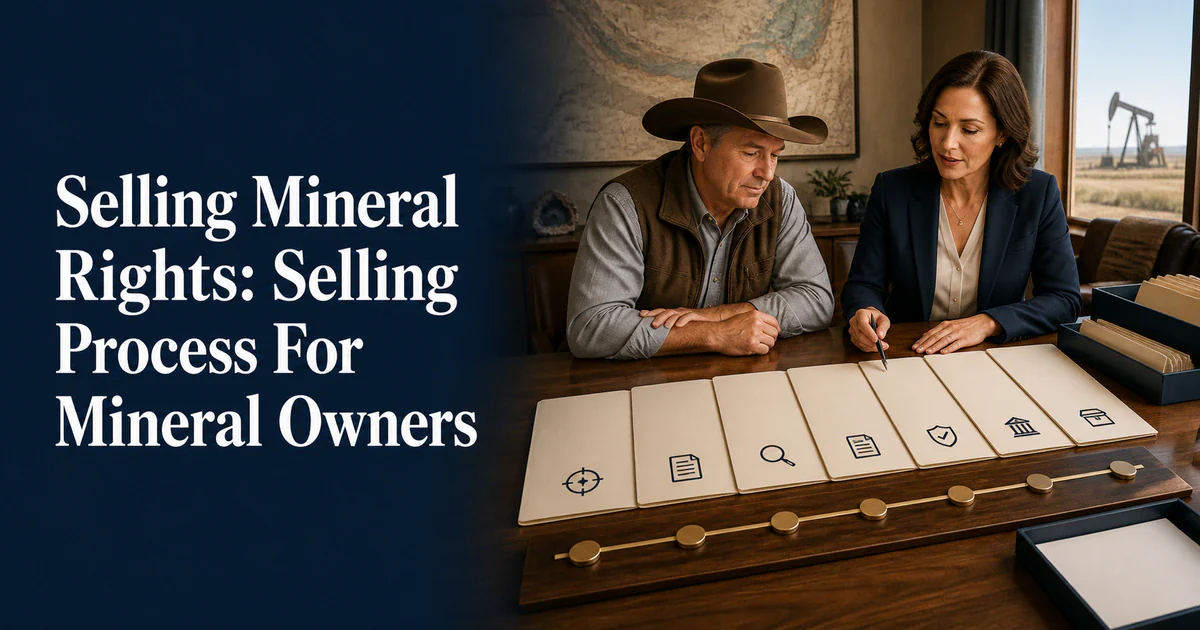
Selling Mineral Rights: Selling Process For Mineral Owners
A mineral owner can control the sale process by requiring a defined input, decision, output, and stop condition at every transaction handoff.
Read the post →A practical next step
Put your mineral rights in context.
Every mineral interest, royalty history, and written offer is different. Start with a question, or share what you have for a free underwriter review.
- Free
- Confidential
- No obligation to sell
Ready for a closer look?
Organize My Review PacketGet a directional range with the assumptions clearly stated.