
MRX Learning Center
How Much Are Mineral Rights Worth: Checklist For Mineral Owners
A mineral-rights worth checklist is complete enough for a directional review when the exact interest is scoped, available evidence is organized, assumptions are dated, and unresolved items are visible.

Direct answer for mineral owners
A mineral owner can prepare for a directional worth review by identifying the exact interest, gathering ownership and tract records, reconciling payment and production evidence, collecting lease and burden terms, and dating every model assumption. Label each item verified, owner-provided, inferred, missing, or professional-review-needed. The checklist improves the quality of a review but does not prove title, reserves, future production, tax treatment, or a guaranteed value.
Key takeaways for mineral owners
- Define the exact tract, interest type, fraction, depths, lease status, and producing status before asking what the interest is worth.
- Keep ownership, payment, production, lease, and assumption evidence in separate folders because each source answers a different question.
- Mark missing or conflicting information visibly instead of converting it into a zero or an unsupported fact.
- A complete checklist supports a scoped directional review; it is not a title opinion, reserve report, appraisal, tax conclusion, or assurance that an offer will be made.
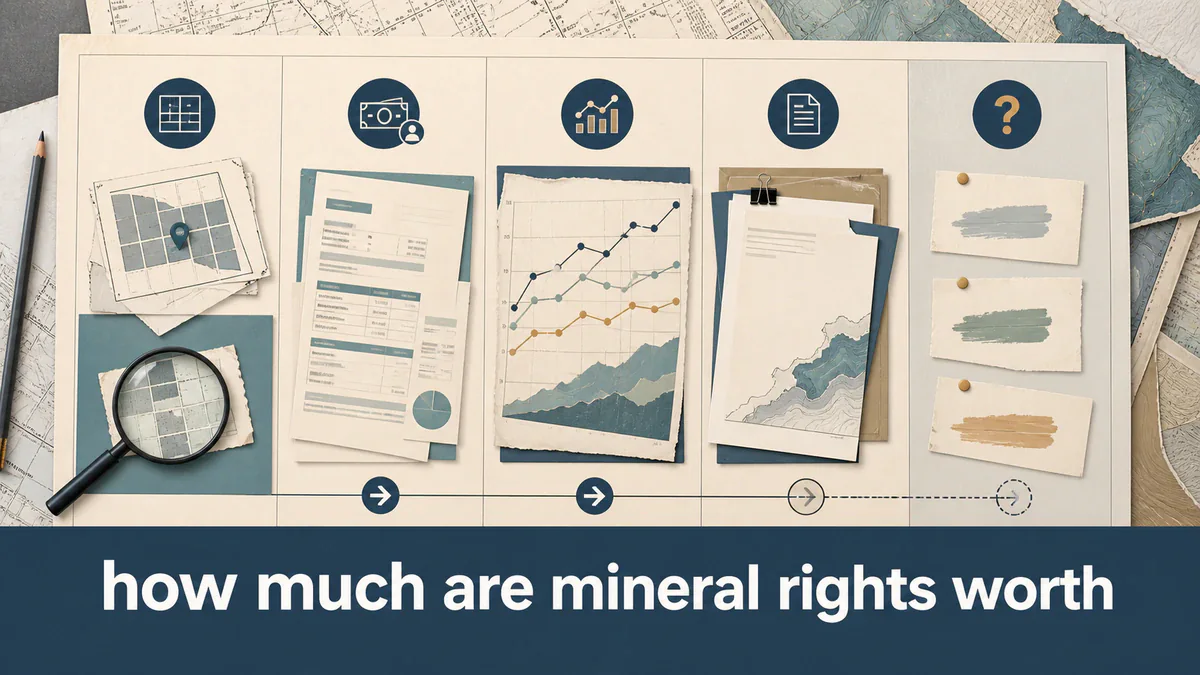
Educational and commercial-role scope. This checklist organizes information for a directional mineral-rights value review. It does not prove ownership, interpret a deed or lease, audit payments, certify reserves, forecast drilling, provide a credentialed appraisal, or determine an owner-specific legal, tax, accounting, engineering, investment, estate-planning, or transaction outcome. MRX provides educational information and resources only and does not buy mineral rights. Use the appropriate qualified professional for owner-specific conclusions.
The short answer is that a mineral owner can prepare for the question “how much are mineral rights worth?” by building five evidence folders: ownership and tract identity, payments, production, lease and burdens, and dated valuation assumptions. Every item should be labeled verified, owner-provided, inferred, missing, or professional review needed.
The checklist is ready for a directional review when the exact interest is scoped, available records can be matched to that scope, conflicts and gaps are visible, and assumptions have a source and date. “Ready” does not mean every question is resolved. It means the reviewer can see which conclusions are supported and which remain uncertain.
Start with one interest statement
Before collecting numbers, write a one-paragraph interest statement. It should identify the asset you believe is under review without pretending that your summary is a title opinion.
Include:
- owner name or entity shown in the available file;
- state and county;
- survey, abstract, section, block, tract, unit, or other location identifiers you have;
- mineral, royalty, overriding royalty, nonparticipating royalty, or other claimed interest type;
- claimed gross acres, net mineral or royalty acres, fraction, or decimal and the source of that claim;
- leased or unleased status;
- producing, nonproducing, or mixed status;
- depths, formations, tracts, or products included or excluded, if known; and
- the date through which the statement is current.
Do not force missing details into the paragraph. Write “unknown” and add the item to the missing-evidence log. A precise-looking interest statement built from guesses is less useful than a clearly bounded statement with three open questions.
Use five evidence folders
Each folder answers a different part of the worth question. Combining them too early can turn one record into proof of something it does not establish.
1. Ownership and tract identity
Collect the documents and identifiers that show how the claimed interest is described and how it may have moved between owners.
Checklist:
- deeds, mineral deeds, royalty deeds, assignments, reservations, and exceptions;
- probate orders, wills, heirship materials, trust documents, or entity records relevant to the claimed transfer;
- recorded memorandum, lease, release, ratification, pooling, or unit instruments you already have;
- legal descriptions and any referenced exhibits;
- county, survey, abstract, section, block, tract, and parcel references;
- a source note for every claimed acreage, fraction, depth, formation, or interest type; and
- a list of name variations, prior owners, recording references, and apparent gaps.
The Texas State Library explains that real-property records, including deeds, surveys, liens, and tax records, are maintained by the county where the property is located. That makes the appropriate county clerk a central source for recorded documents. It does not mean one recorded document, viewed by itself, conclusively resolves the chain of title or legal effect of every reservation.
The Texas General Land Office’s archival collections can help locate historical land-grant and survey material. Treat those materials as research leads. An archival map is not a current county title record, and neither a map nor this checklist is an owner-specific title opinion.
Mark this folder professional review needed when the chain contains ambiguous reservations, missing probate links, conflicting descriptions, depth limitations, fractional language you cannot reconcile, or a dispute. Do not resolve legal language by assumption.
2. Payment and owner-account evidence
For a producing interest, gather a continuous run of royalty statements when available. Twelve recent months can reveal timing and reconciliation issues, while a longer history may be useful for trend work. The relevant period depends on the interest and the review purpose.
Checklist:
- payor and operator names;
- owner number and statement period;
- lease, property, well, or unit identifiers;
- product and sales-month identifiers;
- decimal shown on the statement or division order;
- gross volume, gross value, taxes, deductions, adjustments, and net payment fields;
- division orders and later amendments;
- suspense, transfer, address-change, or ownership-change correspondence; and
- an explanation for unusual checks, reversals, or missing months when known.
A royalty statement is payment evidence, not a complete ownership conclusion. The displayed decimal may apply only to a particular well, unit, product, or period. A division order can help explain the payor’s calculation, but it should not silently become proof of every tract and depth the owner may hold.
Build a reconciliation note: which statement identifiers match the interest statement, which do not, and which remain unknown? Keep the original statement and a working copy. Redact bank information, tax identifiers, and unrelated private data before sharing unless a secure process specifically requires them.
3. Production and operating context
Collect production records only after identifying the likely lease, well, field, unit, operator, and reporting period. A county total or nearby well is not a substitute for matching the correct asset.
Checklist:
- regulator lease or well identifiers;
- operator, field, county, district, and unit names where applicable;
- monthly oil, gas, and relevant product history;
- first production, shut-in, workover, completion, or status dates that can be supported;
- permit and completion records relevant to the scoped interest;
- the retrieval date and reporting period; and
- a note describing how the public record was matched to the payor statement and tract.
The Railroad Commission of Texas says its production information comes from operator reports. Its Production Data Query FAQ also explains important limits: Texas oil may be reported by lease, the online information has reporting lag, and records can change when revised, corrected, or delinquent reports arrive.
Use that information as operating context. It does not establish mineral title, interpret a private lease, prove the owner decimal, confirm payment entitlement, certify reserves, predict future production, or determine value. A mismatch between a statement and regulator data is a question to investigate, not automatic proof that either source is wrong.
Separate evidence from assumptions
4. Lease terms, burdens, and scope
Valuation can change when the lease, royalty fraction, deductions, pooling authority, depth rights, amendments, or other burdens change. Capture the language and the source document rather than relying on memory.
Checklist:
- current lease and all amendments, ratifications, extensions, releases, and memoranda available;
- royalty fraction and any product-specific language;
- pooling, unitization, allocation, depth, formation, acreage, and retained-acreage provisions relevant to the review;
- deduction, post-production-cost, transportation, marketing, or similar language for professional interpretation when material;
- overriding royalty, nonparticipating royalty, lien, mortgage, or other burden evidence in the file;
- producing-well, shut-in, continuous-development, or expiration questions that affect scope; and
- proposed transaction documents, if the review is tied to an offer.
This is a collection task, not a legal interpretation. If the answer depends on what a clause means, whether a lease remains effective, which depths were released, or what a deed would convey, mark it for a qualified attorney. Do not convert a disputed legal interpretation into a valuation fact.
5. Dated market and model assumptions
Only after the first four folders are organized should the file list the assumptions used to translate evidence into a directional range.
Checklist:
- effective valuation date;
- producing and nonproducing components kept separate;
- attributable production history and decline assumptions;
- commodity-price source, date, and scenario;
- differentials, taxes, deductions, and expenses used in the model;
- discount rate and stated rationale;
- forecast period and terminal treatment;
- development timing and probability, if any, with the evidence supporting each scenario;
- ownership, title, data-quality, and timing confidence; and
- lower, reference, and higher cases with the changed assumptions visible.
MRX’s published methodology explains how a discounted-cash-flow review can organize expected royalty income with stated inputs and uncertainty. The broader guide to what determines mineral-rights value explains the underlying ownership, location, production, lease, development, market, title, and transaction drivers.
This checklist has a narrower job: make sure each input has a document, source, date, or uncertainty label before it enters the review.
The IRS defines fair market value in Publication 561 for its donated-property context and emphasizes relevant facts, valuation date, market conditions, comparable-property similarity, and evidentiary support. That general discipline is useful here. Publication 561 is not a mineral-rights appraisal formula, does not determine an owner’s tax treatment, and does not convert a directional MRX review into a qualified appraisal.
Apply five evidence labels consistently
Use the same label vocabulary in every folder.
Verified
The item has been matched to a current source that is appropriate for the claim. Record the source, retrieval date, scope, and reviewer. “Verified” should be claim-specific. A verified production record does not verify title.
Owner-provided
The owner supplied the fact or document, but the review has not independently confirmed it. This label respects the evidence without overstating it.
Inferred
The item is a reasoned connection rather than a direct fact. State the inference and its basis. For example, a statement identifier may appear to correspond to a regulator lease record, but the match may remain uncertain.
Missing
The item is needed or potentially material but unavailable. Do not replace missing acreage, decimals, production, or lease terms with zero unless zero is itself supported.
Professional review needed
The question requires legal, title, tax, accounting, engineering, reserve, appraisal, financial, or other specialized judgment outside the directional review’s scope.
Build a missing-evidence log
A strong checklist does not hide gaps at the bottom of a folder. Put them in one visible log.
For each gap, record:
- the unresolved question;
- why it could affect scope, confidence, or assumptions;
- the record or professional review that may resolve it;
- who is responsible for the next step;
- the request date and status; and
- whether the directional review can proceed with a labeled scenario.
Prioritize gaps that can change what is owned before gaps that merely refine a model. An unknown interest fraction, unclear depth reservation, unmatched producing property, or missing lease can affect the asset definition. A different price scenario can be modeled after the asset is scoped.
When the file is ready for a directional review
Use the following readiness test.
The file is generally ready to enter a directional review when:
- the interest statement names the asset and its effective date;
- every claimed acreage, fraction, decimal, lease term, and producing property has a source or an uncertainty label;
- payment and public production identifiers are matched where reasonably possible;
- material conflicts and missing records appear in the log;
- professional-review questions are not presented as resolved facts;
- model assumptions have a source, date, scenario, and confidence label; and
- the requested output is defined as a directional range, not a guarantee.
The file is not ready for a high-confidence conclusion when the asset itself cannot be scoped, a producing property cannot be matched, the claimed interest quantity has no usable source, or a material legal interpretation is being assumed. A lower-confidence directional scenario may still be possible if the limitation is explicit and the output is not used beyond its stated purpose.
Common checklist mistakes
Starting with a price-per-acre shortcut
A generic multiple does not identify the rights, production, lease, burdens, development timing, market evidence, or title confidence. Start with the interest statement.
Treating the largest royalty check as recurring income
One check may include several products, wells, adjustments, or prior periods. Reconcile the statement history and production period before projecting it.
Treating a regulator map as a title map
Well locations and production context can help match operating records. They do not show every private ownership fraction, reservation, or payment right.
Treating a division-order decimal as universal
Confirm which well, unit, product, and effective period the decimal covers. Do not apply it to unrelated tracts or future wells without support.
Removing uncertainty to make the file look complete
A blank marked missing is better than an unsupported fact. The reviewer can model an explicit uncertainty; hidden uncertainty creates false precision.
Calling an organized file an appraisal
Organization improves traceability. It does not change the reviewer’s credentials, the assignment scope, or the professional standards applicable to an appraisal engagement or reserve report.
The useful output of the checklist
The output is not a price. It is a compact evidence package containing:
- the scoped interest statement;
- the five folders and their indexes;
- a source-and-status label for each material input;
- a missing-evidence and conflict log;
- a list of professional-review questions;
- dated model assumptions and scenario definitions; and
- a confidence note explaining what could materially change the range.
That package makes a directional review more useful because another reviewer can trace the range back to the available evidence. It also makes disagreement productive: instead of debating one unexplained number, the parties can identify whether they disagree about ownership scope, production match, lease effect, timing, price assumptions, development probability, discounting, or market evidence.
Bounded next steps for mineral owners
If the five folders are ready, request a free mineral-rights review and bring both the supporting records and the missing-evidence log. MRX can organize a directional underwriter review and explain the assumptions used. That review is educational and commercial in nature, not a title opinion, legal or tax opinion, payment audit, reserve report, engineering study, financial plan, credentialed appraisal, guarantee of value, or promise that an offer or transaction will occur.Frequently asked questions
Can I find out what my mineral rights are worth with only a royalty statement?
Usually not with useful confidence. A statement can show a payor, owner number, reported decimal, products, deductions, adjustments, and net payment for a period, but it may cover only certain wells or units. The review still needs the interest scope, relevant ownership and lease records, production match, and dated assumptions.
Do I need perfect title records before requesting a directional review?
No. A directional review can begin with an incomplete file if missing and conflicting items are identified. It should not treat owner-provided acreage, a division-order decimal, an archival map, or a payor record as a title opinion. A qualified attorney or land professional may be needed for ownership conclusions.
Can Railroad Commission production data tell me what my mineral rights are worth?
No. Reported production is one operating input. It does not prove title, the owner decimal, payment entitlement, remaining reserves, future production, commodity prices, lease terms, or market value. It must be matched to the correct lease, well, unit, and period and reconciled with other evidence.
What if I do not know my net mineral acres or royalty decimal?
Record the claimed amount, its source, and the uncertainty instead of guessing. Gather deeds, probate records, leases, division orders, statements, and tract identifiers. A qualified land professional or attorney may be needed to interpret the chain of title or legal effect of the documents.
Does completing this checklist guarantee an offer or sale price?
No. The checklist organizes evidence for a directional review. It does not guarantee value, income, production, drilling, an offer, marketability, closing, or a transaction price. A buyer may use different assumptions, scope, diligence, terms, and timing.
Sources reviewed for this article
- Mineral Rights Xchange, Published DCF Methodology (accessed 2026-08-12)
- Mineral Rights Xchange, What Determines the Value of Your Mineral Rights? (accessed 2026-08-12)
- Railroad Commission of Texas, Oil & Gas Production Data (accessed 2026-08-12)
- Railroad Commission of Texas, Production Data Query FAQs (accessed 2026-08-12)
- Texas State Library, Land and Property History Research (accessed 2026-08-12)
- Texas General Land Office, Search Our Collections (accessed 2026-08-12)
- Internal Revenue Service, Publication 561 (accessed 2026-08-12)
Related mineral-rights articles

How Mineral Rights Valuation Affects Your Asset Decisions
A directional mineral-rights valuation can compare asset options only when its date, scope, scenarios, confidence, and owner-specific decision criteria remain visible.
Read the post →
What Determines the Value of Your Mineral Rights?
Mineral-rights value depends on the exact interest, tract-level evidence, production or development context, assumptions, and the terms of a real transaction.
Read the post →
Unlocking Value: A Comprehensive Guide to Assessing Your Mineral Rights Worth
A useful mineral-rights assessment is an evidence file with explicit assumptions, not a single online estimate or universal royalty multiple.
Read the post →
How Much Are Mineral Rights Worth: Checklist Without Obligation
A no-obligation mineral-rights review should make its price, scope, commercial role, deliverable, information use, communication choices, stopping points, and optional next steps clear before an owner proceeds.
Read the post →A practical next step
Put your mineral rights in context.
Every mineral interest, royalty history, and written offer is different. Start with a question, or share what you have for a free underwriter review.
- Free
- Confidential
- No obligation to sell
Ready for a closer look?
Request a free mineral-rights reviewGet a directional range with the assumptions clearly stated.