
MRX Learning Center
Documents Needed to Sell Texas Mineral Rights
A practical document checklist for Texas mineral rights owners preparing for an underwriter review or a sale. Plain-language, with the assumptions stated.
Direct answer for mineral owners
Useful records for a Texas mineral rights sale include the mineral deed or inheritance documents, legal description, lease and amendments, division order, recent royalty statements, operator and well information, title material, and every page of a written offer. Start with what is available and identify missing records during review.
Key takeaways for mineral owners
- Ownership and inheritance records help identify how the current owner acquired the interest.
- Leases and division orders help connect the interest to royalty and operator information.
- Royalty statements provide property, well, production, deduction, and payment details.
- Every page and attachment of a written offer can affect the proposed transaction.
- Missing records are common and do not by themselves resolve an ownership question.
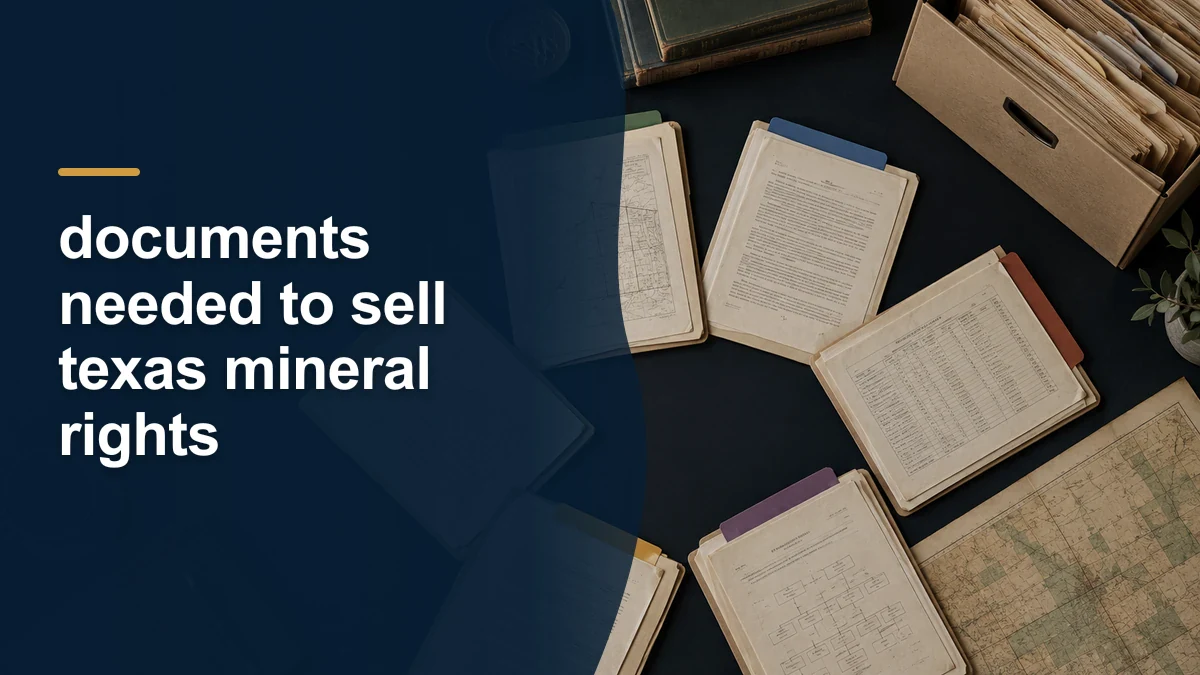
Texas mineral rights transactions involve a specific set of documents. Owners often consider gathering these in advance of a review because it sharpens the analysis and shortens the timeline. This post is general information, not legal advice; verify any specific situation with a Texas-licensed attorney.
Why the documents matter
An MRX directional review can use production, royalty income, stated assumptions, and offer terms when those inputs are available. Complete records can reduce follow-up questions. Start with what is available and identify gaps during the review.
Core documents for a Texas mineral-rights sale
The records below can provide useful identifiers and transaction context. The exact documents depend on the interest and what is available. The “how to get it” note points to a possible source.
- Recent royalty check stub, royalty statement, or Form 1099-MISC showing royalties in Box 2. These records can help document income from the interest, deductions, and the payer’s contact information. How to get it: the operator or the company that pays the royalty (often the same entity).
- Division order. A document the operator issues to each working-interest and royalty-interest owner after the well is completed, describing the owner’s share, the unit, and the decimal interest. How to get it: the operator, or the title company that handled the original conveyance.
- Lease. The original oil and gas lease (and any modifications) under which the royalty is paid. Specifies the royalty fraction, the primary term, the depth of rights, and any post-production deductions. How to get it: the owner, the family’s records, the operator, or the county records.
- Mineral deed or other conveyance document. The document that transferred the mineral interest to the current owner (purchase, gift, will, trust distribution). How to get it: the family’s records, the county clerk’s office (most Texas counties have online records), or the original closing agent.
- Title and curative material, if available. Prior title opinions, ownership schedules, probate records, affidavits, releases, and curative requests may help identify the ownership history or an open question. How to get it: prior closing files, the operator, the county record, or the professional who prepared the material.
- Offer letter or letter of intent (if any). If a buyer has approached you, the offer letter sets the headline number, the effective date, the closing timeline, and the post-close obligations. How to get it: the buyer’s representative, or your own records.
What the underwriter actually does with the documents
Each document feeds a different part of the review. The royalty check and the production data feed the income side of the DCF. The lease and division order feed the royalty fraction, the depth of rights, and any deductions. The mineral deed and the title opinion feed the ownership-confidence side of the range. The offer letter feeds the comparison side.
Review timing varies. Having the key documents available can reduce follow-up questions, while missing records, multiple counties or operators, and title issues can add time because the underwriter must fill gaps with public data and owner clarifications.
What the documents are not
A document does not, by itself, authorize MRX to act for the owner. The review organizes information for a directional range and does not commit the owner to a transaction. MRX provides educational information and resources only and does not buy mineral rights.
A document is not a guarantee of value. Production can decline, operators can change, and title surprises can happen. The range reflects the inputs; the inputs can change.
When to involve a Texas-licensed attorney
If any of the following apply, the right next step is a Texas-licensed attorney before the documents go to a buyer or to closing:
- The mineral interest is held by multiple heirs, a trust, or an estate.
- The lease is old, amended, incomplete, or unclear about depth of rights or post-production deductions.
- The offer letter includes a clawback, depth-of-rights limitation, or other clause the owner does not fully understand.
- The title opinion shows partial interests, outstanding royalties, or encumbrances.
The review can run in parallel with an attorney’s review. They serve different purposes: the underwriter gives a directional range; the attorney gives legal opinion.
Summary for mineral owners
Gather what you have and ask for what is missing. Review timing depends on the available records and the complexity of the interest. Verify any specific situation with a Texas-licensed attorney and CPA. The review is a working conversation, not a sales pitch.Frequently asked questions
Do I need every document before requesting a review?
No. Start with what you have. The state, county, legal description, royalty statement, division order, lease, deed, or written offer can each provide useful identifiers for locating other records.
Which document shows that I own the mineral rights?
Ownership may be supported by deeds, probate records, trust instruments, affidavits, court orders, and the recorded chain of title. The relevant evidence depends on how the interest was acquired.
Why does a buyer request royalty statements?
Royalty statements can identify the operator, property, well, ownership decimal, production volumes, prices, deductions, and payment history used during diligence.
What if my lease or mineral deed is missing?
County records, family files, operators, prior closing files, and public land-record systems may help locate copies or related instruments. A title professional or attorney can address record sufficiency.
Should I send only the signature page of an offer?
No. Definitions, exhibits, adjustment rights, property descriptions, and post-closing obligations may appear elsewhere, so include every page and attachment available for comparison.
Sources reviewed for this article
Related mineral-rights articles

How to Sell Mineral Rights in Texas
How a Texas mineral rights sale actually works, from first contact to closing. A step-by-step read with the assumptions stated and the documents named.
Read the post →
How to Compare Mineral Rights Buyers in Texas
How to compare Texas mineral rights buyers and their offers beyond the headline number. Plain-language questions, what to look for, and how a free underwriter review helps.
Read the post →
How Title Review Findings Can Change a Mineral Rights Offer
Title review may identify a different ownership fraction, missing records, liens, or tract issues. Learn how those findings can change an offer.
Read the post →
How Long Does It Take to Sell Mineral Rights in Texas?
A practical explanation of the records, diligence, contract, payment, and recording steps that control the timing of a Texas mineral-rights sale.
Read the post →A practical next step
Put your mineral rights in context.
Every mineral interest, royalty history, and written offer is different. Start with a question, or share what you have for a free underwriter review.
- Free
- Confidential
- No obligation to sell
Ready for a closer look?
Review My Available RecordsGet a directional range with the assumptions clearly stated.