
MRX Learning Center
Selling Mineral Rights: Selling Process For Mineral Owners
A mineral owner can control the sale process by requiring a defined input, decision, output, and stop condition at every transaction handoff.
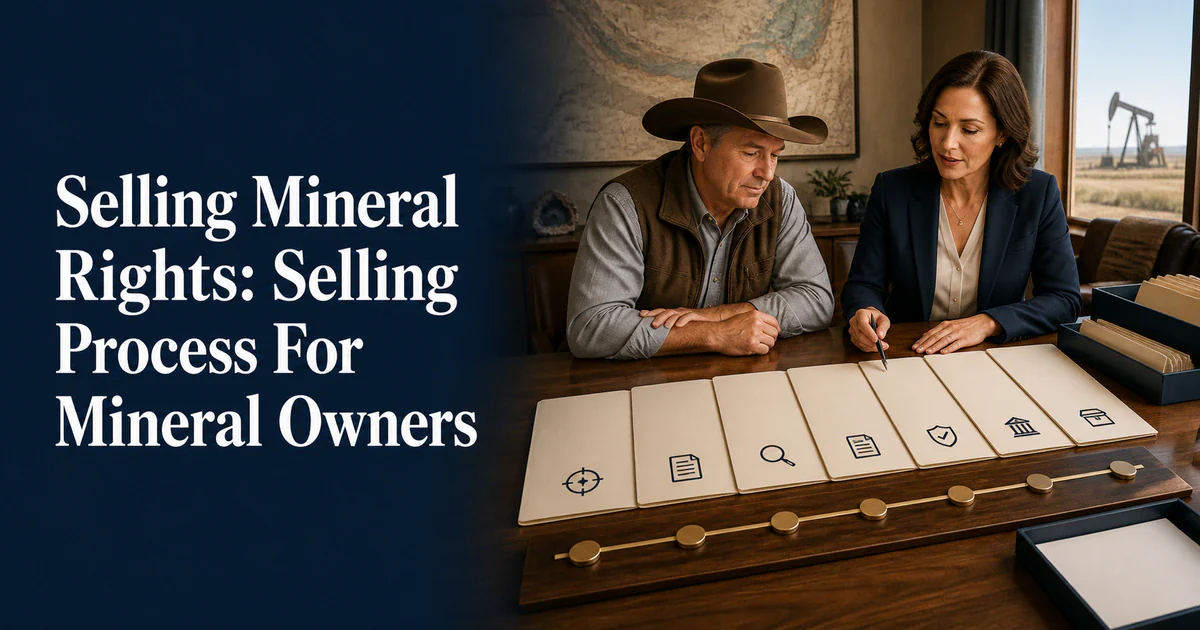
Direct answer for mineral owners
The selling process is easier to control when every stage has a required input, an owner decision, a written output, and a stop condition. Define the possible interest first, require comparable written terms, track diligence issues, obtain state-specific professional review, verify payment instructions independently, coordinate signing, funding, delivery, and recording, and retain the final transaction and tax records.
Key takeaways for mineral owners
- A conversation, proposal, letter of intent, purchase agreement, deed, payment confirmation, and recording record are different transaction states.
- Normalize each written proposal to the same property, depths, interest, consideration, adjustment rights, conditions, deadlines, and closing mechanics.
- Keep diligence requests, title issues, proposed changes, and unresolved questions in one dated issue log before final documents are approved.
- Independently verify payment-instruction changes and preserve the signed, funded, delivered, recorded, and tax records after closing.
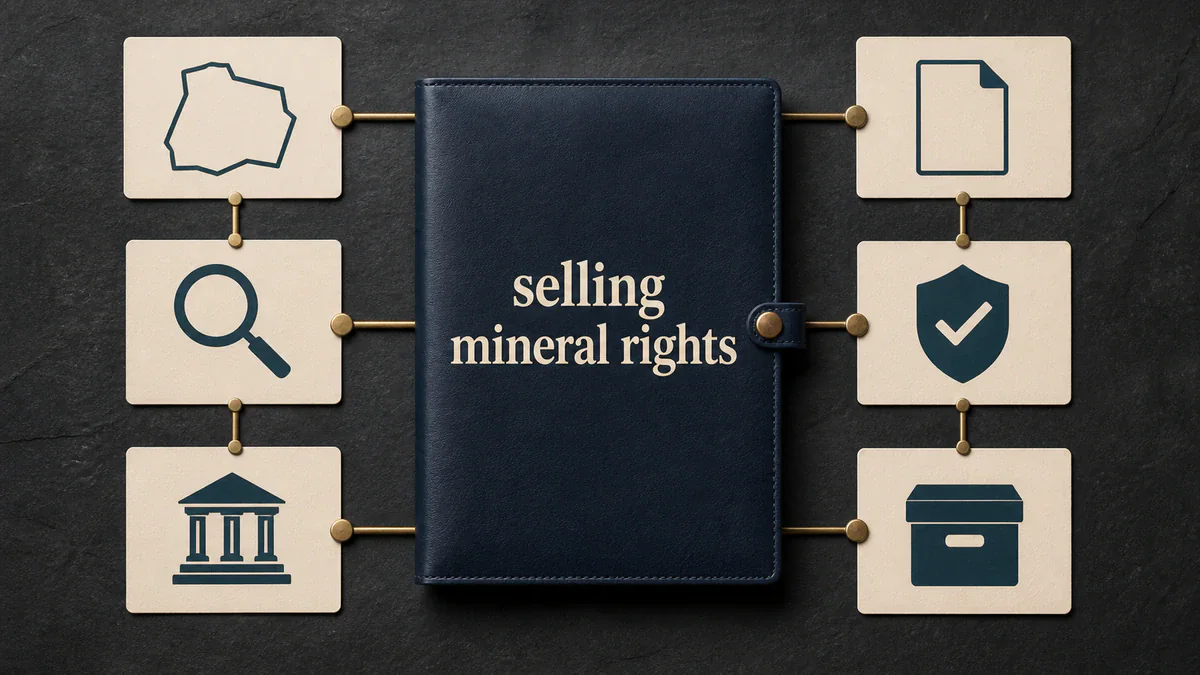
Educational transaction scope. This article explains a nationwide control file for a possible mineral-rights sale. It does not determine title, authority, legal effect, tax treatment, value, payment entitlement, cybersecurity, recording priority, or whether a transaction will close. State law and the complete documents control. Use qualified professionals for owner-specific legal, title, tax, accounting, valuation, cybersecurity, escrow, and transaction questions. MRX provides educational information and resources only and does not buy mineral rights.
The short answer is to give every stage of the selling process a required input, an owner decision, a written output, and a stop condition. A conversation is not a proposal. A proposal is not necessarily a binding agreement. A signed agreement is not the same event as a signed deed, verified funding, deed delivery, buyer acceptance, or recording.
That distinction lets an owner stay oriented even when buyers use different labels or combine several stages in one document. The process can stop at any stage. The owner may reject every proposal, narrow the interest under consideration, request better terms, obtain professional advice, or decide not to sell.
This article is a nationwide seller-control map. The companion Texas process article owns the Texas-specific overview and Texas conveyance and recording references.
Build one seller-control file
Use one controlled folder with four working records:
- Scope memo. What interest may be considered, what is excluded or retained, who may decide, and what the owner wants the process to accomplish.
- Comparable-proposal sheet. The property, depths, interest, consideration, adjustment rights, conditions, deadlines, assignment rights, obligations, and closing mechanics in each complete written proposal.
- Diligence issue log. Every request, title or ownership question, proposed assumption, proposed change, responsible party, due date, status, and unresolved effect.
- Closing control sheet. The approved documents, signers, verified payment channel, funding condition, deed-delivery condition, acceptance step, recording responsibility, and final evidence.
Preserve the source documents beside those records. The working records summarize the process; they do not replace the controlling agreement, deed, settlement record, public record, or professional advice.
Stage 1: define the possible sale before discussing price
Start with the scope memo. Identify:
- the owner or ownership vehicle;
- state, county, and tract or legal-description reference;
- mineral, royalty, overriding royalty, working, or other interest type;
- relevant depths or formations if known;
- producing and nonproducing components;
- whether a full or partial sale is being considered;
- any acreage, depths, rights, proceeds, claims, or future interests intended to be retained;
- the people or entities who may need authority to decide or sign; and
- the owner’s objective and nonnegotiable limits.
Do not use a royalty decimal, tax parcel, well name, family shorthand, or buyer map as a substitute for the legal interest. Those items may help with matching, but they do not resolve title, net acres, depths, authority, or what a proposed document conveys.
Required output: one dated scope memo. Stop condition: the possible interest, exclusions, decision makers, or authority cannot be described without guessing.
Stage 2: control first contact and information sharing
Record the buyer’s stated legal entity, representative, contact channel, requested information, and reason for the request. Keep marketing language separate from verified facts. An entity search, website, reference, or professional-looking document may support a question, but none alone proves capacity, terms, or trustworthiness.
Share only records the owner is authorized to provide. Remove unrelated account information, taxpayer identifiers, signatures, access credentials, and family data when they are not required for the stated review. Use an agreed secure channel for sensitive documents and keep a list of what was sent, when, to whom, and for what purpose.
An exploratory call should remain exploratory until the owner receives complete written terms. Do not let urgency or an informal phrase such as “just permission to review” substitute for reading the actual document.
Required output: a contact and disclosure log. Stop condition: the recipient, purpose, security of the channel, or requested scope is unclear.
Stage 3: require a complete written proposal
A useful proposal should identify the buyer, seller, property or interest, consideration, assumptions, adjustment rights, conditions, deadlines, assignment rights, and closing mechanics. If the proposal refers to exhibits, schedules, incorporated terms, online terms, or later documents, obtain and preserve them before comparing it.
Normalize each proposal to the same scope:
- Is the same tract and depth interval included?
- Is the same interest type and fraction being purchased?
- Is the proposal for a full or partial sale?
- Which stated amount is fixed, estimated, or subject to adjustment?
- Which title, acreage, decimal, production, or diligence finding can change the amount?
- Does the buyer receive exclusivity, access, assignment, termination, or extension rights?
- Which representations, remedies, indemnities, or obligations survive closing?
- What must happen before funds and the deed are released?
The MRX methodology explains why title and acreage, production, lease terms, operator and development evidence, commodity assumptions, discount rates, and the exact written offer can affect a directional underwriter range. The proposal sheet records those assumptions; it does not prove them or determine market value.
Required output: one comparable-proposal sheet tied to the complete source document. Stop condition: a proposal cannot be compared without silently changing the property, interest, consideration, or conditions.
Stage 4: decide whether to enter exclusivity or buyer diligence
Some processes move from a proposal to a letter of intent, option, exclusivity agreement, purchase agreement, or another instrument. The name is not enough to determine legal effect. Review the complete language and the governing state’s law.
Before signing, identify:
- what becomes binding and what remains nonbinding;
- the exclusivity period and covered property;
- access to records and permitted contacts;
- title, valuation, production, and other diligence rights;
- adjustment, extension, termination, and assignment rights;
- confidentiality and use of owner information;
- remedies if either party does not proceed; and
- every referenced exhibit or future document.
A qualified attorney should review owner-specific contract, deed, title, authority, remedy, and state-law questions. A directional underwriter can organize the economic and evidence questions, but it cannot decide legal effect.
Required output: a signed-or-rejected decision record with the reviewed document version. Stop condition: the owner cannot explain the obligation, property, duration, exit path, or remedy created by the document.
Stage 5: run buyer diligence through one issue log
Buyer diligence often tests ownership, authority, acreage, depths, lease burden, decimal, production, suspended funds, liens, probate, entity status, and other matters. Keep every request and proposed conclusion in the dated issue log.
Each row should identify:
- property and issue;
- source document or public-record reference;
- exact request;
- person responsible for responding;
- date sent and date answered;
- buyer’s proposed assumption, adjustment, cure, or exclusion;
- owner’s response and supporting record;
- whether professional review is needed; and
- resolved, unresolved, withdrawn, or disputed status.
Do not accept a shortened legal description, unexplained acreage reduction, changed depth interval, new deed exhibit, or revised consideration only because it appears in a later email. Tie every material change to the proposal sheet and the draft transaction documents.
Required output: a current issue log and document index. Stop condition: a material adjustment or conveyance change lacks a source, method, responsible reviewer, or written resolution.
Stage 6: reconcile the final transaction documents
The final agreement, deed, assignments, affidavits, settlement record, tax forms, and closing instructions should describe the same transaction. Compare them against the locked scope memo and the latest approved proposal sheet.
Check for differences in:
- parties and signature capacity;
- legal description and covered property;
- interest type, fraction, depths, and retained rights;
- effective date and entitlement to proceeds;
- consideration and adjustment method;
- representations, warranties, indemnities, and remedies;
- assignment, confidentiality, and surviving obligations;
- delivery, acceptance, funding, and recording conditions; and
- dispute, venue, and governing-law provisions.
Do not use a generic checklist to decide the legal effect of a deed or agreement. State rules differ, facts differ, and one word can change scope. Route those conclusions to a qualified attorney in the governing jurisdiction.
Required output: an approved document set with version identifiers and unresolved items stated. Stop condition: the deed, agreement, settlement record, or instructions do not describe the same approved transaction.
Stage 7: verify payment instructions independently
Treat payment security as its own handoff. The FBI’s Business Email Compromise guidance says these scams can target individuals transferring funds and recommends using a secondary channel to verify requests that change account information. The FTC also advises people not to use a phone number contained in a suspicious email or text; instead, obtain the organization’s number independently.
Use a known contact or separately verified first-party channel to confirm:
- the paying or disbursing party;
- the authorized recipient;
- the approved payment method;
- the account-information exchange process;
- any change to prior instructions; and
- the person who confirms receipt.
Never send money, passwords, one-time codes, or account credentials because an unexpected message says a closing problem must be fixed immediately. If instructions change, pause the closing sequence until the change is independently confirmed.
Required output: a dated verification record that does not expose full sensitive account data in the general transaction file. Stop condition: payment instructions changed through an unverified channel or the owner cannot identify who authorized them.
Stage 8: coordinate signing, funding, delivery, and recording
The closing control sheet should state the order of events. At minimum, identify:
- the final documents and every required signer;
- acknowledgment or notarization requirements;
- where signed documents are held before release;
- what proves funds are available or received;
- who may release or deliver the deed;
- what constitutes buyer acceptance;
- who submits the instrument for recording;
- what happens if a condition is not met; and
- which evidence each party receives afterward.
Do not infer that signing completed every later step. The final documents and applicable law determine when rights and obligations change. If an escrow, title company, attorney, closing agent, or other intermediary is involved, confirm that party’s role and written instructions directly.
Required output: an approved closing control sheet and final document checklist. Stop condition: the sequence can release a deed or sensitive information without the funding, authorization, or evidence required by the approved documents.
Stage 9: close the file only after the evidence is complete
After closing, collect:
- the final signed agreement and every exhibit;
- the final deed and related instruments;
- settlement or disbursement record;
- verified payment confirmation;
- evidence of delivery or release;
- buyer acceptance or closing confirmation;
- recording receipt, instrument reference, or returned recorded copy when available;
- correspondence that resolves material changes; and
- records needed for accounting and tax review.
IRS Publication 551 explains that basis is used to figure gain or loss and that records affecting basis should be kept. IRS Publication 544 shows that the tax classification and reporting path for a disposition can depend on the property, use, holding period, and parties.
The Instructions for Form 1099-S also distinguish reportable real-estate transactions and describe an exception for an interest in surface or subsurface natural resources when the transfer is unrelated to other reportable real estate. That is a reason to obtain transaction-specific guidance from a qualified tax professional, not a conclusion that a mineral owner will or will not receive a particular form.
Keep the scope memo and proposal sheet with the final documents so a later reviewer can understand what was considered, what changed, what closed, and which rights were retained. Ask qualified tax and legal professionals which records and retention periods apply.
Required output: a complete post-closing archive and specialist handoff list. Stop condition: payment, delivery, acceptance, recording, retained rights, or final-document identity remains unverified.
A process map is not a fixed timeline
The stages are ordered, but they do not promise a number of days. Ownership questions, probate, entity authority, title cure, buyer capacity, document revisions, security verification, notarization, funding, and recording can create dependencies. A fast process with unresolved controls is not necessarily complete, and a longer process is not necessarily safer.
Use the file to know the current transaction state:
- Considering: scope is defined, but no complete proposal is under review.
- Comparing: complete written proposals are normalized to the same interest.
- Diligence: a reviewed agreement permits defined buyer investigation.
- Document review: the final agreement, deed, settlement record, and instructions are being reconciled.
- Closing pending: documents are approved, but one or more funding, signing, delivery, acceptance, or recording conditions remain.
- Closed and archived: required events occurred and the owner has the final evidence.
If the record does not support the next state, do not advance the label. That simple discipline is the core of an owner-controlled selling process.
What MRX can and cannot do
MRX can organize a directional underwriter review of the possible interest, production and royalty context, assumptions, complete written offer, diligence questions, and transaction handoffs. It can help an owner see which facts are observed, which are assumed, and which questions need a professional.
MRX does not determine title, interpret a deed or contract for the owner, provide tax conclusions, act as escrow, secure a payment channel, or promise that a buyer will fund or record a transaction. MRX provides educational information and resources only and does not buy mineral rights. When that applies, the relationship should be disclosed in writing before the owner signs an agreement.
The useful result is not pressure to move faster. It is a file that shows exactly what stage exists, what changed, what remains unresolved, and what evidence is required before the next handoff.
Frequently asked questions
What is the first step when selling mineral rights?
Define the possible interest before comparing proposals. Record the state and county, tract or legal-description reference, interest type, relevant depths if known, whether the possible sale is full or partial, the rights the owner intends to retain, the decision makers, and the owner’s objective. If the scope or authority is unclear, pause before treating any proposal as comparable.
Is a letter of intent the same as a mineral-rights purchase agreement?
Not necessarily. A label does not determine legal effect. Review the complete document for binding language, exclusivity, diligence rights, termination, assignment, remedies, deadlines, confidentiality, and incorporated terms. A qualified attorney in the governing state should address what a specific document requires before it is signed.
What should a buyer diligence request include?
The request should be specific enough to identify the property, issue, source, requested record, responsible party, due date, proposed assumption or adjustment, and whether the item is resolved. Owners should share only records they are authorized to provide and use an appropriate secure channel for sensitive documents.
Does signing a mineral deed mean the sale is closed?
Signing is only one event. The controlling documents should state when funds are verified, when the deed is delivered or released, when the buyer accepts the closing package, who records the instrument, and what evidence each party receives. State law and the final documents control the legal result.
Which records should a mineral owner keep after closing?
Keep the final agreement, deed, settlement or disbursement record, verified payment confirmation, delivery evidence, recording information, correspondence that resolves material changes, and records relevant to basis and tax reporting. Ask qualified legal and tax professionals which additional records and retention periods apply to the specific transaction.
Sources reviewed for this article
- Mineral Rights Xchange, How the Step-by-Step Process of Selling Texas Mineral Rights Works (accessed 2026-08-12)
- Mineral Rights Xchange, Published DCF Methodology (accessed 2026-08-12)
- Internal Revenue Service, Publication 544, Sales and Other Dispositions of Assets (accessed 2026-08-12)
- Internal Revenue Service, Publication 551, Basis of Assets (accessed 2026-08-12)
- Internal Revenue Service, Instructions for Form 1099-S (accessed 2026-08-12)
- FBI Internet Crime Complaint Center, Business Email Compromise (accessed 2026-08-12)
- Federal Trade Commission, Spotting Scammy Emails (accessed 2026-08-12)
Related mineral-rights articles
How the Step-by-Step Process of Selling Texas Mineral Rights Works
A seven-step owner checklist for moving from property and ownership records to a fully documented Texas mineral-rights closing.
Read the post →
What Happens After You Sell Your Mineral Rights in Texas?
A practical post-closing checklist for recording evidence, royalty-payor changes, retained interests, transaction records, and tax questions.
Read the post →
Can You Sell Part of Your Mineral Rights? Partial Interest Sales Explained
A partial-interest sale explainer that focuses on written conveyance, title clarity, and decision tradeoffs instead of generic valuation shortcuts.
Read the post →
Selling Mineral Rights: Timeline In 2026
A 2026 planning framework for dating dependencies, parallel work, decisions, closing handoffs, and timeline resets without relying on a promised duration.
Read the post →A practical next step
Put your mineral rights in context.
Every mineral interest, royalty history, and written offer is different. Start with a question, or share what you have for a free underwriter review.
- Free
- Confidential
- No obligation to sell
Ready for a closer look?
Request a mineral-rights selling-process reviewGet a directional range with the assumptions clearly stated.