
MRX Learning Center
Why Reeves CAD Has No 2025 Ratio-Study Worksheet
Reeves appears in the official 2025 MAP list, not the 2025 appraisal-district ratio-study list; the official 2024 findings retain the Reeves worksheet route.
Direct answer for mineral owners
The official Texas Comptroller 2025 appraisal-district ratio-study findings list does not include 195 Reeves. Reeves appears instead in the official 2025 MAP review list, consistent with the statewide MAP-versus-SDPVS/ADRS cycle. For an official Reeves appraisal-district ratio-study worksheet in the controlled source set, use the 2024 findings route. The 2025 omission does not show missing data or any property-level result.
Key takeaways for mineral owners
- The official 2025 findings page publishes a studied-district list with no 195 Reeves entry.
- The official 2025 MAP results page includes Reeves; that listing supplies cycle context, not a mineral-property result.
- Texas Comptroller guidance says each appraisal district receives an ADRS at least once every two years rather than every district appearing every year.
- The official 2024 findings page includes the 195 Reeves worksheet route.
- The absence of a 2025 district row is not evidence about a mineral account, appraisal, tax, protest, private value, offer, or sale.
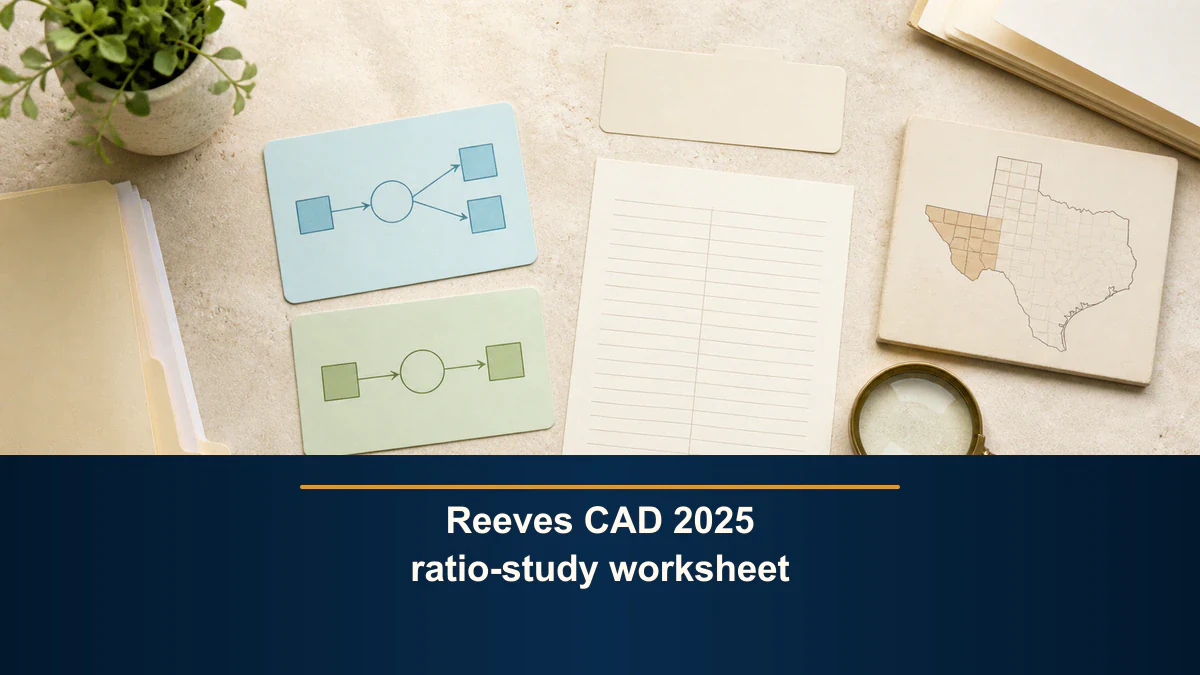
Study-set routing, not a mineral-property finding. This page explains where Reeves appears in two official Texas Comptroller program lists. It does not identify an owner, parcel, mineral account, title, acreage, lease, well, production interest, appraisal notice, tax bill, protest result, market value, private mineral-interest value, offer, buyer action, or transaction result. MRX provides educational information and resources only and does not buy mineral rights.
The direct answer is: the official 2025 appraisal-district ratio-study findings list does not include 195 Reeves, so that publication set has no Reeves district worksheet. Reeves appears instead in the official 2025 Methods and Assistance Program list. Texas Comptroller guidance explains that appraisal districts move through a two-year review-and-study cycle rather than every district receiving both programs every year.
For the Reeves appraisal-district ratio-study worksheet in this controlled source set, use the official 2024 findings route. The 2025 omission is a study-set fact. It is not evidence that a mineral record is missing or that any property value changed.
Direct answer: the 2025 findings list has no 195 Reeves row
The Texas Comptroller 2025 Appraisal District Ratio Study findings page identifies itself as 2025 Tax Year Findings and says the information was published on January 30, 2026 in compliance with Tax Code Section 5.10. Under Appraisal Districts Studied, it presents the districts included in that publication set.
195 Reeves does not appear in that list. The controlled page capture contains no Reeves link, no 195 district entry, and therefore no route to a 2025 Reeves appraisal-district summary worksheet.
That is the full negative claim. It does not say the website lost a file, the district failed to submit something, a mineral account is absent, or a property record changed. It says only that Reeves is not one of the appraisal districts studied in the published 2025 ADRS list.
Reeves appears in the separate 2025 MAP list
The Texas Comptroller 2025 MAP Review Results page says the listed appraisal-district MAP reviews were completed in 2025. Reeves appears in that list.
MAP and ADRS are different programs. The MAP page routes to a review report. The ADRS findings page routes to district ratio-study worksheets. A Reeves entry on the MAP page should not be copied into the ADRS list, and the MAP report should not be described as a ratio-study worksheet.
This page uses the Reeves MAP listing only as cycle context. For the internal findings and recommendations in that review, use the dedicated Reeves MAP article. Article 296 does not reproduce or reinterpret those results.
The statewide cycle explains the route
The Texas Comptroller Property Tax System Basics page says PTAD performs MAP reviews of all appraisal districts every two years, reviews approximately half of the districts each year, and subjects school districts in counties not receiving a MAP review that year to an SDPVS and ADRS.
The Property Tax Data Reports and Surveys page states the ADRS cadence another way: Tax Code Section 5.10 requires the Comptroller to conduct a ratio study measuring each appraisal district at least once every two years and publish the results. It also says the published results cover each appraisal district studied that year.
Read together, those official descriptions support a narrow routing conclusion:
- the 2025 MAP list includes Reeves;
- the 2025 ADRS findings list does not include Reeves; and
- the ADRS requirement is at least once every two years, not a Reeves worksheet in every annual publication set.
This is not a claim about how Reeves CAD performed. It is not a trend analysis. It does not establish why any individual record was selected, excluded, appraised, or taxed.
Use the 2024 findings route for the Reeves worksheet
The Texas Comptroller 2024 Appraisal District Ratio Study findings page identifies the prior tax-year publication set and includes 195 Reeves in its studied-district list. That entry links to the Reeves appraisal-district summary worksheet.
Use Reeves CAD 2024 Ratio Study: 66 Category G Ratios when the task is to read the displayed aggregate Category G row. That article owns the row labels and figures. Article 296 owns only the year-to-program routing question and does not repeat those fields.
A citation-ready route should preserve:
| Route field | Required entry |
|---|---|
| Program | Appraisal District Ratio Study |
| Findings set | 2024 Tax Year Findings |
| District link | 195 Reeves |
| Worksheet type | Appraisal District Summary Worksheet |
| Retrieval evidence | Official landing page and linked district route |
| Limitation | No owner- or property-level inference |
Do not silently change the route year to 2025 merely because the page is being accessed in 2026. The study year, publication date, page-access date, and any worksheet update label are separate fields.
What the missing 2025 route does not prove
No Reeves entry in the 2025 findings list does not prove any of the following:
- that a Reeves mineral account or appraisal record is missing;
- that Reeves CAD omitted a property from its local roll;
- that a named property increased or decreased in value;
- that an appraisal is correct or incorrect;
- that a tax amount or protest outcome changed;
- that a private mineral interest has a particular value;
- that an offer, buyer, sale, or transaction outcome is supported; or
- that 2024 and 2025 study figures should be combined or trended.
Those conclusions require different records and different authority. A statewide publication list cannot establish property ownership, title, acreage, decimal interest, production, burdens, appraisal correctness, tax liability, private market value, or a transaction result.
A repeatable missing-record check
When a year-specific district worksheet cannot be found, preserve the search in this order:
- Record the exact program and tax year being searched.
- Open the official annual findings landing page.
- Confirm the page labels its district links as the districts studied.
- Search for the district number and district name separately.
- Record whether a link is present without inventing a reason for absence.
- Check the official MAP year list for cycle context.
- Use the statewide basics and reports pages for the program cadence.
- Locate the closest official findings year that actually contains the district route.
- Keep any worksheet fields in the separate article that owns that record.
- Stop before making an owner, property, appraisal, tax, value, offer, or transaction inference.
This sequence creates an auditable answer to a retrieval question. It does not transform absence into a substantive property finding.
Keep the adjacent Reeves records in their lanes
Use Reeves CAD 2025 MAP Review: Four Passes and Two Recommendations for the review report’s internal results. Article 296 cites only the Reeves entry in the official 2025 MAP list.
Use Reeves County 2024 Category G Worksheets: Two ISDs, Strata, and Ratios for the school-district PVS worksheet structures. Use Reeves County 2025 Preliminary PVS: Two Category G Totals for the two preliminary PVS summary routes. Use Reeves County Mineral Records: A Source-by-Source Search Log for clerk, CAD, GLO, and RRC retrieval separation.
Those pages answer different jobs. Article 296 is the missing-year route explanation only.
Controlled retrieval record
Five official source objects were retrieved on August 31, 2026 and retained as 651,810 controlled bytes.
| Source object | Bytes | SHA-256 prefix | Role |
|---|---|---|---|
| 2025 ratio-study findings | 129,567 | df71a9be2123 | 2025 study set and no Reeves route |
| 2025 MAP review results | 129,458 | a70f63d866da | Reeves MAP-list entry |
| Property Tax System Basics | 131,798 | 654ef614634a | Program-cycle relationship |
| Property Tax Data Reports | 131,568 | 1213cab5f9ae | At-least-once-every-two-years cadence |
| 2024 ratio-study findings | 129,419 | bcdebb9f7c70 | 195 Reeves worksheet route |
Claim ledger and stop conditions
| Claim ID | Supported statement | Allowed evidence label | Stop condition |
|---|---|---|---|
C296-01 | 2025 findings identify the 2025 tax year and January 30, 2026 publication date | STUDY-SET-IDENTITY | Do not call publication date a property effective date |
C296-02 | The 2025 studied-district list has no 195 Reeves entry | NEGATIVE-ROUTE-CHECK | Do not claim a missing local record or submission failure |
C296-03 | Reeves appears in the 2025 MAP results list | PROGRAM-ROUTE | Do not reproduce or reinterpret MAP report findings |
C296-04 | Comptroller basics describe the MAP-versus-SDPVS/ADRS cycle | PROGRAM-CADENCE | Do not convert cadence into a performance conclusion |
C296-05 | ADRS covers each district at least once every two years | STATUTORY-CADENCE | Do not promise a specific future publication date |
C296-06 | The 2024 findings list includes 195 Reeves | PRIOR-YEAR-ROUTE | Do not reproduce Article 295’s aggregate row |
Research scope and review boundaries
Before using a study route in an owner-specific review, verify the owner, legal description, county, interest type, decimal, effective date, production relationship, and purpose from separate authoritative records. This article supplies none of those facts.If the question concerns an appraisal notice, tax amount, protest deadline, legal title, or transaction, use the responsible official office or qualified adviser. Do not use a statewide study-cycle article as a substitute.
Sources reviewed for this article
- Texas Comptroller: 2025 Appraisal District Ratio Study Findings
- Texas Comptroller: 2025 MAP Review Results
- Texas Comptroller: Property Tax System Basics
- Texas Comptroller: Property Tax Data Reports and Surveys
- Texas Comptroller: 2024 Appraisal District Ratio Study Findings
Related mineral-rights research guides
- Texas Mineral Rights Guide
- Reeves CAD 2024 Ratio Study: 66 Category G Ratios
- Reeves CAD 2025 MAP Review: Four Passes and Two Recommendations
- Reeves County Mineral Records: A Source-by-Source Search Log
Educational information only. This article explains official study-set routing and source boundaries. It is not legal, tax, appraisal, engineering, investment, or financial advice; it is not a title opinion, property valuation, offer, or transaction recommendation. Verify owner-specific facts with the responsible office and qualified advisers. MRX provides educational information and resources only and does not buy mineral rights.
Frequently asked questions
Does the official 2025 ratio-study list include 195 Reeves?
No. The Texas Comptroller 2025 Tax Year Findings page presents the appraisal districts studied and contains no 195 Reeves entry.
Where does Reeves appear in the official 2025 records?
Reeves appears in the Texas Comptroller 2025 MAP Review Results list. That is a different program and is used here only to explain the study-cycle route.
How often must an appraisal district receive an ADRS?
The Texas Comptroller reports page says Tax Code Section 5.10 requires a ratio study for each appraisal district at least once every two years.
Which official findings page contains a Reeves ratio-study worksheet route?
The official 2024 Tax Year Findings page includes the 195 Reeves link to its appraisal-district summary worksheet.
Does no 2025 Reeves row mean a mineral account lost value or has missing data?
No. The omission identifies the statewide study set for that year. It does not establish a missing account, appraisal change, tax result, protest result, private value, offer, or transaction outcome.
Sources reviewed for this article
- Texas Comptroller 2025 Appraisal District Ratio Study Findings (accessed 2026-08-31)
- Texas Comptroller 2025 MAP Review Results (accessed 2026-08-31)
- Texas Comptroller Property Tax System Basics (accessed 2026-08-31)
- Texas Comptroller Property Tax Data Reports and Surveys (accessed 2026-08-31)
- Texas Comptroller 2024 Appraisal District Ratio Study Findings (accessed 2026-08-31)
Related mineral-rights articles
Reeves CAD 2024 Ratio Study: 66 Category G Ratios
The Reeves CAD 2024 ratio-study summary displays 66 Category G ratios and six adjacent aggregate fields that must remain inside their official district-study context.
Read the post →
Reeves County 2025 Preliminary PVS: Two Category G Totals
The Reeves County 2025 preliminary PVS routes to two separate ISD summaries whose Category G rows must remain attached to their districts and public-study purpose.
Read the post →
Reeves CAD 2025 MAP Review: Four Passes and Two Recommendations
The Reeves CAD 2025 final MAP report separates four mandatory results, four review-area scores, and two recommendations from any property-specific conclusion.
Read the post →
Reeves County 2024 Category G Worksheets: Two ISDs, Strata, and Ratios
The Reeves County 2024 final-findings route separates Category G worksheets by school district, then separates property rows, G1 strata, stratum totals, and category totals inside each worksheet.
Read the post →A practical next step
Put your mineral rights in context.
Every mineral interest, royalty history, and written offer is different. Start with a question, or share what you have for a free underwriter review.
- Free
- Confidential
- No obligation to sell
Ready for a closer look?
Open the Texas Mineral Rights GuideGet a directional range with the assumptions clearly stated.
