
MRX Learning Center
Pecos CAD Pipeline Appraisal Models: RCNLD, Unit Value, and Land
Pecos CAD's plan describes a pipeline RCNLD baseline, a conditional whole-system unit-value route, component allocation, and separate land treatment.
Direct answer for mineral owners
Pecos CAD's plan says every pipeline receives an RCNLD calculation, while a unit-value model may also be used only with appropriate financial data, then reconciled at the whole-system level before component allocation; land is handled separately under the stated plan rules.
Key takeaways for mineral owners
- The controlled plan PDF is 971,223 bytes with SHA-256 c95d84641a0d024c04b9d8ba491e5972085b29a05a9aba4038128d78e8e12d01.
- Physical page 54 limits this section to utility, railroad, and pipeline operating property excluding land, plus related personal property and improvements.
- Physical page 56 says all pipelines receive an RCNLD calculation using location, length, diameter, composition, and three forms of depreciation.
- Physical page 57 makes unit value conditional on appropriate financial statements and describes whole-system reconciliation before component allocation.
- Physical pages 58 and 59 separate land treatment and state why infrequent, mixed-property sales make review difficult.
Pipeline-model source guide, not a property valuation. This article records the pipeline model sequence on physical pages 54 and 56 through 59 of Pecos County Appraisal District’s 2025-2026 Reappraisal Plan. It does not identify a pipeline owner, establish an easement or right of way, validate a model input, calculate depreciation, allocate system value, determine tax, appraise a mineral interest, guide a protest, or produce a private value or transaction result. MRX provides educational information and resources only and does not buy mineral rights.
The direct answer is: Pecos CAD’s plan says every pipeline receives a replacement-cost-new-less-depreciation calculation, while a unit-value model may also be used only when the stated financial data condition is met. The unit-value result is built for the entire pipeline system, reconciled with the RCNLD indicator, and then may be allocated among system components. The plan treats land through a separate responsibility and reduction step.
Those are descriptions of a local ad valorem appraisal process. They are not a private mineral valuation method and do not establish the value of a pipeline segment, easement, surface estate, mineral interest, or transaction.
Direct answer: follow the model path before reading a result
| Plan step | What the controlled plan says | Stop before inferring |
|---|---|---|
| Scope and date | Utility, railroad, and pipeline operating property excluding land; retrospective appraisal effective January 1. | Mineral-reserve scope, current ownership, a current account result, or a private valuation date. |
| Pipeline RCNLD | Every pipeline receives an RCNLD calculation using replacement cost and deductions for depreciation. | A named pipeline’s dimensions, cost, depreciation, or indicated value. |
| Conditional unit value | Unit value may also be used with appropriate income statements and balance sheets, generally for common carriers. | That a named pipeline qualifies or that its financial data is complete, appropriate, or accepted. |
| Whole-system reconciliation | Unit-value indicators are reconciled and then compared with RCNLD for the entire system before allocation. | A segment allocation, account value, tax-roll value, or tax amount. |
| Land separation | Appraisal-district staff handle utility and pipeline land, and specified indicators are reduced by land value. | Land ownership, an easement boundary, right-of-way compensation, or a private land-value conclusion. |
| Review limitation | Sales are infrequent and often mix sites, property types, and tangible and intangible items. | A comparable sale, market conclusion, or proof that a model is correct for a named property. |
The official Pecos CAD Data and Records page routes readers to the 2025-2026 Reappraisal Plan PDF. The observations below stay inside that controlled file and preserve its physical-page labels.
Bind the file, section, and date
The controlled PDF retrieved for this review is 971,223 bytes with SHA-256 c95d84641a0d024c04b9d8ba491e5972085b29a05a9aba4038128d78e8e12d01. It is unencrypted, contains no embedded JavaScript, and has 75 physical pages. That identity makes the source reproducible; it does not prove that a plan statement was implemented for a named property.
Physical page 54 begins the Utility, Railroad and Pipeline Properties report. It describes operating property excluding land, owned by utilities, railroads, and pipeline companies, together with related personal property and improvements. It also describes the completed appraisals as retrospective and gives January 1 as their effective date.
The scope must remain separate from the plan’s oil-and-gas reserve section. For that different source path, use Pecos CAD Oil and Gas Property Discovery: RRCID, Permit, and January 1 and Pecos CAD Oil and Gas Review: Infrequent Sales and Multi-Site Limits.
RCNLD is the pipeline baseline described by the plan
Physical page 56 says a value is calculated for all pipelines using Replacement Cost New Less Depreciation, abbreviated RCNLD. It describes replacement cost new as the cost of building a new pipeline of equal utility using current prices. It then names four replacement-cost inputs: location, length, diameter, and composition.
The same page describes three forms of depreciation:
- physical depreciation, associated with the age of the pipeline;
- functional depreciation or obsolescence; and
- economic depreciation or obsolescence.
After those deductions, the remainder is the RCNLD cost-approach indicator. The page describes a model, not the input evidence for a named pipeline. This article therefore does not supply a length, diameter, composition, service life, utilization measure, survivor curve, depreciation amount, replacement cost, or resulting indicator.
Unit value is conditional and system-wide
Physical page 57 says a unit-value model may also be used for pipelines with appropriate income statements and balance sheets. It says this model is generally used for pipelines that regulation treats as common carriers and that the calculation must cover the entire pipeline system.
The plan then describes several possible indicator layers:
- an income approach using projected typical net operating income and a cost of capital;
- a rate-base cost approach using the stated regulatory investment and book-depreciation frame;
- a calculation for economic obsolescence; and
- a possible stock-and-debt approach in place of a market-data approach.
The word may and the data condition matter. The passage does not establish that a named pipeline is a common carrier, that a financial statement is appropriate, that one indicator was selected, or that any model result is current.
Reconciliation comes before component allocation
The plan says the unit-value indicators are reconciled into a final unit appraisal model indicator. That result is then reconciled with the RCNLD indicator for the entire pipeline system. Only after that whole-system step does the passage say the final correlated value can be allocated among system components to determine a tax-roll value for each segment.
That sequence creates an evidence ladder:
| Evidence layer | Record needed to verify it for a named pipeline |
|---|---|
| Model eligibility | The property type, regulatory status, and stated financial-data condition. |
| Input selection | The dated source for each cost, income, rate-base, debt, equity, or obsolescence item. |
| Whole-system reconciliation | The property-specific appraisal work showing the indicators and weighting. |
| Component allocation | The stated allocation method and component schedule. |
| Tax-roll result | The correct appraisal-roll account, year, jurisdiction, and current official record. |
Stop when one layer is missing. A general plan description cannot substitute for the property-specific record at the next layer.
Land is separated under stated plan rules
Physical page 58 says land valuation for utility and pipeline properties is the responsibility of appraisal-district staff. It separately says railroad corridor land is included in the appraisal of operating property. Those statements should not be silently merged.
The page also says the rate-base cost, stock-and-debt, and income approach models must be reduced by the value of land to reach a value for improvements, personal property, and other operating property. That is a model-component separation rule. It does not identify who owns land, establish the area or boundary of an easement, interpret a right-of-way instrument, set compensation, or determine a surface or mineral value.
For title, inspection, sketch, and hidden-condition assumptions in the different industrial section, use Pecos CAD Industrial Appraisal Limits: Title, Inspection, and Sketches.
Infrequent mixed-property sales limit what review can show
Physical page 59 says appraisal-to-sales ratios are the preferred performance measure but sales are very infrequent. It adds that market transactions normally involve multiple sites and include real and personal property plus tangible and intangible property, making analysis difficult and subjective.
That is a source limitation, not a conclusion that no relevant sale exists. It also does not validate one comparison, one allocation, one model, or one appraisal. The plan says performance is also assessed through valid single-property appraisals submitted for staff review and annual testing by the Texas Comptroller’s Property Tax Assistance Division.
The Texas Comptroller Property Tax System Basics page explains the appraisal district’s local role and January 1 timing. The Comptroller Valuing Property page supplies statewide context for market value and generally accepted appraisal methods. Neither source validates a Pecos pipeline account, model choice, input, reconciliation, allocation, land value, or tax result.
A five-field pipeline-model source worksheet
When a pipeline appraisal statement appears in a record, preserve these fields before drawing a conclusion:
| Field | Record exactly | Stop condition |
|---|---|---|
| Property scope | Pipeline, utility, railroad, land, personal property, improvement, or mineral. | Stop if categories are being mixed. |
| Effective date and year | The stated January 1 date, appraisal year, and source version. | Stop if a current conclusion is being drawn from an unmatched year. |
| Model and condition | RCNLD, unit value, or another indicator, plus any stated eligibility condition. | Stop if a conditional method is presented as automatic. |
| Reconciliation level | Asset, component, segment, or entire system. | Stop if a whole-system result is presented as a segment result without allocation evidence. |
| Land treatment | Who handles land and which indicators are reduced by land value. | Stop if model separation is presented as ownership or easement evidence. |
This worksheet preserves source structure. It does not select an appraisal method, validate a model, determine tax, interpret a deed or easement, or calculate a private value.
Evidence claim ledger and source status
| Claim ID | Evidence label | Controlled observation | Boundary |
|---|---|---|---|
| C291-01 | ROUTING-ONLY | The current Pecos Data and Records page links the 2025-2026 Reappraisal Plan. | Routing does not prove implementation, a model input, allocation, appraisal, tax, or result. |
| C291-02 | VERIFIED-OBSERVATION | The controlled PDF is 971,223 bytes, SHA-256 c95d84...12d01, unencrypted, without JavaScript, and 75 pages. | File identity does not validate a statement. |
| C291-03 | SCOPE-LIMITATION | Physical page 54 covers utility, railroad, and pipeline operating property excluding land plus related personal property. | The section is not applied to a mineral interest. |
| C291-04 | DATE-LIMITATION | Physical page 54 describes retrospective appraisals effective January 1. | No current property or private-valuation result is inferred. |
| C291-05 | MODEL-DESCRIPTION | Physical page 56 says all pipelines receive an RCNLD calculation using stated replacement-cost and depreciation fields. | No named-property input, calculation, or result is inferred. |
| C291-06 | CONDITIONAL-METHOD | Physical page 57 says unit value may also be used when appropriate financial statements are available. | No eligibility, data-quality, or method-selection conclusion is inferred. |
| C291-07 | SYSTEM-ALLOCATION | Physical page 57 describes whole-system reconciliation followed by possible component allocation. | No segment allocation or tax-roll value is inferred. |
| C291-08 | LAND-SEPARATION | Physical page 58 assigns utility and pipeline land valuation to district staff and reduces specified indicators by land value. | No ownership, easement, right-of-way, or private land value is inferred. |
| C291-09 | SOURCE-LIMITATION | Physical page 59 describes infrequent sales and mixed multi-site transactions. | No market, comparable-sale, or model-validity conclusion is inferred. |
| C291-10 | GENERAL-CONTEXT | Comptroller materials describe local appraisal responsibility, January 1 timing, and accepted methods. | Statewide context does not validate a Pecos property model or result. |
Retrieval, originality, and creative evidence
The rejected county-value timeline identity is not published. The replacement title and slug were absent before implementation. The nearest current canonical title is Pecos CAD Industrial Appraisal Limits: Title, Inspection, and Sketches at token-Jaccard 0.2667. That article owns the industrial assumptions page; this article owns the separate pipeline model sequence.
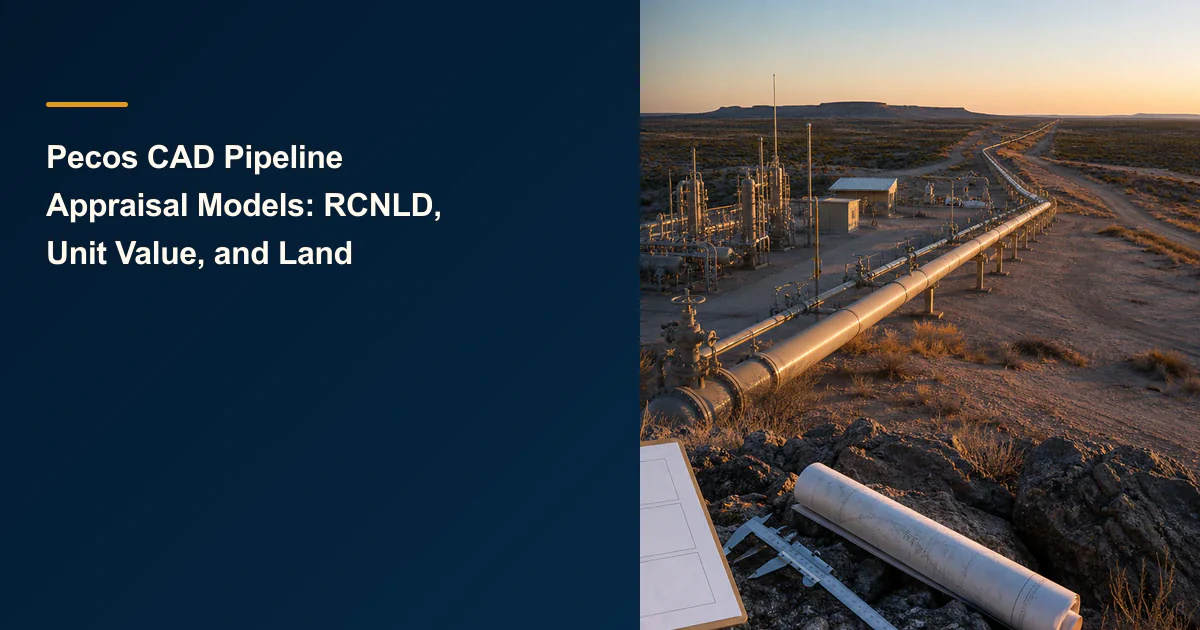
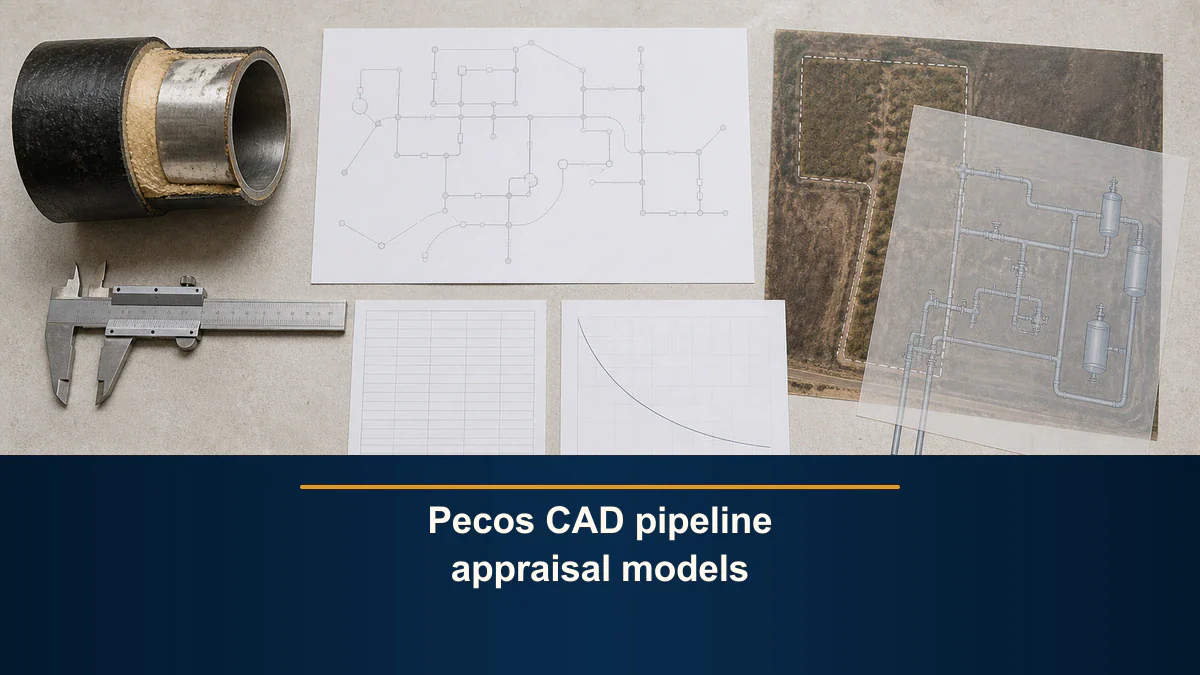
Physical pages 54 and 56 through 59 were text-extracted and visually checked against the controlled complete PDF. The people-free elevated oblique pipeline-system hero and people-free strict-overhead model-reconciliation workspace are materially different compositions. Deterministic typography adds the exact canonical title to the hero and the exact primary keyword to the separate in-body image. The hero is the canonical visible, Open Graph, Twitter, schema, featured, and share asset; the inline image is not used as a social asset.
Sources reviewed for this article
- Pecos CAD Data and Records page
- Pecos CAD 2025-2026 Reappraisal Plan
- Texas Comptroller Property Tax System Basics
- Texas Comptroller Valuing Property
Use the current official record for the exact pipeline, account, model, input, reconciliation, allocation, land treatment, and appraisal year rather than treating the general plan as the final answer.
Frequently asked questions
Where does the Pecos plan describe pipeline appraisal models?
The utility, railroad, and pipeline section begins on physical page 54. The RCNLD description is on page 56, unit-value and system allocation are on page 57, land treatment is on page 58, and the sales-review limitation is on page 59.
Does the plan say a unit-value model is used for every pipeline?
No. Physical page 57 says a unit-value model may also be used when appropriate income statements and balance sheets are available and says it is generally used for pipelines regulated as common carriers.
Does RCNLD determine a private mineral-rights value?
No. The cited section concerns utility, railroad, and pipeline operating property for ad valorem appraisal. It does not appraise a mineral interest or determine a private mineral offer.
Does the plan prove pipeline ownership or an easement value?
No. The model descriptions do not establish ownership, the terms of an easement or right of way, compensation, a boundary, or a legal conclusion.
Can this article calculate a pipeline segment tax-roll value?
No. The plan describes system reconciliation and possible component allocation, but this article supplies no property-specific inputs, allocation method, account record, appraisal result, tax rate, or calculation.
Sources reviewed for this article
Related mineral-rights articles
Pecos CAD Industrial Appraisal Limits: Title, Inspection, and Sketches
Pecos CAD's plan states assumptions and limits for industrial appraisals, including title, inspection, sketch, purpose, and hidden-condition boundaries.
Read the post →
Pecos CAD Oil and Gas Review: Infrequent Sales and Multi-Site Limits
Pecos CAD’s plan describes annual oil-and-gas appraisal review and explains why infrequent, nonpublic, bundled sales can limit appraisal-to-sales analysis.
Read the post →
Pecos CAD Oil and Gas Property Discovery: RRCID, Permit, and January 1
The Pecos plan describes an RRCID-to-permit discovery sequence and three January 1 tests, but those statements do not establish a current property result.
Read the post →
Pecos CAD 2025-2026 Reappraisal Plan: Category G Parcel Counts by ISD
The plan prints separate Category G parcel estimates for 2025 Buena Vista ISD and 2026 Fort Stockton ISD, not a county total or owner-level result.
Read the post →A practical next step
Put your mineral rights in context.
Every mineral interest, royalty history, and written offer is different. Start with a question, or share what you have for a free underwriter review.
- Free
- Confidential
- No obligation to sell
Ready for a closer look?
Open the Texas Mineral Rights GuideGet a directional range with the assumptions clearly stated.
