
MRX Learning Center
Pecos CAD Industrial Appraisal Limits: Title, Inspection, and Sketches
Pecos CAD's plan states assumptions and limits for industrial appraisals, including title, inspection, sketch, purpose, and hidden-condition boundaries.
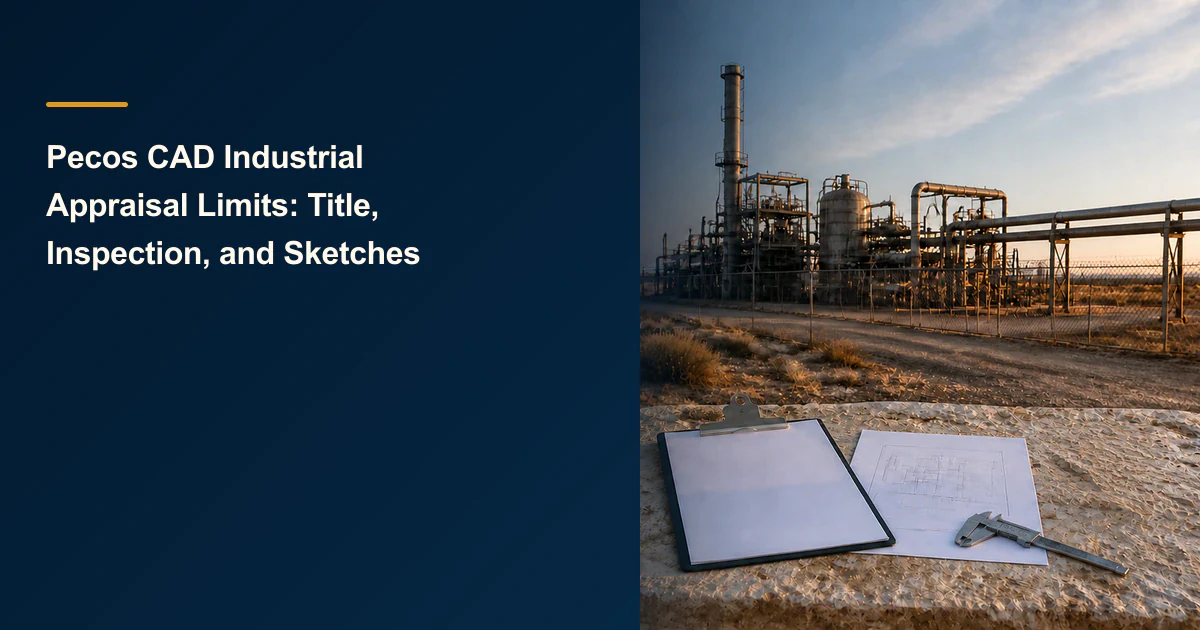
Direct answer for mineral owners
Pecos CAD's industrial section assumes title and legal-description facts, does not necessarily inspect every property annually, and treats sketches as visual aids, not proof of title, inspection, survey, engineering, or hidden conditions.
Key takeaways for mineral owners
- The controlled plan PDF is 971,223 bytes with SHA-256 c95d84641a0d024c04b9d8ba491e5972085b29a05a9aba4038128d78e8e12d01.
- Physical page 48 limits the industrial section to processing facilities and related personal property; it is separate from the plan’s oil-and-gas reserve section.
- Physical page 49 assumes title and legal-description facts and disregards liens and encumbrances for appraisal purposes; it does not prove those facts.
- The plan says every property is not necessarily inspected every year and that appraisal sketches are visual aids rather than surveys or engineering reports unless specified.
- The plan limits hidden-condition representations and says the appraisals were prepared exclusively for ad valorem tax purposes.
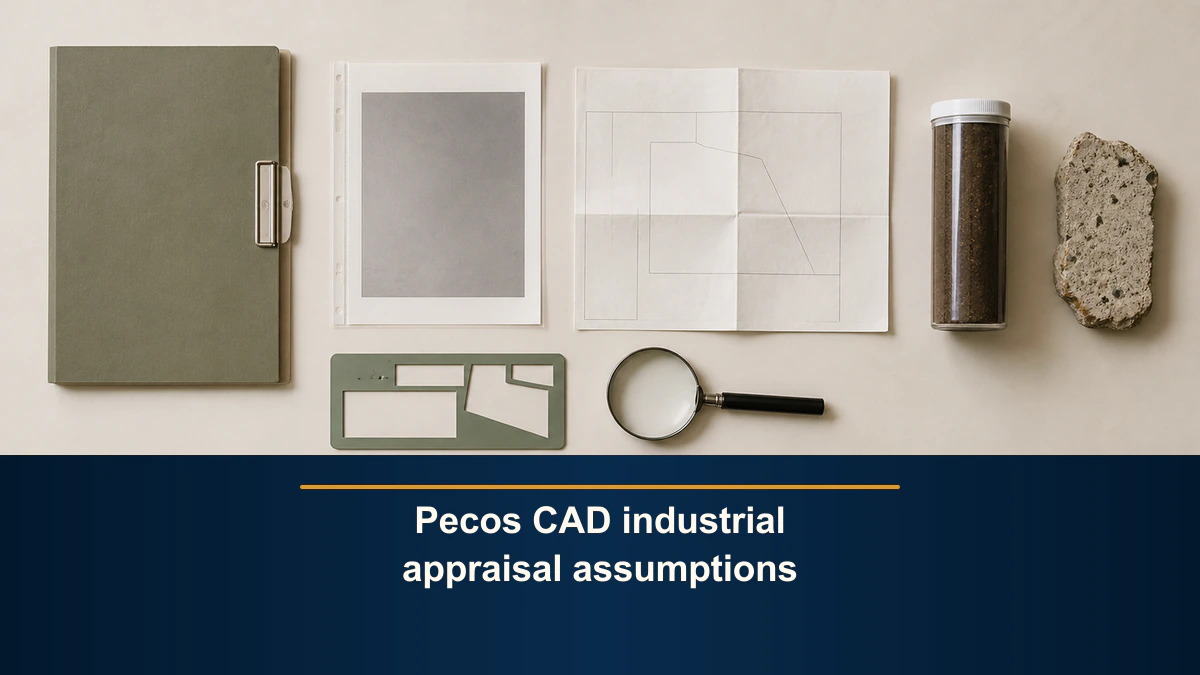
Industrial-plan source guide, not proof of a property fact. This article records the assumptions and limiting conditions on physical page 49 of Pecos County Appraisal District’s 2025-2026 Reappraisal Plan. It does not establish title, a legal description, the absence of liens, an inspection, a boundary, an engineering conclusion, a hidden condition, a mineral-interest value, a tax or protest position, or a transaction result. MRX provides educational information and resources only and does not buy mineral rights.
The direct answer is: Pecos CAD’s industrial appraisal section tells readers not to treat the appraisal record as proof of title, inspection, surveying, engineering, or hidden conditions. The plan assumes title and legal-description facts, says every property is not necessarily inspected each year, and calls sketches visual aids rather than surveys or engineering reports unless otherwise specified.
That is also an industrial-property section. The plan defines its scope as processing facilities and related personal property. It is not the oil-and-gas reserve section and should not be applied to a mineral interest.
Direct answer: what the industrial record does not prove
| Plan statement on physical page 49 | Safe reading | Do not infer |
|---|---|---|
| Title and legal description are assumed | The appraisal proceeds from stated assumptions. | Proven title, a title opinion, or a confirmed legal description. |
| Liens and encumbrances are disregarded | The appraisal treats the property as free and clear for its stated purpose. | That no lien, mortgage, or encumbrance exists. |
| Every property is not necessarily inspected yearly | Inspection frequency cannot be established from the appraisal record alone. | That a named property was or was not inspected in a named year. |
| Sketches are visual aids | A sketch can help a reader understand the appraisal document. | A survey, boundary determination, dimension certification, or engineering report. |
| Appraisals are for ad valorem tax purposes | The record belongs to the local taxable-property appraisal process. | A private mineral value, transaction opinion, or investment conclusion. |
| Hidden conditions cannot be personally observed | The plan limits representations about subsurface and concealed structural facts. | A clean condition finding or an engineering conclusion about hidden items. |
The official Pecos CAD Data and Records page routes readers to the 2025-2026 Reappraisal Plan PDF. The observations below stay inside that controlled document.
Bind the file and section before interpreting a statement
The controlled PDF retrieved for this review is 971,223 bytes with SHA-256 c95d84641a0d024c04b9d8ba491e5972085b29a05a9aba4038128d78e8e12d01. It is unencrypted, contains no embedded JavaScript, and has 75 physical pages. File identity makes the source reproducible; it does not prove that a plan statement was implemented for a named property.
Physical page 48 begins the Industrial Property report. Its overview defines industrial property as processing facilities and related personal property. Physical page 49 is labeled Industrial Property Page 2 and lists eight assumptions and limiting conditions. That scope control matters for mineral owners: an industrial record may sit near oil-and-gas records in the same county system without answering the same appraisal question.
For the oil-and-gas review section, use Pecos CAD Oil and Gas Review: Infrequent Sales and Multi-Site Limits. For the plan’s discovery sequence, use Pecos CAD Oil and Gas Property Discovery: RRCID, Permit, and January 1.
“Title is assumed” is not a title finding
Item 1 says title to the property is assumed to be good and marketable and the legal description correct. The verb matters: assumed is not verified.
Item 2 adds that no responsibility for legal matters is assumed. It says liens, mortgages, and other encumbrances are disregarded and the property is appraised as though free and clear. That establishes an appraisal premise, not the real-world absence of a recorded or unrecorded burden.
Keep three records separate:
- the appraisal record and its stated assumptions;
- the current deed, conveyance, reservation, assignment, probate, or other ownership chain; and
- any title examination or legal opinion prepared for the actual question.
This article does not examine any of those property-specific records or decide which one controls.
“Not necessarily inspected every year” leaves the date unresolved
Item 4 says the appraisers do not necessarily inspect every property every year. It does not say that no properties are inspected, that one named property was skipped, or that an old observation controls a current result.
If inspection timing matters, record the exact property, the exact appraisal year, the official source of the claimed date, and what the source says was inspected. Stop if the date or scope cannot be tied to the named property. A general plan statement cannot fill that gap.
The Texas Comptroller’s Property Tax System Basics page explains that appraisal districts appraise local property values and directs readers to the local district for local appraisal-process details. That general responsibility does not prove a Pecos inspection date.
A sketch can orient a reader without establishing a boundary
Item 5 says appraisal-document sketches are intended as visual aids and should not be construed as surveys or engineering reports unless otherwise specified. Preserve both halves of the statement:
- the default role is visual aid; and
- a different role requires the document to specify it.
Do not use an ordinary appraisal sketch to certify acreage, establish a boundary, locate an easement, prove a facility dimension, or make a structural conclusion. Those questions require the relevant current official record and, when needed, an appropriately qualified professional.
Hidden conditions remain outside ordinary observation
Item 8 says appraisers inspect improvements as far as possible by observation, then limits what can be personally observed beneath the soil or within hidden structural components. It says no representations are made about those matters unless an individual appraisal specifically considers them.
That is a source limitation, not a warning that a defect exists. It supports neither a clean-condition conclusion nor an adverse-condition conclusion. Record the hidden-condition question as unresolved until property-specific evidence addresses it.
Ad valorem purpose is not a private mineral valuation
Item 7 says the appraisals were prepared exclusively for ad valorem tax purposes. The Texas Comptroller’s Valuing Property page explains the statewide taxable-property context, including January 1 valuation timing, mass appraisal, and common cost, income, and sales-comparison approaches.
That context does not turn an industrial appraisal record into a private mineral acquisition valuation. A private mineral question may require separate ownership, lease, production, engineering, price, timing, risk, market, buyer, and transaction evidence. None is supplied by the industrial assumptions page.
A four-question separation worksheet
Before relying on an industrial appraisal record for a different question, write down:
| Verification question | Evidence needed | Stop condition |
|---|---|---|
| What property type? | The section, account category, and property actually covered. | Stop if industrial and oil-and-gas scopes are being mixed. |
| What fact is assumed? | The exact statement and whether it is an assumption or finding. | Stop if an assumption is being presented as verified fact. |
| What work occurred? | Property-specific date, scope, method, and official record. | Stop if inspection, survey, or engineering work cannot be shown. |
| What purpose applies? | The stated appraisal purpose and the question being asked. | Stop if an ad valorem record is being used as a private value opinion. |
This worksheet is an evidence-separation aid. It does not establish title, direct an appraiser, interpret a survey, provide an engineering opinion, calculate tax, or determine a mineral value.
Evidence claim ledger and source status
| Claim ID | Evidence label | Controlled observation | Boundary |
|---|---|---|---|
| C290-01 | ROUTING-ONLY | The current Pecos Data and Records page links the 2025-2026 Reappraisal Plan. | Routing does not prove a plan step or property result. |
| C290-02 | VERIFIED-OBSERVATION | The controlled PDF is 971,223 bytes, SHA-256 c95d84...12d01, unencrypted, without JavaScript, and 75 pages. | File identity does not validate a statement. |
| C290-03 | SCOPE-LIMITATION | Physical page 48 defines industrial property as processing facilities and related personal property. | The industrial section is not applied to a mineral interest. |
| C290-04 | SOURCE-ASSUMPTION | Physical page 49 assumes good and marketable title and a correct legal description. | The assumption is not title proof or a legal opinion. |
| C290-05 | SOURCE-ASSUMPTION | Physical page 49 disregards liens, mortgages, and encumbrances for the appraisal premise. | The statement does not establish that no encumbrance exists. |
| C290-06 | SOURCE-LIMITATION | Physical page 49 says appraisers do not necessarily inspect every property every year. | No property-specific inspection conclusion is inferred. |
| C290-07 | SOURCE-LIMITATION | Physical page 49 calls sketches visual aids, not surveys or engineering reports unless specified. | No boundary, dimension, survey, or engineering conclusion is inferred. |
| C290-08 | PURPOSE-LIMITATION | Physical page 49 says the appraisals were prepared exclusively for ad valorem tax purposes. | The record is not a private mineral value or transaction opinion. |
| C290-09 | SOURCE-LIMITATION | Physical page 49 limits representations about subsurface and hidden structural conditions. | Neither a clean nor adverse hidden-condition conclusion is inferred. |
| C290-10 | GENERAL-CONTEXT | Comptroller materials describe local appraisal responsibility, January 1 timing, mass appraisal, and common approaches. | Statewide context does not validate the Pecos plan or determine a property-specific result. |
Retrieval, originality, and creative evidence
The rejected risk-checklist identity is not published. The replacement title and slug were absent before implementation. The nearest current canonical title is Pecos CAD Oil and Gas Review: Infrequent Sales and Multi-Site Limits at token-Jaccard 0.2500. That article owns oil-and-gas review and sparse or bundled sales limits; this article owns the industrial assumptions section only.
Physical page 49 was text-extracted and visually checked against the controlled complete PDF. The people-free oblique industrial evidence hero and people-free strict-overhead evidence-limit workspace are materially different compositions. Deterministic typography adds the exact canonical title to the hero and the exact primary keyword to the separate in-body image. The hero is the canonical visible, Open Graph, Twitter, schema, featured, and share asset; the inline image is not used as a social asset.
Sources reviewed for this article
- Pecos CAD Data and Records page
- Pecos CAD 2025-2026 Reappraisal Plan
- Texas Comptroller Property Tax System Basics
- Texas Comptroller Valuing Property
Use the current official record for the exact property, appraisal year, title, inspection, sketch, condition, and purpose rather than treating the plan as the final answer.
Frequently asked questions
Where are the Pecos industrial appraisal assumptions listed?
They appear on physical page 49 of the 75-page 2025-2026 Reappraisal Plan, labeled Industrial Property Page 2.
Does the plan prove that industrial title is good and marketable?
No. Physical page 49 states that good and marketable title and a correct legal description are assumptions. An assumption is not title evidence or a title opinion.
Does an appraisal record prove the property was inspected that year?
No. The industrial assumptions say appraisers do not necessarily inspect every property every year. A property-specific inspection date requires separate official evidence.
Can an appraisal sketch replace a survey or engineering report?
No. The plan calls sketches visual aids and says they should not be construed as surveys or engineering reports unless otherwise specified.
Does the industrial section determine a private mineral value?
No. It concerns processing facilities and related personal property and says the appraisals were prepared exclusively for ad valorem tax purposes.
Sources reviewed for this article
Related mineral-rights articles
Pecos CAD Oil and Gas Review: Infrequent Sales and Multi-Site Limits
Pecos CAD’s plan describes annual oil-and-gas appraisal review and explains why infrequent, nonpublic, bundled sales can limit appraisal-to-sales analysis.
Read the post →
Pecos CAD Oil and Gas Property Discovery: RRCID, Permit, and January 1
The Pecos plan describes an RRCID-to-permit discovery sequence and three January 1 tests, but those statements do not establish a current property result.
Read the post →
Pecos CAD 2025-2026 Reappraisal Plan: Category G Parcel Counts by ISD
The plan prints separate Category G parcel estimates for 2025 Buena Vista ISD and 2026 Fort Stockton ISD, not a county total or owner-level result.
Read the post →
Pecos CAD Pipeline Appraisal Models: RCNLD, Unit Value, and Land
Pecos CAD's plan describes a pipeline RCNLD baseline, a conditional whole-system unit-value route, component allocation, and separate land treatment.
Read the post →A practical next step
Put your mineral rights in context.
Every mineral interest, royalty history, and written offer is different. Start with a question, or share what you have for a free underwriter review.
- Free
- Confidential
- No obligation to sell
Ready for a closer look?
Open the Texas Mineral Rights GuideGet a directional range with the assumptions clearly stated.
