
MRX Learning Center
How Much Are Mineral Rights Worth: Due Diligence Step By Step
A defensible directional range begins with a defined interest, matched evidence, explicit stop conditions, and assumptions that remain visible through every step.

Direct answer for mineral owners
To review what mineral rights may be worth, first define the exact interest and question. Then match ownership and payment records, reconcile reported production, classify development evidence, state market and model assumptions, preserve unresolved items, and document a directional range. Stop for legal, title, tax, accounting, engineering, reserve, or appraisal help when the evidence requires it.
Key takeaways for mineral owners
- Define the tract, depths, interest type, review date, and purpose before discussing value.
- Use match keys to connect owner records, county records, payor statements, production, wells, and permits without assuming they describe the same interest.
- Pause when a material ownership, decimal, payment, production, development, or assumption conflict cannot be resolved from the available evidence.
- Present a bounded directional range with assumptions, sensitivities, exclusions, and specialist handoffs instead of a guaranteed answer.
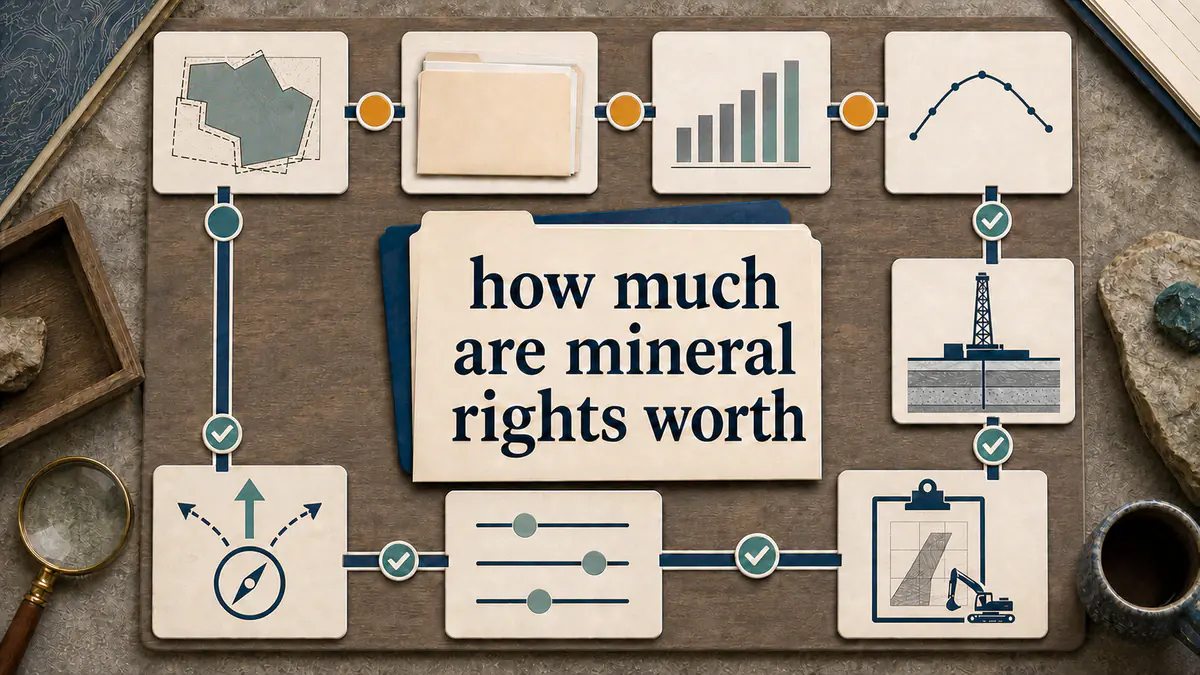
Educational workflow scope. This article orders the evidence used in a directional mineral-rights review. It does not determine title, ownership, payment entitlement, reserves, legal effect, tax treatment, well economics, market value, or the outcome of a transaction. It is not a title opinion, legal opinion, owner-specific tax conclusion, payment audit, reserve report, engineering conclusion, appraisal engagement, financial plan, or transaction recommendation. MRX provides educational information and resources only and does not buy mineral rights.
The short answer is to define the interest, match the records, test the producing and development evidence, state the assumptions, and keep every unresolved item visible. A useful result is not one precise number. It is a directional range tied to a defined interest, a review date, named evidence, stated scenarios, and clear limits.
This workflow is sequential because later steps depend on earlier ones. A production curve cannot repair a tract mismatch. A nearby permit cannot establish that an owner participates in the permitted well. A current value range cannot answer a tax-basis question. When a material input does not pass its checkpoint, pause, narrow the scope, or route the question to the right specialist.
The companion 2026 due-diligence guide explains how to test the freshness of each input. This article owns the order of work.
Step 1: define the interest and the review question
Start by writing one scope sentence. It should identify the owner or ownership vehicle, state and county, tract or legal-description reference, relevant depths or formations if known, interest type, producing status, review effective date, and purpose.
The purpose matters because different questions need different evidence. Examples include:
- estimating a directional range for a defined mineral or royalty interest;
- understanding why royalty cash flow changed;
- comparing the economic terms of a written offer;
- organizing records after an inheritance or trust transfer; or
- preparing questions for a lawyer, accountant, engineer, appraiser, or tax professional.
Do not combine those questions into one undefined request. A directional value review can support them, but it cannot silently become a title examination, payment audit, reserve report, tax calculation, or appraisal.
Checkpoint: Can the reviewed interest and the question be described without guessing? If not, stop or mark the exact assumption that limits the remaining work.
Step 2: build the match-key sheet
Before interpreting any document, collect the identifiers that may connect it to other evidence. Useful match keys can include:
- county, survey, abstract, section, block, tract, and legal-description language;
- operator, payor, lease or property name, well number, API number, oil lease number, or gas ID;
- product, statement period, production month, sales month, and adjustment period;
- owner name or entity, interest type, owner decimal, and effective dates; and
- deed recording reference, probate reference, lease date, division-order reference, or other document locator.
Do not publish private owner data or force two records together because their names look similar. Spelling differences, operator changes, pooled units, amended designations, multiple completions, and different accounting identifiers can create legitimate mismatches.
The RRC explains that its oil and gas data queries are different slices of a larger system. A wellbore can contain more than one completion, and wellbore, completion, lease, permit, field, operator, and production identifiers are not interchangeable.
Checkpoint: Are the records linked by sufficient identifiers and dates? If not, keep them separate until the match is supported.
Step 3: organize the ownership evidence
Create a chronology of the documents that appear to affect the interest. This can include deeds, mineral or royalty conveyances, reservations, leases, assignments, probate documents, trust documents, and division orders. Record what each document says, what it appears to cover, and which question remains unresolved.
The Texas State Library property-research guide explains that real-property records such as deeds, surveys, liens, and tax records are maintained by the county where the property is located. It also notes that online access and older-record handling vary by county.
That makes county records an important source class, not an automatic title conclusion. The absence of an online image does not prove that no record exists. A recorded deed does not, by itself, resolve every reservation, depth limitation, probate event, competing description, or legal effect.
Checkpoint: Does the available record set support the interest scope used in the review? If the chain, reservation, decimal, depths, or legal effect is material and unclear, identify the assumption and route the issue to a qualified attorney or title professional.
Step 4: reconcile payment records before modeling cash flow
For a producing interest, build a statement table before drawing a decline curve. Capture the payor, property or lease identifier, product, production month, sales month, gross volume if shown, price if shown, deductions, taxes, adjustments, owner decimal, and net amount.
Then test continuity:
- Are periods missing or duplicated?
- Did the payor, operator, property identifier, product, or decimal change?
- Is an adjustment tied to a prior period?
- Are oil, gas, and natural-gas-liquids entries being mixed?
- Does the statement appear to cover one well, several wells, a lease, or another accounting unit?
This is a reconciliation step, not a payment audit. A discrepancy can identify a question without proving underpayment, ownership, or the legal meaning of a division order.
Checkpoint: Is the cash-flow history internally consistent enough for the stated purpose? If not, preserve the conflicting periods and ask the payor, accountant, auditor, or attorney the bounded question needed to resolve them.
Step 5: match reported production to the right scope
Use the official RRC research-query directory to locate production, permits, well records, and related data. Match by the available identifiers rather than by proximity or a familiar name alone.
The RRC Production Data Query System FAQ explains that Texas production is reported by lease, that online data has reporting lag, and that records can later change after revised, corrected, or delinquent reports. That creates two separate tasks:
- determine whether the public record describes the same lease or reporting unit as the owner evidence; and
- determine whether the reporting period and any later revisions are suitable for the review date.
Do not divide lease production among wells or owners unless the allocation method and evidence support it. Do not treat public reported production as proof of the owner decimal, payment entitlement, reserves, or future output.
Checkpoint: Is the production series matched, dated, and bounded to the reviewed interest? If not, use a qualified limitation or stop the production-based model.
Step 6: separate historical production from development evidence
Existing production and future development answer different questions. Historical production can support cash-flow and decline context. Development records can support scenarios, but their evidentiary weight depends on what actually occurred.
The RRC describes oil and gas well records as a history that can extend from a drilling-permit application through completion and plugging records. Its online query directory separately identifies permits, completions, wellbores, fields, operators, and production systems.
Classify each development item as observed or assumed:
- application or approved permit;
- wellbore record;
- completion report;
- initial or later reported production;
- plugging record;
- nearby activity without a supported tract-and-depth match; or
- owner, operator, or buyer statement that still needs independent support.
A permit is not a producing well. A completion report is not a guarantee of economic performance. Nearby activity is not proof that an owner participates. Keep the tract, depths, timing, and interest match visible.
Checkpoint: Does each future-development scenario name the observed event, the match evidence, and the remaining assumption? If not, remove it from the base case or label it separately.
Step 7: normalize the producing history
Once the interest, statements, and public production are matched well enough, prepare a clean historical series. Preserve the raw records, then document each transformation:
- period alignment;
- product separation;
- adjustment treatment;
- missing or conflicting periods;
- gross-to-owner cash-flow relationship if supported;
- owner-decimal changes; and
- any exclusion that materially affects the series.
Avoid smoothing away a conflict simply to make a curve look orderly. The model should carry the uncertainty created by incomplete evidence. If the available history is too short, unstable, or unmatched for a reliable trend, say so and widen or withhold the relevant scenario rather than inventing precision.
Checkpoint: Can another reviewer reproduce the normalized history from the preserved source set? If not, document or correct the transformation before modeling.
Step 8: state the cases and assumptions
The published MRX methodology identifies production history, decline context, operator and development evidence, royalty terms, commodity assumptions, discount rate, title and acreage, and written offer terms as inputs that can affect a directional range.
For each scenario, name:
- which producing interests are included;
- the production and decline treatment;
- the commodity benchmark or price assumption;
- deductions or expense treatment where relevant and supported;
- discount-rate or timing assumption;
- whether any future locations are included;
- the ownership or acreage assumption; and
- the sensitivity that changes the result most.
Use a base case only when the evidence supports one. Otherwise, present bounded alternatives. Do not hide a speculative development case inside an apparently precise range.
Checkpoint: Are all material assumptions visible, sourced where appropriate, and separated from observed facts? If not, the range is not ready to communicate.
Step 9: keep tax basis and tax planning in a separate lane
A current value range and tax basis are different records. IRS Publication 551 describes basis as the amount of investment in property used for tax computations including gain or loss on a disposition. It also explains that records affecting basis should be kept.
That does not tell a particular owner what basis applies to inherited, gifted, partitioned, partially sold, depleted, or otherwise changed mineral interests. Do not infer tax basis from a current directional range, a royalty statement, a deed recital, an appraisal-district value, or a purchase offer.
Preserve acquisition, inheritance, allocation, depletion, improvement, sale, and prior-return records that may be relevant, then ask a qualified tax professional to apply current law to the specific facts. If a transaction is contemplated, address tax structure before signing deadlines make choices irreversible.
Checkpoint: Is the value review being mistaken for a tax conclusion? If so, separate the files and obtain qualified advice before acting.
Step 10: document the range, exclusions, and handoffs
The final review packet should make it possible to understand the result without reverse engineering the model. Include:
- the exact interest and purpose reviewed;
- effective date and observed-through periods;
- evidence index and match keys;
- normalized producing history;
- observed development evidence;
- scenarios and material assumptions;
- directional range or reason a range was withheld;
- sensitivity drivers;
- unresolved items and their possible effect; and
- the specialist or source best positioned to answer each open question.
The handoff list can include a lawyer or title professional for ownership and legal effect, an accountant or tax professional for basis and tax treatment, an engineer or qualified reserves professional for technical reserve conclusions, a payment auditor for a payment claim, or a credentialed appraiser when an appraiser’s report is required.
Checkpoint: Can the reader distinguish facts, assumptions, estimates, exclusions, and professional questions? If yes, the packet can support an informed next conversation. If not, revise it before treating the result as decision-ready.
A compact stop/go review
- Interest scope: Go when the tract, depths, interest type, date, and question are defined. Stop or limit the review when a material ownership or legal-description conflict remains.
- Record matching: Go when documents and public records share supported identifiers and periods. Stop when similar names or proximity are the only match.
- Payments: Go when statement periods, products, decimals, and adjustments are traceable. Hand off when a material discrepancy needs a payor response or audit.
- Production: Go when the reporting unit, period, lag, and corrections are understood. Stop when lease data cannot be bounded to the reviewed interest.
- Development: Go when observed events and assumptions are separated. Stop when a permit, completion, or nearby activity is being treated as guaranteed production.
- Modeling: Go when material inputs, cases, sensitivities, and exclusions are visible. Stop when missing evidence is being converted into false precision.
- Tax: Go when basis records are preserved separately. Hand off when a current range is being treated as an owner-specific tax answer.
- Final packet: Go when facts, assumptions, range, limits, and handoffs are clear. Revise when another reader cannot reproduce or explain the result.
What this process can and cannot produce
This workflow can produce a transparent directional range when the available records support one. It can show which evidence drives the result, which assumptions matter most, and which unresolved questions deserve more work.
It cannot prove title, certify reserves, determine tax basis or tax liability, audit royalty payments, establish legal effect, guarantee future development, act as a credentialed appraiser, guarantee market value, or decide whether an owner should sell, hold, lease, gift, exchange, or litigate.
MRX can return a directional range with the inputs, assumptions, sensitivities, exclusions, and unresolved items stated. The review does not commit an owner or buyer to a transaction.
Frequently asked questions
What is the first step in mineral-rights valuation due diligence?
Define the interest and the question before collecting a value. Record the state and county, tract or legal-description reference, relevant depths if known, interest type, producing or nonproducing status, review effective date, and whether the owner is testing a range, a payment issue, or written offer terms. If that scope is unclear, the review should pause or proceed only with an explicit assumption.
Can county records prove that I own the mineral rights?
County records are a key source class for deeds, transfers, surveys, liens, and related filings, but an online search or one document does not by itself complete a chain-of-title analysis. Use the records to build and test the ownership story. Route unresolved legal effect, reservations, probate, or title questions to a qualified attorney or title professional.
Can Railroad Commission production be matched directly to my royalty check?
Not automatically. The RRC explains that Texas production is generally reported by lease rather than by individual well, while a royalty statement may use payor, product, property, volume, price, deduction, and owner-decimal fields. Match the identifiers and periods carefully, preserve known lag or corrections, and do not treat a difference as proof of underpayment without a payment audit.
Does a drilling permit add value to mineral rights?
A permit can be relevant development evidence, but it is not proof that a well was drilled, completed, producing, economic, attributable to the reviewed tract and depths, or included in the owner’s interest. Verify the permit and later well records, classify what is observed versus assumed, and show the uncertainty in scenarios rather than as guaranteed value.
Is tax basis part of a mineral-rights value estimate?
Tax basis and a current directional value range answer different questions. IRS Publication 551 describes basis as an amount used for tax computations such as gain or loss, while a value review estimates an asset under stated assumptions. Preserve basis records separately and ask a qualified tax professional how the rules apply to a specific ownership history or transaction.
Sources reviewed for this article
- Mineral Rights Xchange, Published DCF Methodology (accessed 2026-08-12)
- Texas State Library, Land and Property History Research (accessed 2026-08-12)
- Railroad Commission of Texas, Online Research Queries (accessed 2026-08-12)
- Railroad Commission of Texas, About Oil and Gas Data Queries (accessed 2026-08-12)
- Railroad Commission of Texas, Oil and Gas Well Records (accessed 2026-08-12)
- Railroad Commission of Texas, Production Data Query System FAQs (accessed 2026-08-12)
- Internal Revenue Service, Publication 551, Basis of Assets (accessed 2026-08-12)
Related mineral-rights articles

How Much Are Mineral Rights Worth: Due Diligence In 2026
A 2026 mineral-rights review is only as current as its effective dates, observed-through dates, source updates, correction checks, and assumption vintages.
Read the post →
How Much Are Mineral Rights Worth: Checklist For Mineral Owners
A mineral-rights worth checklist is complete enough for a directional review when the exact interest is scoped, available evidence is organized, assumptions are dated, and unresolved items are visible.
Read the post →
Texas Railroad Commission: Public Records for Mineral Rights
Use RRC records to research production, leases, operators, and permits. Investigate title separately through county instruments and qualified review.
Read the post →
How Much Are Mineral Rights Worth: Checklist Without Obligation
A no-obligation mineral-rights review should make its price, scope, commercial role, deliverable, information use, communication choices, stopping points, and optional next steps clear before an owner proceeds.
Read the post →A practical next step
Put your mineral rights in context.
Every mineral interest, royalty history, and written offer is different. Start with a question, or share what you have for a free underwriter review.
- Free
- Confidential
- No obligation to sell
Ready for a closer look?
Request a step-by-step mineral-rights reviewGet a directional range with the assumptions clearly stated.