
MRX Learning Center
How Much Are Mineral Rights Worth: Due Diligence In 2026
A 2026 mineral-rights review is only as current as its effective dates, observed-through dates, source updates, correction checks, and assumption vintages.
Direct answer for mineral owners
For 2026 due diligence, give every valuation input an effective date, source date, observed-through date, query status, correction note, and confidence label. Refresh owner statements, county records, reported production, development evidence, and commodity assumptions before relying on a range. The year is an as-of-date control, not a special legal, title, engineering, reserve, tax, or appraisal standard.
Key takeaways for mineral owners
- Treat 2026 as an as-of-date control: a current review needs dated inputs, not a year added to an old estimate.
- Record both the latest period observed and the date the source was checked because operator-reported production can lag and later change.
- Keep permit status, commodity assumptions, ownership records, and owner statements tied to named sources and vintages.
- Use a change log to decide whether a range needs an annotation, a corrected input, or a complete refresh.
Educational and effective-date scope. This article explains how to check the freshness of inputs used in a 2026 directional mineral-rights review. It does not determine title, ownership, reserves, payment entitlement, permit effect, well economics, market value, or the legal or tax consequences of an owner’s facts. It is not a title opinion, legal opinion, owner-specific tax conclusion, payment audit, reserve report, engineering conclusion, appraisal engagement, financial plan, or transaction recommendation. MRX provides educational information and resources only and does not buy mineral rights.
The short answer is that 2026 due diligence should make the age and status of every important input visible. For each item, record its effective date, source date, observed-through date, query status, correction risk, and confidence. Then decide whether the existing range can be used with a freshness note, needs one corrected input, or should be rerun.
The year does not create a special valuation, legal, title, engineering, reserve, tax, or appraisal standard. It is an as-of-date control. A document created years ago can still be relevant. A webpage checked today can still describe data that stops months earlier. “Current” should therefore be demonstrated, not assumed.
What 2026 changes: the freshness burden
A directional range represents expected cash flow under a defined scope and stated assumptions as of a particular date. Time can change several parts of that statement:
- a new royalty statement can add production, deductions, adjustments, or a different owner decimal;
- an operator can revise a previously reported production month;
- a permit can be filed, approved, amended, expire, or remain only a permit;
- a completion or production event can occur after the earlier review;
- a county record can add a conveyance, reservation, lien, probate filing, or other item that needs professional interpretation;
- a public commodity forecast or market benchmark can be replaced by a newer vintage; and
- an offer can change the exact rights, effective date, adjustment language, or obligations under review.
None of those events automatically determines value. Each can change an input, a scenario, a confidence label, or the questions that need verification.
The companion mineral-owner checklist explains which records to gather. This article asks a narrower question: are those records and assumptions fresh enough for a review dated in 2026?
Give every input a freshness card
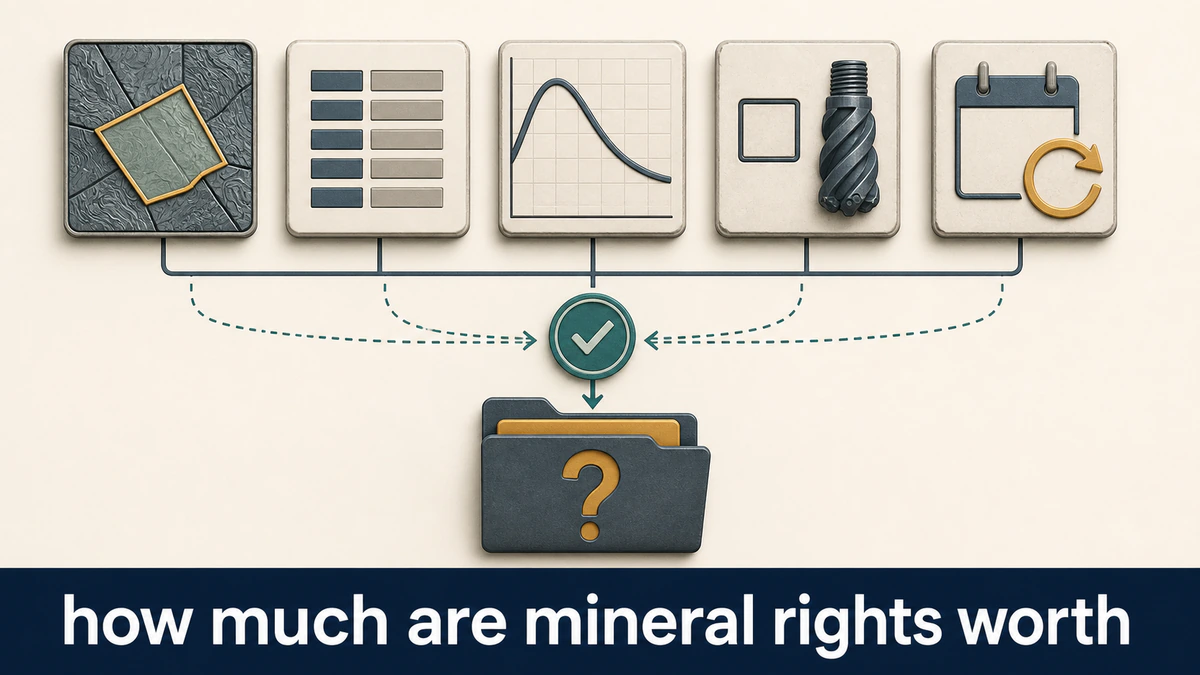
Use one small record for every material input. It should answer seven questions.
1. What is the input?
Name it narrowly. “Production” is too broad. “Operator-reported oil production for the matched lease through the latest visible month” is more useful. “Ownership” is too broad. “The fractional interest assumed from the documents currently available for the identified tract and depths” is clearer.
2. What is the review effective date?
This is the date the range is intended to describe. It is not necessarily the date a document was signed, a query was run, or a forecast was published. Put the review date at the top of the file so later readers do not mistake an older range for a current one.
3. What period is actually observed?
A source accessed in August can stop in June or earlier. Record the latest production month, payment period, filing date, or status date visible in the source. This is the observed-through date.
4. When was the source checked?
Record the access or query date separately. It establishes when the reviewer saw the result. It does not convert an older observed period into current data.
5. What is the source and match key?
Name the owner statement, county record office, RRC query, operator filing, EIA release, or other source. Keep the tract, lease, well, API, operator, payor, product, and owner identifiers used for the match, without publishing private owner data.
6. Can the record change later?
Label sources that accept revisions, corrections, amendments, or delinquent filings. A later change does not prove an earlier review was careless. It does mean a current use may require a refresh.
7. What is the confidence and next check?
Use bounded labels such as current for stated period, current query with lag, superseded, conflicting, owner confirmation needed, or professional review needed. Add the next source or event that would resolve the limitation.
Six 2026 freshness audits
Audit 1: ownership and tract scope
Start with the interest the range is supposed to cover. Record the county, tract or survey description, rights type, fractional scope, depths or formations when relevant, and the documents supporting the assumption.
The Texas State Library explains that real-property records, including deeds, surveys, liens, and tax records, are maintained by the county where the property is located. It also notes that county availability and treatment of older records differ. A current online search can therefore be a useful source check without proving that the search was exhaustive.
For a 2026 freshness card, record:
- county and record source checked;
- access date and visible filing date;
- grantor, grantee, instrument, volume/page, or other locator used internally;
- whether the document concerns the same tract, interest type, and depth scope;
- any later transfer, reservation, estate, trust, entity, lien, or curative item observed; and
- whether a qualified attorney, land professional, or other appropriate specialist must interpret chain of title or legal effect.
Do not promote found online today into title proved today. Source freshness and legal sufficiency are different questions.
Audit 2: owner payment evidence
Owner statements often show the freshest property-specific cash-flow evidence, but they also need date controls. Record the statement period, payor, property or lease identifier, product, volumes when shown, price basis when shown, deductions, taxes, adjustments, suspense notes, and owner decimal as owner-provided evidence.
Then compare the latest statement with the earlier review:
- Did a new month appear?
- Did a prior period receive an adjustment?
- Did the payor, property identifier, product, or owner decimal change?
- Did the check include a one-time item that should not be treated as recurring cash flow?
- Does the statement need to be matched to a different lease or operator record?
The task is not to decide whether the payment is legally correct. It is to prevent a stale or exceptional payment from silently becoming a normal forward assumption.
Audit 3: reported production and correction status
The Railroad Commission of Texas says its production compilations and summaries use information reported by Texas operators. Its Production Data Query FAQ adds three important timing controls:
- Texas production is generally reported by lease rather than by individual oil well.
- Online production information has a two-month lag.
- Records can change when operators submit revised, corrected, or delinquent reports, and historical records become substantially complete only after additional time.
That means a 2026 production note should include more than a screenshot date. Record:
- the lease, field, operator, district, county, or other query scope;
- the latest production month visible;
- the date the query was run;
- whether recent months are inside the stated lag window;
- whether a previously used month changed;
- whether the record is lease-level or well-level context; and
- whether the owner statement and public record are matched to the same interest.
Do not fill the lag window with zeroes. Do not assume a later correction belongs to one particular well or owner. Keep not yet visible, reported zero, unmatched, and corrected later as separate states.
Audit 4: development evidence and permit status
The RRC research directory links official queries for drilling permits, well records, completions, production, and related records. It also identifies update cadences for several systems, including nightly updates for drilling-permit and completion queries.
The W-1 drilling-permit query lets a user filter by status, operator, lease, well, field, county, API number, submitted date, approved date, amendment status, and other criteria. Those fields make the query useful as dated development evidence.
They do not collapse the development chain. Keep these states distinct:
- application submitted;
- permit pending;
- permit approved;
- permit amended;
- permit expired or otherwise no longer current;
- well spudded;
- completion filed;
- production reported; and
- owner payment observed.
An approved permit does not prove that a well was drilled, completed, productive, economic, inside the relevant depth or tract scope, or attributable to an owner’s payment. Record the query date and status, then wait for the appropriate later evidence before changing the state.
Audit 5: commodity and economic assumption vintage
MRX’s published methodology says a directional review should state its production, decline, royalty, commodity, discount-rate, title-confidence, and offer assumptions. A 2026 review should also state when a time-sensitive assumption was observed.
The U.S. Energy Information Administration’s Short-Term Energy Outlook makes the point plainly. The live page displays a release date, forecast-completion date, next release date, current assumptions, and changes from the prior release. On August 12, 2026, the page identified an August 11 release completed August 6 and compared selected current projections with the July vintage.
The lesson is not that an EIA figure belongs automatically in a property model. It is that a forecast has a vintage and can change.
For every commodity assumption, record:
- named benchmark or source;
- observation or release date;
- curve, strip, flat case, or scenario treatment;
- products and differentials represented;
- whether the figure is nominal or adjusted in another stated way;
- whether a later vintage materially changed the scenario; and
- the exact assumption actually used in the review.
Do not describe a current forecast as a fact about future property revenue. Show the base assumption and relevant sensitivities instead.
Audit 6: range scope and later transaction evidence
A directional range and a transaction proposal can have different effective dates and scopes. If an offer exists, record its date, expiration language, proposed buyer, rights and depths described, price structure, adjustments, post-close obligations, and documents incorporated by reference.
Then keep three questions separate:
- Is the underlying property and cash-flow range current?
- Is the offer still open and accurately transcribed?
- Do the written agreement terms change what is actually proposed?
A new offer may justify refreshing the comparison even when production did not change. A new production month may justify refreshing the range even when no offer exists. Neither event tells an owner what decision to make.
Build a one-page 2026 change log
The change log should make revision visible without becoming a second model. For each material item, record:
- input name;
- prior source and observed-through date;
- current source and observed-through date;
- current query or access date;
- change observed;
- likely model area affected;
- confidence or unresolved match issue;
- action:
no change,annotate,correct input,rerun scenario,rerun range, orprofessional review; and - reviewer and review date.
Describe direction only when supported. For example, a corrected production month may affect the decline history, but its net effect on a range depends on the complete model. A new permit may affect development context, but it does not create a guaranteed future location or payment.
Decide whether to annotate, correct, or rerun
Annotate the existing range
An annotation may be enough when the new information does not change a material input, the source simply confirms the earlier scope, or the latest period remains inside a clearly stated reporting lag. State what was checked and why the range was not rerun.
Correct one input
Correct the record when a transcription, identifier, product, month, assumption label, or source reference was wrong but the surrounding model remains valid. Preserve the prior value and correction date so the history stays auditable.
Rerun a scenario
Rerun a scenario when a time-sensitive assumption changes but the property scope and core evidence remain stable. Commodity benchmark vintage and timing assumptions are common examples. Keep the prior and current scenario labels distinct.
Rerun the directional range
A fuller refresh may be appropriate when ownership scope changes, material production history is revised, a new completion or sustained production record changes the operating context, a prior match is invalid, or several assumptions move together.
Escalate for professional review
Use the appropriate qualified professional when the issue turns on chain of title, deed or agreement interpretation, owner-specific tax consequences, reserve certification, engineering work, accounting treatment, or a regulated valuation purpose. Fresh source data does not remove the need for the right professional scope.
What 2026 due diligence does not prove
Current does not mean complete
A source can be current for its stated update cycle and still omit a later event, an older record, a different identifier, or owner information outside that system.
Official does not mean owner matched
An official production or permit record can describe a lease, well, or application without proving that it belongs in a specific owner’s range.
Recent does not mean recurring
A recent royalty statement can contain an adjustment, catch-up payment, one-time item, or correction. Preserve its character before using it as a forward baseline.
Approved does not mean completed
A permit approval is not a completion report, production record, reserve report, or owner payment.
Forecast does not mean outcome
A federal forecast or public benchmark provides a dated market assumption. It does not predict a particular tract, well, royalty check, offer, or sale result.
Directional does not mean regulated certification
A directional underwriter range with assumptions stated can support questions and comparisons. It does not become a regulated valuation certification because the inputs were refreshed.
Bounded next steps for mineral owners
Before relying on an older range, attach a 2026 freshness card to each material input and complete the change log. If the scope is correct and the source gaps are understood, request a current mineral-rights review. Provide the prior range date, the latest owner statements you are authorized to share, and the identifiers used to match public records.MRX can return a directional range with the inputs and assumptions stated. The review does not prove title, certify reserves, audit payments, provide legal guidance or an owner-specific tax conclusion, complete an appraisal engagement, guarantee value, or commit an owner or buyer to a transaction.
Frequently asked questions
Does 2026 use a different mineral-rights valuation method?
Not by itself. The year identifies the review’s timing. A 2026 review still needs a defined interest, dated evidence, stated assumptions, and an effective date. The important control is whether the inputs and sources are current enough for the question being asked, not whether the title contains the current year.
How current is Texas Railroad Commission production data?
The RRC says online production information has a two-month lag because operators report the prior month at the end of the next month. It also says records can change after revised, corrected, or delinquent reports and become substantially complete only after additional time. Record the latest production month observed, the query date, and any later refresh.
Does an approved drilling permit prove future mineral-rights value?
No. A permit is dated development evidence. It does not by itself prove that a well was drilled, completed, producing, economically successful, inside the owner’s relevant interest, or included in a future payment. Preserve the permit status and query date, then verify later events separately.
Should an EIA forecast be copied directly into a mineral-rights model?
Not automatically. EIA’s outlook is useful evidence that forecasts have release dates, completion dates, assumptions, and revisions. The review should name the benchmark and vintage actually used and show relevant scenarios. A public forecast does not guarantee a property-specific price path or value.
When should a mineral-rights range be refreshed?
Refresh or annotate it when a new owner statement arrives, reported production is corrected, ownership scope changes, a material permit or completion status changes, the commodity benchmark or model assumptions change, a new offer changes the rights under review, or the range will support a later material decision.
Sources reviewed for this article
- Mineral Rights Xchange, Published DCF Methodology (accessed 2026-08-12)
- Railroad Commission of Texas, Production Data (accessed 2026-08-12)
- Railroad Commission of Texas, Production Data Query System FAQs (accessed 2026-08-12)
- Railroad Commission of Texas, Online Research Queries (accessed 2026-08-12)
- Railroad Commission of Texas, Drilling Permit W-1 Query (accessed 2026-08-12)
- Texas State Library, Land and Property History Research (accessed 2026-08-12)
- U.S. Energy Information Administration, Short-Term Energy Outlook (accessed 2026-08-12)
Related mineral-rights articles

How Much Are Mineral Rights Worth: Checklist For Mineral Owners
A mineral-rights worth checklist is complete enough for a directional review when the exact interest is scoped, available evidence is organized, assumptions are dated, and unresolved items are visible.
Read the post →
Oil Prices and Texas Mineral Rights Value
Oil prices can change royalty revenue quickly, but owners still need production, lease, and ownership records before drawing value conclusions.
Read the post →
Texas Railroad Commission: Public Records for Mineral Rights
Use RRC records to research production, leases, operators, and permits. Investigate title separately through county instruments and qualified review.
Read the post →
How Much Are Mineral Rights Worth: Due Diligence Step By Step
A defensible directional range begins with a defined interest, matched evidence, explicit stop conditions, and assumptions that remain visible through every step.
Read the post →A practical next step
Put your mineral rights in context.
Every mineral interest, royalty history, and written offer is different. Start with a question, or share what you have for a free underwriter review.
- Free
- Confidential
- No obligation to sell
Ready for a closer look?
Request a current mineral-rights reviewGet a directional range with the assumptions clearly stated.