
MRX Learning Center
Texas Railroad Commission: Public Records for Mineral Rights
Use RRC records to research production, leases, operators, and permits. Investigate title separately through county instruments and qualified review.

Direct answer for mineral owners
The Texas Railroad Commission publishes free public records for wells, permits, operators, leases, and production. RRC records are inputs for mineral-rights research; county instruments help investigate title, and owner-specific conclusions may require qualified review. MRX uses RRC data as one of several inputs in its disclosed valuation methodology.
Key takeaways for mineral owners
- The Texas Railroad Commission (RRC) publishes well, lease, operator, permit, and production records online at no cost; it does not publish ownership or title records.
- RRC records help verify what is happening on or near your acreage; recorded county instruments are used to investigate the chain of title, and complex ownership questions may require a qualified title professional.
- RRC data is one input to MRX directional reviews, alongside the lease, division order, royalty statements, and county records; it is not by itself a valuation.
- Public RRC queries work best when paired with a specific county, section, block, or operator name and a date range for the production or permit record of interest.
- Use public production records to frame questions; an owner’s payment decimal depends on separate ownership, lease, and allocation evidence.
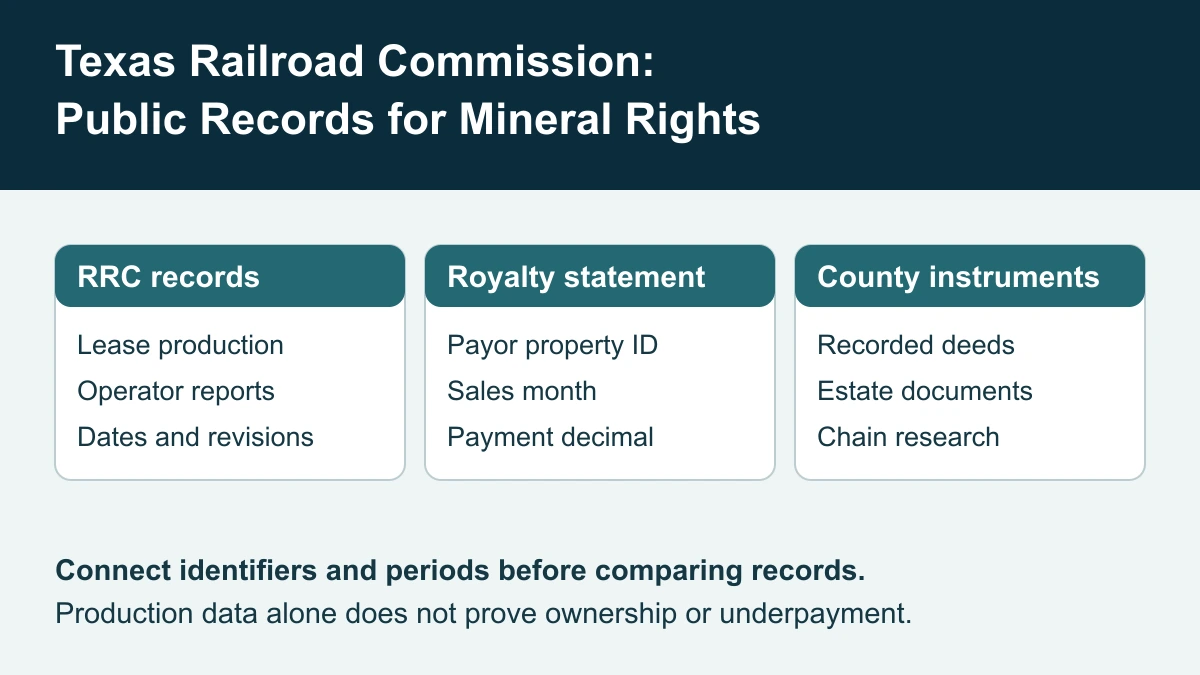
How Texas mineral-rights owners use Railroad Commission public records
The Texas Railroad Commission (RRC) maintains public records that owners and reviewers can use to understand what is happening on or near a mineral interest. Those records describe wells, drilling permits, completions, operators, leases, and reported production. They do not establish who owns the minerals, and they are not a valuation on their own. They are useful, dated inputs that complement the county deed records, the lease, the division order, and the royalty statements.
This article describes what the RRC publishes, what it does not, and how an owner can combine RRC records with county records to assemble a fuller picture of a mineral interest. It also explains how MRX uses RRC data as one of several inputs in its directional reviews, and where a qualified land, title, or tax professional should be consulted.
What the Texas Railroad Commission publishes
The RRC is the state agency that regulates oil and gas activity in Texas. Among other duties, it collects and publishes records that the public can search online. The RRC publishes:
- Production records. Lease-level oil and gas production totals and broader summaries, available through the RRC production-data page and the online research query portal.
- Permit and drilling-permit records. Drilling permit applications and dispositions, organized by operator, well, and county.
- Well records. Completion reports, plug records, and other well-bore records available through the RRC research portal.
- Operator and organization records. Operator names, organization filings, and compliance history.
- Lease-level records. Lease names and identifiers as reported by operators, useful for locating the relevant production record once its connection to the owner’s documents is established.
Online research queries are free; some historical copies or bulk datasets may have fees. Preserve the fields each record actually displays and the retrieval date. Missing identifiers or unclear matches should remain unresolved.
What the RRC does not publish
The RRC does not publish:
- Mineral ownership records. Recorded deeds, probate or estate instruments, and other chain-of-title documents are reviewed in the county where the land lies. Leases and division orders answer related contract and payment questions, but the RRC has no ownership file that proves what an owner owns.
- Royalty fractions or net-revenue-interest decimals. The royalty share is set in the lease and shown on the division order, and the RRC does not centrally publish these figures for owners.
- Certified valuations. RRC data shows production; it does not produce a market value for the underlying mineral interest.
If a question is about ownership, royalty share, or value, RRC public records are an input, not an answer.
How to assemble an owner-research file using RRC data
A practical research file pairs RRC public data with the documents used to investigate ownership and explain payment. The order below is a common starting point; the actual records available for any given tract depend on its location, age, and lease status.
- Identify the tract. Confirm the county, survey, abstract, or block where the interest sits using the county deed records or an existing deed.
- Retrieve lease-level production. Use the RRC query for the identified lease. Oil-lease totals may combine several wells, and reported totals can arrive late or be revised. See the RRC production-query explanation. Record the RRC identifier separately from the payor’s property number; they may differ. Ask the payor for the connection when uncertain.
- Pull RRC permit and completion records. Match the wells to drilling permits and completion reports to see when each well was drilled, completed, and (if applicable) plugged.
- Cross-check operator history. Compare the operator on the RRC records to the operator paying royalties. A difference can indicate a change in operator that may not yet be reflected in the owner’s records.
- Compare like periods and reporting levels. Keep the division-order decimal, royalty statement, and RRC production record separate. Check the property identifier, product, production versus sales month, lease aggregation, and revisions before treating a difference as a payment question. RRC data does not verify an owner’s decimal or establish underpayment. The RRC royalties FAQ explains its records and the limits of its authority over royalty disputes.
- Investigate the recorded chain through the county. Review the recorded deeds and probate or estate instruments tied to the property. A qualified land or title professional can examine the chain of conveyances where the records are complex or incomplete.
How MRX uses RRC records in its reviews
MRX’s published methodology describes how it assembles a directional mineral-rights review from public data and owner-provided documents. Among other inputs, MRX uses RRC production and permit data as a dated record of what is being produced on or near an interest. RRC data is combined with the lease, the division order, royalty statements, and the owner’s other documents to support a directional range. The MRX methodology page describes how those inputs are organized.
When to bring in a qualified professional
RRC public records can answer “what is happening on or near my land,” but several related questions are outside the RRC’s scope:
- Ownership disputes, severance questions, and chain-of-title review. A land professional can help research records; consult a qualified Texas oil and gas attorney for legal interpretation or a title opinion.
- Royalty-fraction interpretation and division-order review. A division-order analyst or oil and gas attorney can compare the lease, the division order, and the deed records.
- Federal royalty-tax treatment and depletion. Tax treatment is specific to each owner’s facts and is outside an RRC records search. A CPA or tax attorney can address an owner’s individual situation.
Records an owner can request during a review
For a directional MRX review, the following records are commonly useful:
- The current royalty statement(s) for the interest.
- The lease and any amendments.
- The division order(s) issued by the operator.
- Recent (typically 12 months) RRC production for the relevant leases, which MRX can help assemble from public RRC queries.
- County deed records establishing the chain of ownership for the interest.
A note on terminology
Public-record searches can surface unfamiliar terms: division order, net revenue interest, working interest, lease identifier, completion report, plug report, and others. MRX’s mineral rights value hub explains the underlying concepts, and the published MRX methodology describes how those concepts fit into a directional review. For a discussion of your own records, book a free underwriter conversation so the review can help identify the inputs but does not establish ownership or provide a certified conclusion about value.
Frequently asked questions
Are RRC records a substitute for a title opinion on mineral rights?
No. The RRC publishes well, permit, lease, operator, and production records, but it does not determine ownership. Recorded deeds, probate or estate instruments, and other chain-of-title documents are reviewed separately, and a qualified title professional may be needed to interpret them.
Can I look up a specific well or operator on the RRC site for free?
Yes. The RRC online research query portal allows free searches by lease name, operator, well number, county, and other fields. Production, permit, and completion records are accessible without an account.
Do RRC records tell me what my mineral rights are worth?
No single record can tell you that. RRC data shows well production and operator history; a valuation also requires dated price series, the royalty fraction on the lease, division-order decimals, and an understanding of the acreage position. MRX uses its own published methodology and inputs to produce a directional review.
What should I gather before searching RRC records?
Start with the county, survey or abstract, lease name, operator name, well number, and the reporting period. Match each result to the lease, division order, royalty statement, and county deed records rather than treating one database result as proof of ownership.
Why might RRC production and my royalty statement differ?
They may use different reporting periods, adjustments, or measurement and payment bases. Treat the RRC record as a reconciliation input, then compare the relevant dates, lease identifier, operator, and division-order decimal with the statement.
Sources reviewed for this article
Related mineral-rights articles
Texas Oil and Gas Production by County: An Owner Primer
Texas oil and gas production by county is reported publicly by the RRC and EIA. Learn what those records show, what they do not, and how an owner can use them.
Read the post →
Eagle Ford Shale and South Texas Mineral Rights
The Eagle Ford Shale is a South Texas formation with public geology, production, and price data. This article explains those sources and how an owner can use them.
Read the post →
The Permian Basin Explained: An Owner Overview
The Permian Basin is a major oil-producing region spanning West Texas and southeastern New Mexico. This article explains its geology, agencies, and how owners can research their interests.
Read the post →
CAD Account Number, RRC Lease ID, and Operator Number in Texas Mineral Records
A CAD account number, API number, RRC lease or gas-well ID, district, and P-5 operator number identify different record objects and should not share one field.
Read the post →A practical next step
Put your mineral rights in context.
Every mineral interest, royalty history, and written offer is different. Start with a question, or share what you have for a free underwriter review.
- Free
- Confidential
- No obligation to sell
Ready for a closer look?
Review My RRC and County RecordsGet a directional range with the assumptions clearly stated.