
MRX Learning Center
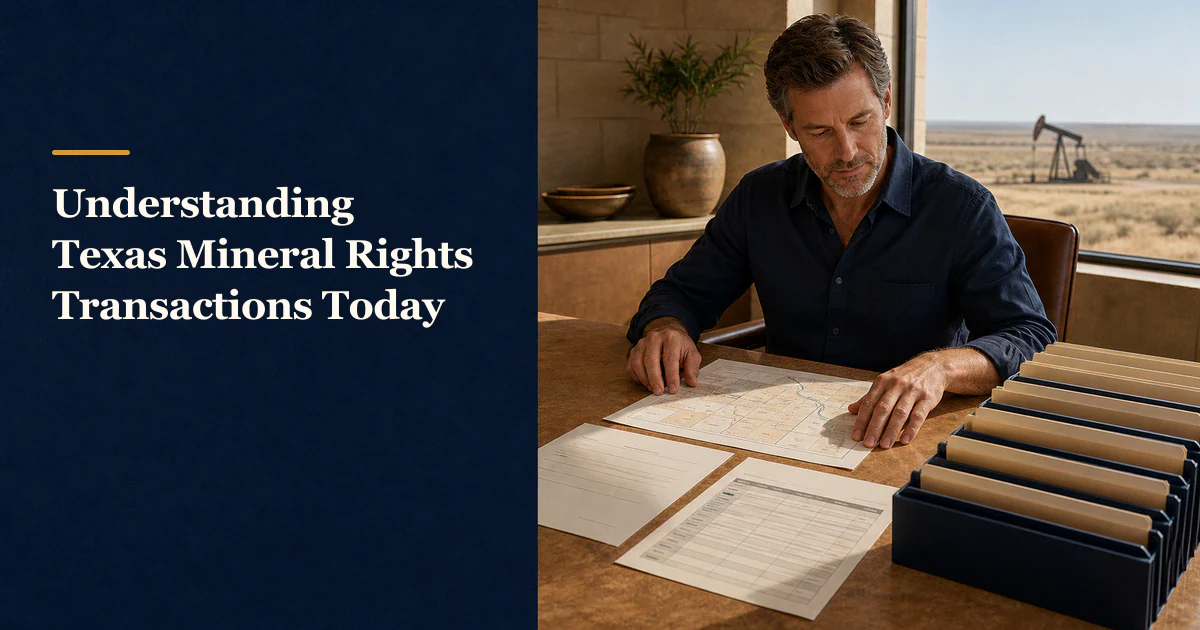
Understanding Texas Mineral Rights Transactions Today
A Texas mineral-rights transaction becomes easier to control when each question is matched to the evidence source that can answer it and its limits are recorded.
Direct answer for mineral owners
Navigate a Texas mineral-rights transaction with one dated control record and six evidence lanes: ownership and authority, asset and operating identity, payment history, directional economics, counterparty and proposal, and closing records. For every material fact, record the exact identifier, source, as-of date, scope, limitation, conflict status, and professional handoff. No county, Railroad Commission, payor, entity, proposal, deed, or payment record proves every other transaction question.
Key takeaways for mineral owners
- Texas mineral-rights transaction evidence lives in different public, private, and professional systems; no single record answers every question.
- Every material input should carry an exact identifier, source, as-of date, scope, limitation, and conflict status.
- Railroad Commission operational data can be useful while remaining informational, updateable, and distinct from ownership, contract, and royalty-payment conclusions.
- Ownership, directional value, proposal terms, expected owner net, document effect, payment, recording, and tax treatment are separate determinations.

Educational Texas transaction boundary. This guide is an evidence-routing framework, not a legal interpretation, title opinion, tax or accounting conclusion, appraisal conclusion, buyer endorsement, authority finding, funding verification, cybersecurity determination, escrow instruction, deed-delivery rule, recordability opinion, or transaction recommendation. It cannot determine ownership, authority, acreage, royalty decimals, value, fair terms, enforceability, remedies, payment security, tax treatment, or a closing result. Texas records, documents, and facts vary. Use qualified professionals for the property and question. MRX provides educational information and resources only and does not buy mineral rights.
Navigating mineral rights transactions in Texas starts with one rule: match each question to the evidence source that can answer it, record what that source cannot establish, and reconcile conflicts before relying on the result. A county instrument, Railroad Commission query, royalty statement, business filing, buyer proposal, deed, or payment record can be useful. None should be treated as proof of every other transaction fact.
Use one transaction control record with six lanes:
- ownership and signer authority;
- asset and operating identity;
- payment history and payor records;
- directional economics;
- counterparty and proposal evidence; and
- documents, closing, recording, and post-closing records.
For every material fact, record seven fields: the exact identifier, source, as-of date, question answered, question not answered, conflict status, and next reviewer. That structure is the core of this guide.
This is not another linear selling checklist. The Texas selling-process guide owns the sequence of a possible sale. The seller-readiness guide owns advance, pause, and stop decisions. This article answers a different question: when Texas transaction information lives in several systems, which lane should own each fact?
Build the transaction control record first
Create a control record before interpreting the documents. A simple document or spreadsheet is enough if it preserves traceability.
Each row should include:
- the fact being tested, such as owner name, county, tract, lease number, payor property number, proposal scope, or deed version;
- the exact name or identifier as shown by the source;
- the source document, website, person, or professional role;
- the source date, covered period, and date accessed;
- whether the source is complete and current for the question;
- what the source can reasonably support;
- what it cannot establish;
- whether another source agrees, conflicts, or uses a different identifier; and
- who owns the next action.
Use restrained status labels: observed, owner-reported, counterparty-reported, professionally concluded, assumed, inferred, conflicted, superseded, or missing. A copied figure without its source and period is not a resolved fact.
The control record should also name its evidence cutoff. A production file through one month, a proposal dated later, and a county-record search performed earlier are different snapshots. “Current” is not an adequate date.
Lane 1: ownership and signer authority
This lane answers who may own an interest, what documents appear in the chain, and who may have authority to act. It does not turn an owner-created list into a title opinion.
Collect, when available:
- deeds, mineral or royalty conveyances, reservations, assignments, and recorded memoranda;
- probate orders, wills, heirship records, trust instruments, powers, and certificates relevant to authority;
- entity formation, amendment, assumed-name, merger, and authority records;
- the names and capacities that appear on proposed agreements and deeds; and
- county, volume, page, instrument, clerk-file, or electronic-recording references.
The Railroad Commission’s royalties FAQ directs people seeking existing lease or royalty-agreement information toward the courthouse in the county where the land is located. The same page explains that the Commission does not decide private lease, royalty, or contract questions. That boundary matters: operational records can help identify activity, but they do not replace county, estate, trust, entity, or professional title evidence.
Record names exactly, including initials, suffixes, former names, trust dates, and stated signer capacities. Do not silently merge similar names. If a proposal names an individual while the apparent record owner is a trust, estate, or entity, mark the authority question open.
Route chain-of-title, conveyance, probate, trust, marital-property, entity-authority, legal-description, depth, fraction, reservation, and signer-capacity questions to the appropriate Texas attorney, title professional, land professional, or other qualified reviewer. The lane is ready only when the transaction scope can be tied to the reviewed ownership and authority evidence.
Lane 2: asset and operating identity
This lane connects the property described in the ownership file to wells, leases, units, operators, permits, and production records. It does not prove ownership or the payment decimal.
The Railroad Commission’s online research-query menu provides routes to production, drilling-permit, well, organization, GIS, imaged-record, and other operational queries. The Commission also states that these datasets are continually updated, informational, not authoritative public records, and without legal force. Preserve that limitation in the control record instead of treating a screen result as a legal conclusion.
Build an identifier crosswalk with separate fields for:
- county, survey, abstract, section, block, tract, and legal-description references;
- Railroad Commission district, API number, oil lease number, gas well ID, field, operator, and well name or number;
- unit or pooled-unit name and any available plat or permit reference;
- operator, purchaser, and payor names;
- payor property, owner, statement, and remittance identifiers; and
- the proposal’s property, exhibit, tract, depth, and interest labels.
Do not assume that a number on a royalty statement is the Railroad Commission identifier. The Commission’s royalties FAQ specifically notes that the identification used for production research may differ from the number shown on an owner’s payment documentation.
When an identifier does not crosswalk cleanly, keep both values and mark the relationship unresolved. A tract can relate to more than one well or lease. A reported oil lease can include production from multiple wells. A legal description, regulatory identifier, and payor property number describe different parts of the evidence system.
Lane 3: payment history and payor records
This lane answers what the owner was reported or paid, for which property and period, under the payor’s records. It does not independently prove the underlying title fraction, contract interpretation, or completeness of production reporting.
Preserve complete statements rather than only check totals. Record:
- statement and payment dates;
- owner and property identifiers;
- product, volume, price, decimal, gross value, deductions, taxes, adjustments, and owner net when shown;
- sales month or production month;
- check, ACH, remittance, or suspense references; and
- later reversals, corrections, or prior-period adjustments.
Separate four dates: production month, sales month, statement date, and payment date. A mismatch between a public production query and a royalty statement is not automatically an error. The sources may cover different products, levels of aggregation, periods, or identifiers.
The Commission’s Production Data Query FAQ explains that reported Texas production comes from operator submissions, oil production can be reported at the lease level rather than by individual well, online information has a reporting lag, and records may change when revised, corrected, or delinquent reports arrive. It also describes production data as a snapshot. Record the query’s access date and covered months, then reconcile the exact lease or well and period before drawing a conclusion.
Route royalty-calculation, deduction, contract, division-order, suspense, late-payment, audit, and legal questions to the relevant payor and qualified land, accounting, audit, or legal professional. A public production value and a royalty payment are related evidence, not interchangeable totals.
Lane 4: directional economics
This lane organizes an asset under stated assumptions. It does not determine title, certify value, or convert a range into a promise.
The current MRX methodology describes a directional discounted-cash-flow review using dated evidence, disclosed inputs, assumptions, and sensitivities. It keeps the asset range separate from a buyer’s written offer and the expected owner net after transaction-specific adjustments and costs.
A useful directional file should identify:
- the exact property and interest assumed;
- the evidence cutoff and production periods used;
- observed production, payment, lease, operator, development, commodity, decline, discount, and title-confidence inputs when applicable;
- low, central, and high scenarios or another disclosed sensitivity structure;
- missing, conflicted, inferred, and assumed inputs; and
- the professional questions excluded from the analysis.
Do not repair an identifier conflict by averaging figures from different properties. Do not treat recent production as a guaranteed forecast. Do not present a directional range as an appraisal conclusion, minimum offer, or expected closing price.
Keep these outputs on separate rows in the control record:
- directional asset range under stated assumptions;
- buyer’s gross stated consideration;
- permitted adjustments and contingencies;
- estimated owner net under stated assumptions; and
- owner-specific tax and professional-cost questions.
That separation lets a reviewer find the reason for a difference instead of debating one unlabeled number.
Lane 5: counterparty and complete proposal evidence
This lane answers who is making the proposal, through which verified channel, for what exact scope, and under which written terms. It does not make a filing or polished document an endorsement.
The Texas Secretary of State’s Business Services page provides routes to online searches, filings, copies, and certificates. Use those records to confirm the entity name and locate official filing information. A business filing alone does not prove that the person contacting the owner is authorized, that the communication channel is controlled by the entity, that funds exist, that the terms are fair, or that a closing will occur.
Preserve:
- the exact legal entity and any assumed name shown in the proposal;
- the representative’s stated name, title, and contact information;
- the independently sourced channel used to confirm the contact;
- the complete dated proposal and every attachment, exhibit, incorporated document, amendment, and later version;
- the rights, tracts, depths, formations, products, fractions, reservations, and exclusions in scope;
- stated consideration, permitted adjustments, conditions, deadlines, costs, obligations, remedies, and closing mechanics; and
- the version that each reviewer actually examined.
Normalize competing proposals to the same asset scope and evidence date before comparing them. If one proposal includes more rights, different depths, or broader acreage, a higher headline amount may not represent a better same-scope result.
Route representative authority, entity authority, contract interpretation, enforceability, remedies, title conditions, document scope, and transaction structure to qualified professionals. MRX’s current How It Works page distinguishes a directional review from the separate path for organizing a complete written offer. Neither path guarantees eligibility, value, an offer, payment, sale, or closing.
Lane 6: documents, closing, recording, and post-closing records
This lane preserves what was approved, signed, funded, delivered, recorded, and retained. These are separate events unless the controlling documents and qualified reviewers determine otherwise.
Before signing, create a version-lock record containing:
- the final agreement, deed, exhibits, legal descriptions, affidavits, certifications, and closing instructions;
- a checksum or another reliable version identifier;
- the reviewer, professional role, review date, and document version reviewed;
- unresolved issues and their written resolution; and
- the owner’s approval of the exact version presented for signature.
At closing, preserve the settlement statement, payment instructions, verified change-control procedure, evidence of funds received, deed-delivery instructions, courier or electronic-transmission evidence, recording submission, rejection or correction notices, and the recorded copy when applicable.
Texas Property Code Chapter 12 shows that recording instruments concerning property is a formal statutory process with requirements. It does not let a general article decide whether a particular document was acknowledged, delivered, valid, recordable, effective, or superior to another interest. Keep signing, funding, delivery, recording, and the recorded return as separate evidence rows and route owner-specific questions to a qualified Texas attorney and closing or title professional.
Build the post-closing archive while the evidence is fresh. Include final signed documents, recorded documents, payment and settlement evidence, the complete communication history, professional correspondence, prior ownership and operating files, and a tax folder.
The IRS Publication 544 describes general concepts for sales and other dispositions, including amount realized, adjusted basis, and possible gain or loss. It cannot determine the classification, basis, allocation, holding period, reporting position, or tax result for a particular mineral owner. Give the complete transaction and basis file to a qualified tax professional.
Reconcile conflicts instead of choosing the convenient record
When two sources differ, do not select the value that produces the preferred answer. Open a conflict record.
Name:
- both values exactly as observed;
- the source and access date for each;
- whether the identifiers and periods truly match;
- whether one source was later corrected, superseded, or scoped differently;
- the transaction decision affected by the conflict;
- the professional or counterparty responsible for resolving it; and
- the written evidence required to close the conflict.
Common routing errors include comparing a payor property number to an RRC lease number, using a well-level assumption against lease-level oil production, matching a current operator to an older royalty statement without preserving the period, using a county instrument from one tract against a proposal covering several tracts, or treating a Secretary of State entity record as proof of a representative’s authority.
Mark the conflict closed only when the resolution points to its supporting record or professional conclusion. A verbal explanation can be preserved as counterparty-reported information, but it does not become independently verified merely because it sounds plausible.
The minimum owner transaction packet
A controlled Texas transaction packet should let another qualified reviewer reconstruct what the owner knew, when it was known, and which questions remained open.
Include:
- the transaction control record and evidence cutoff;
- owner objective and exact transaction scope;
- ownership, authority, county-record, and legal-description evidence;
- the operating-identifier crosswalk and dated Railroad Commission research;
- complete royalty statements and payment adjustments for the selected period;
- directional economic analysis with assumptions and limitations;
- complete proposals and same-scope comparison notes;
- counterparty identity, entity, authority, and channel-verification evidence;
- the reviewed and version-locked agreement, deed, exhibits, and closing instructions;
- funding, delivery, recording, and recorded-return evidence when applicable;
- the post-closing archive and tax handoff; and
- a conflict log showing what was resolved, what remains open, and by whom.
The packet does not make the transaction safe or correct by itself. It makes the evidence, limits, and professional handoffs visible. That is what gives a Texas mineral owner a practical way to remain in control while the transaction moves across different systems.
What MRX can and cannot do
MRX can help organize a free, confidential, no-obligation directional underwriter review using the property and payment evidence an owner provides. The review can state assumptions, limitations, conflicts, and missing records and can separate an asset range from a complete written proposal and expected owner net.
MRX does not certify ownership, title, acreage, royalty decimals, value, buyer authority, funding, document effect, payment security, recordability, tax treatment, or a closing result. It does not guarantee an offer, payment, sale, or closing. MRX provides educational information and resources only and does not buy mineral rights. Use the appropriate attorney, title, tax, accounting, appraisal, land, engineering, geology, cybersecurity, entity-authority, escrow, or closing professional for questions within that role.
Frequently asked questions
How do I navigate a Texas mineral rights transaction?
Create one dated control record with six evidence lanes: ownership and authority, asset and operating identity, payment history, directional economics, counterparty and proposal, and document-closing-post-closing evidence. For each material fact, preserve the exact identifier, source, as-of date, scope, limitation, conflict status, and next professional handoff. Do not let one record answer a question outside its lane.
Does Railroad Commission data prove that I own Texas mineral rights?
No. Railroad Commission queries can provide useful well, lease, operator, permit, production, and related operational information, but the Commission states that its online datasets are informational, continually updated, non-authoritative, and without legal force. Ownership, title, authority, and contract questions require the relevant county, estate, trust, entity, and professional evidence.
Why might Texas production records differ from a royalty statement?
The records may use different identifiers, scopes, products, reporting periods, allocation methods, or update cycles. The Railroad Commission explains that production is operator-reported, may be aggregated at lease level for oil, can lag, and may be revised. Reconcile the exact lease or well identifier and month before drawing a conclusion, then route payment or contract questions to the appropriate payor and qualified professional.
Does a Texas business filing prove a mineral buyer can bind an entity or fund a purchase?
No. A Secretary of State record can help confirm entity filing information and obtain official copies or certificates. It does not by itself prove that a representative is authorized for the proposed transaction, that funds are available, that terms are fair, or that the transaction is safe. Verify identity, authority, channel, proposal, and closing evidence separately.
When is a Texas mineral rights transaction complete?
Do not collapse signing, funding, deed delivery, recording, and retained records into one event. The controlling agreement, deed, closing process, and Texas law determine the owner-specific result. Preserve the final signed version, exhibits, settlement and payment evidence, delivery instructions, recorded copy when applicable, correspondence, and the tax file, and use qualified professionals for unresolved legal, title, closing, accounting, or tax questions.
Sources reviewed for this article
- Mineral Rights Xchange, Published DCF Methodology (accessed 2026-08-12)
- Mineral Rights Xchange, Frequently Asked Questions (accessed 2026-08-12)
- Mineral Rights Xchange, How It Works (accessed 2026-08-12)
- Mineral Rights Xchange, Terms of Use (accessed 2026-08-12)
- Railroad Commission of Texas, Online Research Queries (accessed 2026-08-12)
- Railroad Commission of Texas, Production Data Query System FAQ (accessed 2026-08-12)
- Railroad Commission of Texas, Royalties FAQ (accessed 2026-08-12)
- Texas Secretary of State, Business Services (accessed 2026-08-12)
- Texas Legislature, Property Code Chapter 12, Recording of Instruments (accessed 2026-08-12)
- Internal Revenue Service, Publication 544, Sales and Other Dispositions of Assets (accessed 2026-08-12)
Related mineral-rights articles

Understanding Mineral Rights: Your Essential Selling Guide
A seller avoids preventable problems by advancing only when the current stage has a named output, supported evidence, and no unresolved stop condition.
Read the post →
How the Step-by-Step Process of Selling Texas Mineral Rights Works
A seven-step owner checklist for moving from property and ownership records to a fully documented Texas mineral-rights closing.
Read the post →
How Texas Mineral Rights Ownership Works: Deeds, Conveyances, and Title
A deed-and-title explainer for Texas mineral-rights owners that stays grounded in writing, recording, and verification mechanics.
Read the post →
What Should I Do If a Texas Mineral Rights Sale Goes Wrong?
A mineral-rights sale problem needs stage-based triage: preserve the exact record, identify what has and has not happened, stop unsafe changes, and route the specific issue without assuming a remedy.
Read the post →A practical next step
Put your mineral rights in context.
Every mineral interest, royalty history, and written offer is different. Start with a question, or share what you have for a free underwriter review.
- Free
- Confidential
- No obligation to sell
Ready for a closer look?
Organize my Texas transaction recordGet a directional range with the assumptions clearly stated.