
MRX Learning Center
How the Step-by-Step Process of Selling Texas Mineral Rights Works
A seven-step owner checklist for moving from property and ownership records to a fully documented Texas mineral-rights closing.
Direct answer for mineral owners
A careful Texas mineral-rights sale has seven practical steps: define the interest, organize records, review production and lease context, identify the buyer, normalize the written offer, obtain appropriate professional review, and coordinate signing, payment, delivery, and recording.
Key takeaways for mineral owners
- Start by defining the exact tract and interest, including anything the owner intends to retain.
- Separate public production context from title, ownership, and value conclusions.
- Compare expected net terms, adjustment rights, conditions, and obligations, not only the headline amount.
- Treat signing, funding, deed delivery, and recording as one coordinated closing plan.
This article is educational and is not legal advice, tax advice, a title opinion, or a certified appraisal. Use qualified professionals for owner-specific legal, tax, title, or certified-valuation work.
Direct answer for mineral owners
The practical process for selling Texas mineral rights is: define exactly what may be sold, organize the ownership and payment records, review production and lease context, identify the buyer, compare the complete written terms, obtain the professional review the transaction requires, and coordinate signing, payment, delivery, and recording.No step substitutes for another. Production records do not prove title, a directional range is not a certified appraisal, and a signed offer is not necessarily the final deed or a completed closing.
MRX provides directional underwriter reviews. MRX provides educational information and resources only and does not buy mineral rights.
Step 1: define the interest under consideration
Write down the county, tract, legal description, interest type, fraction, depths or formations, and whether the possible sale is full or partial. Also list any interest or right the owner intends to retain.
Do not assume that a royalty decimal, tax parcel, operator name, or family description identifies the legal interest by itself. If multiple family members, estates, trusts, or entities are involved, identify who may need authority to act or sign.
Step 2: organize the records you have
A useful owner file may include:
- recorded deeds and assignments;
- wills, probate orders, heirship or trust records;
- leases, amendments, pooling documents, and memoranda;
- division orders and recent royalty statements;
- tax forms associated with royalty income;
- correspondence about title or suspended funds; and
- every page of each written offer or purchase agreement.
Organizing records is not the same as certifying title. It gives the buyer, attorney, title professional, tax adviser, or underwriter a clearer starting point.
Step 3: review production, lease, and payment context
The Railroad Commission of Texas publishes production information reported by Texas operators. Well, lease, field, operator, permit, and reported production context can help an owner ask better questions.
Public data still has limits. It may be revised, may lag operational events, and does not establish the seller’s title, net acreage, lease burden, decimal, future production, or transaction value. Compare public context with the owner’s lease, division order, and payment records rather than treating any one source as conclusive.
Step 4: identify the proposed buyer
Record the legal entity named in the agreement, the authorized signer, contact information, payment instructions, and any assignment rights. The Texas Comptroller’s public databases can help check taxable-entity information.
An entity search is not an endorsement. It does not prove financial capacity, the quality of an offer, or the accuracy of every representation.
Step 5: normalize the written offer
Before comparing offers, make sure each buyer is purchasing the same property and interest. Then convert the proposal into a term sheet that answers:
- What exact interest is included?
- What is the stated consideration?
- Which acreage, decimal, title, or diligence findings can change that amount?
- Are any fees, deductions, holdbacks, or curative costs involved?
- What are the diligence and exclusivity periods?
- Who may extend, terminate, or assign the agreement?
- Which representations, warranties, indemnities, or obligations survive closing?
- When are the deed and funds released?
A higher headline number for a broader interest or more conditional contract may not be the better trade.
Step 6: obtain the review the transaction requires
Different questions belong with different professionals:
- A qualified attorney can address conveyance, title, authority, remedies, indemnity, and contract language.
- A tax professional can address basis, gain, reporting, installment, and owner-specific consequences.
- A credentialed valuation professional may be appropriate when a certified or independent opinion is required.
- A directional underwriter review can help organize production, royalty, lease, assumption, and offer-term questions, but it is not any of the professional opinions above.
Texas Property Code chapter 5 includes the general requirements for a conveyance of an estate in real property. Applying those rules to a specific mineral deed is legal work, not a generic article conclusion.
Step 7: coordinate closing as one controlled sequence
Do not treat signing, payment, deed delivery, and recording as disconnected events. The written closing instructions should identify:
- the final agreement, deed, and settlement documents;
- every required signer and acknowledgment;
- verified payment instructions;
- the conditions for releasing or delivering the deed;
- the conditions for releasing funds;
- the party responsible for recording; and
- the documents and evidence each party keeps after closing.
Texas Property Code chapter 12 describes recording requirements for instruments concerning real property. Recording does not resolve every underlying title or contract question, so retain the complete closing package and recording information.
A final pre-signature checkpoint
Pause before signing if the property description is incomplete, the buyer identity is inconsistent, the purchase amount can change without a defined method, the deed appears broader than the negotiated sale, or the seller cannot explain the path from signature to verified payment.
The point is not to create delay. It is to keep the owner’s decision connected to the exact rights and obligations in the documents.
Source notes and research limitations
- Texas Property Code Chapter 5 supports the bounded conveyance discussion.
- Texas Property Code Chapter 12 supports the recording discussion.
- Texas Comptroller public databases support the limited entity-status check.
- Railroad Commission production data supports the description of public production context.
Continue with How Long Does It Take to Sell Mineral Rights in Texas?, learn What Happens After You Sell Your Mineral Rights in Texas?, or book a free underwriter review to organize your own facts and questions.
Frequently asked questions
What is the first step in selling Texas mineral rights?
Identify the county, legal description, interest type, ownership fraction, depths or formations, and whether the proposed sale is full or partial.
Which documents are useful?
Prior deeds, probate or inheritance records, leases and amendments, division orders, royalty statements, tax forms, and complete written offers can help organize review.
Does production data prove ownership?
No. It can provide reported well, lease, operator, and production context, but title and the exact interest require separate evidence and analysis.
Should a seller compare more than price?
Yes. Compare the exact interest purchased, adjustment rights, deductions, diligence, exclusivity, assignment, closing certainty, payment, and surviving obligations.
When should a seller seek professional review?
Before signing when deed, title, remedy, tax, entity-authority, or certified-valuation questions could materially affect the decision.
Sources reviewed for this article
Related mineral-rights articles
How Long Does It Take to Sell Mineral Rights in Texas?
A practical explanation of the records, diligence, contract, payment, and recording steps that control the timing of a Texas mineral-rights sale.
Read the post →
What Happens After You Sell Your Mineral Rights in Texas?
A practical post-closing checklist for recording evidence, royalty-payor changes, retained interests, transaction records, and tax questions.
Read the post →
Can You Sell Part of Your Mineral Rights? Partial Interest Sales Explained
A partial-interest sale explainer that focuses on written conveyance, title clarity, and decision tradeoffs instead of generic valuation shortcuts.
Read the post →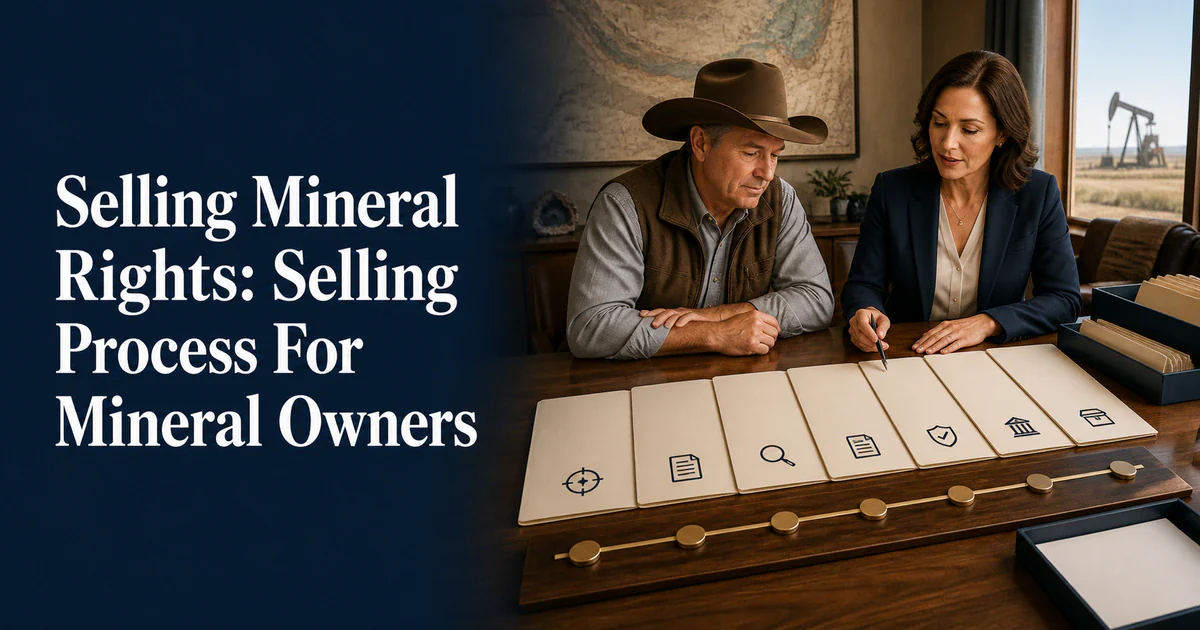
Selling Mineral Rights: Selling Process For Mineral Owners
A mineral owner can control the sale process by requiring a defined input, decision, output, and stop condition at every transaction handoff.
Read the post →A practical next step
Put your mineral rights in context.
Every mineral interest, royalty history, and written offer is different. Start with a question, or share what you have for a free underwriter review.
- Free
- Confidential
- No obligation to sell
Ready for a closer look?
Book a Free Underwriter ReviewGet a directional range with the assumptions clearly stated.