
MRX Learning Center
Understanding Fair Valuation: Key Factors for Assessing Your Mineral Rights' Worth
A fair valuation is not proved by one impressive number. Test whether the same evidence rules work in both favorable and unfavorable directions.

Direct answer for mineral owners
Test procedural fairness in a mineral-rights valuation by checking whether its rules work symmetrically. Confirm the interest, reconcile production and payments, date commodity assumptions, grade development evidence, show uncertainty, and separate asset range from transaction scope. Ask whether the same written rule would handle new favorable and unfavorable evidence. A directional range that passes is easier to inspect, but it is not a promise of value or an ownership determination.
Key takeaways for mineral owners
- Fairness is better tested through consistent evidence rules than through one headline number or universal multiple.
- Every material factor should identify its source, effective date, status, range effect, and rule for both favorable and unfavorable evidence.
- Production records, royalty statements, commodity series, and development indicators answer different questions and should not be substituted for one another.
- Asset worth, offer consideration, adjustment rights, costs, timing, and expected owner net are separate decision fields.
Educational valuation-review scope. This guide explains how to test the procedural fairness of a directional mineral-rights range. It does not establish ownership, title, acreage, royalty decimals, reserves, future development, fair market value, tax treatment, legal meaning, buyer performance, transaction suitability, or an owner-specific result. Records may be incomplete, delayed, corrected, commingled, or reported at a level different from the interest being reviewed. Use qualified professionals for owner-specific title, legal, tax, accounting, land, appraisal, engineering, geology, surveying, brokerage, and transaction questions. MRX provides educational information and resources only and does not buy mineral rights.
You can test whether a mineral-rights valuation is procedurally fair by asking whether its rules work in both directions. A sound review should recognize favorable evidence and unfavorable evidence under the same written standard. It should not raise the range for a positive assumption while hiding the corresponding downside, or reduce the range for uncertainty while refusing to revise it when better evidence resolves that uncertainty.
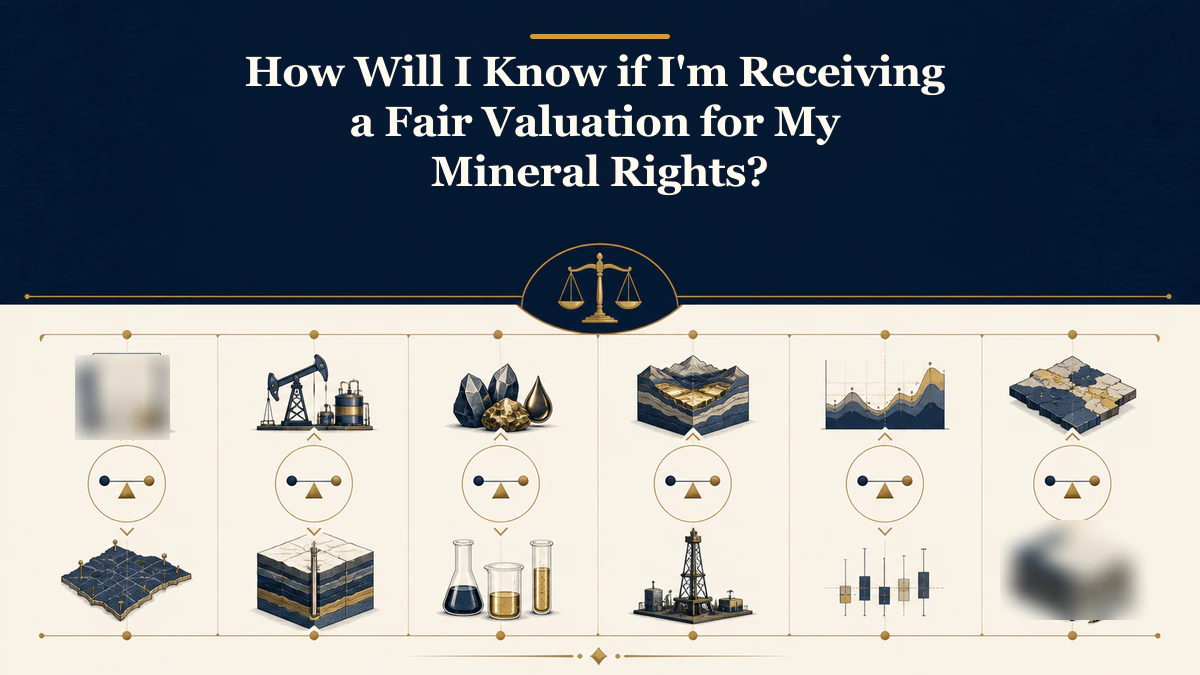
Use six checkpoints:
- the exact interest being analyzed;
- attributable production and owner payments;
- dated oil and gas price assumptions;
- the strength of development evidence;
- uncertainty and sensitivity cases; and
- the difference between asset worth and transaction scope.
For every checkpoint, record the source, date, confidence level, effect on the range, and the rule for revising it. That creates a valuation fairness audit rather than a debate about whether one number feels high or low.
This article owns the symmetry-audit job. The valuation trust guide explains how inspectable assumptions build confidence. The value guide explains the main value categories. The fair-offer guide evaluates a written purchase proposal. Here, the narrower question is whether the directional valuation process applies its evidence rules consistently.
Start by defining what “fair” means
“Fair” is not a substitute for a valuation date, property definition, evidence set, or method. Two careful analysts may produce different ranges because they use different effective dates, scenarios, risk tolerances, or interpretations of incomplete information.
A procedurally fair review should make those differences visible. It should let the owner answer:
- What interest is included?
- Which facts are confirmed, owner-provided, derived, assumed, or unknown?
- Which effective date controls?
- Which source supports each material input?
- What evidence would move the range upward?
- What evidence would move it downward?
- Which uncertainty remains even after the review?
- Does the proposed transaction cover the same rights that were analyzed?
The test is not whether every input helps the owner. The test is whether the input has a stated reason and whether the same standard would apply if the evidence pointed the other way.
Checkpoint 1: confirm the interest before evaluating the range
A valuation cannot be assessed fairly until the interest is described precisely enough to analyze. County, state, tract or legal-description reference, interest type, formation or depth limits, lease status, royalty burden, and the effective date can all change what the range is about.
Build an interest statement that separates:
- owner identity as represented in the supplied records;
- tract identity and jurisdiction;
- mineral, royalty, overriding royalty, working, or other interest type;
- gross acreage from the owner’s claimed or supported net interest;
- leased from unleased rights;
- producing from nonproducing components;
- included formations or depths from excluded ones; and
- facts confirmed by a qualified title review from working assumptions used only for a directional analysis.
Apply the symmetry test. If a lower supported decimal reduces the modeled cash flow, a higher supported decimal should increase it under the same calculation rule. If a title uncertainty creates a downward risk adjustment, newly verified title evidence should trigger reconsideration of that adjustment. Neither a public map nor a division-order decimal should silently prove ownership beyond what that source can establish.
Record unresolved conflicts instead of selecting the version that produces the preferred answer. A range tied to an explicit interest statement is more useful than a confident number attached to an undefined asset.
Checkpoint 2: reconcile production and payment evidence
The Railroad Commission of Texas describes its production information as data reported by operators. Its Production Data Query guidance explains that Texas oil production is generally reported by lease rather than by individual well, that reporting has a lag, and that records can reflect later submissions or corrections.
That makes public production data valuable, but it also defines a boundary. A regulator record can help establish reported lease, field, operator, district, county, product, and monthly volume context. It does not automatically prove the volume attributable to one owner or explain an owner’s check.
Reconcile three layers:
- Regulatory reporting: the lease or well identifiers, product, month, and reported volume.
- Owner payment accounting: statement periods, owner decimal, product lines, prices, taxes, deductions, adjustments, and net payment.
- Valuation treatment: the attributable volume, revenue, burdens, decline pattern, and normalization rules used in the range.
Use the same reconciliation rule for increases and decreases. A large check should not automatically become the recurring baseline if it includes prior-period adjustments. A low check should not automatically prove permanent decline if the production period, price, decimal, or payment timing changed. Identify the cause before changing the baseline.
If regulatory and payment records do not reconcile, retain the conflict as an open item. Document which interpretation appears in each scenario and what record could resolve it.
Checkpoint 3: date commodity assumptions and apply them consistently
Oil and gas prices move. The U.S. Energy Information Administration publishes dated oil spot-price series and Texas natural-gas price series with units, periods, definitions, and notes. Those sources provide market context; they do not by themselves specify the realized price for a particular property or future period.
For each commodity assumption, record:
- the product and benchmark;
- the source URL;
- the observation date or historical window;
- the unit;
- whether the value is historical, current, or a future scenario;
- any location, quality, transportation, or other differential;
- whether escalation or reversion is assumed; and
- the sensitivity cases tested.
Then apply symmetry. If a higher oil or gas case is presented, show the paired lower case using the same production and ownership structure. If an analyst discounts a public benchmark for a negative differential, a supported improvement in realized pricing should be recognized using the stated rule. Do not choose one unusually favorable date for upside and a broad average for downside.
A useful valuation record also states which variables are held constant when the price changes. Otherwise, the owner cannot tell whether the range moved because of commodity prices, production assumptions, ownership, or several changes at once.
Checkpoint 4: grade development evidence separately
Undeveloped potential often creates the widest disagreement. A nearby well, permit, operator statement, spacing pattern, lease term, public map, or basin trend can be relevant, but those items do not carry the same evidentiary weight and do not assure a future well on the owner’s tract.
Use an evidence ladder:
- Observed property facts: existing wells, attributable production, lease terms, and documented tract relationships.
- Dated regulatory activity: permits, completions, reported production, and operator records connected to identified locations.
- Documented nearby context: activity with a stated distance, formation, operator, and time period.
- Scenario assumptions: possible timing, well count, type curve, participation, burden, and chance of occurrence.
- Excluded speculation: unsupported rumors, marketing language, undated maps, or generalized basin enthusiasm.
Apply one upgrade and downgrade rule. Stronger tract-connected evidence may justify a higher probability or nearer timing. A permit expiration, operator change, unfavorable result, spacing conflict, or longer delay may justify the reverse. The rule should be written before the new fact is interpreted.
Avoid converting a scenario into a fact by repeating it. Keep prospective value in a separate component from current producing cash flow so the owner can see how much of the range depends on events that have not happened.
Checkpoint 5: expose uncertainty and sensitivity
Uncertainty is not a defect that can be edited away. It is information about how strongly the available record supports a conclusion.
For each material input, assign one status:
- confirmed: supported for the limited review question by the cited record;
- owner-provided: supplied by the owner but not independently established;
- derived: calculated from identified inputs with the method shown;
- assumed: selected for a scenario and not presented as a fact;
- conflicted: credible sources do not currently reconcile; or
- unknown: material information is missing.
Then show a base case and sensitivity cases that change one important assumption at a time. Useful sensitivities may include ownership decimal, decline, realized price, timing, development probability, discount rate, burdens, or transaction adjustments. The point is not to manufacture a huge range. It is to show which assumptions actually control the result.
Symmetry matters here too. Do not widen uncertainty only when it lowers the owner’s range. Do not collapse uncertainty merely because the optimistic case is attractive. Define what evidence would narrow the range and apply that criterion consistently.
MRX’s published methodology describes a directional DCF range with inputs, assumptions, limitations, and offer separation stated. Its FAQ also preserves the educational, non-certified boundary. An owner should expect a range to remain revisable when better information arrives.
Checkpoint 6: separate asset worth from transaction scope
A directional asset range is not automatically the amount an owner would receive under a purchase agreement. Compare the analyzed asset with the proposed conveyance line by line.
Separate:
- the interest included in the valuation;
- the rights included in the offer and deed;
- stated consideration;
- acreage, title, or ownership adjustment rights;
- deductions, costs, holdbacks, or other economic provisions;
- diligence and closing conditions;
- payment timing and method;
- rights retained or excluded; and
- expected owner net under the complete written terms.
Apply the symmetry test to scope. If additional supported acreage can increase consideration, determine whether the written mechanism also permits a decrease and under what evidence standard. If title uncertainty reduces the amount, identify whether curing that issue restores the adjustment. If the deed conveys broader rights than the model analyzed, the headline amount and the range are not directly comparable.
Do not use a directional range to interpret an agreement. A qualified attorney can address owner-specific document meaning and legal effect. A qualified tax professional can address owner-specific tax treatment. The valuation audit should identify those handoffs, not replace them.
Build a valuation fairness audit record
Use one dated record with these fields:
- Decision: hold, plan, review a proposal, seek alternatives, or another defined question.
- Effective date: the date to which evidence and assumptions are tied.
- Interest statement: property, interest type, acreage or decimal basis, lease status, depths, and included rights.
- Evidence register: source, date, identifier, scope, and limitation for each material record.
- Production reconciliation: regulatory volumes, payment periods, owner accounting, and unresolved differences.
- Commodity cases: benchmarks, dates, units, differentials, and sensitivities.
- Development ladder: observed facts, regulatory activity, nearby context, scenarios, and exclusions.
- Input status: confirmed, owner-provided, derived, assumed, conflicted, or unknown.
- Range bridge: how each material input changes the low, base, or high case.
- Symmetry rule: what favorable and unfavorable evidence would trigger the same type of revision.
- Transaction bridge: analyzed asset, offered rights, adjustments, conditions, costs, timing, and expected owner net kept separate.
- Next evidence action: the specific record or professional question that could change the decision.
Do not mark an item verified merely because it appears in a polished report. Trace it to the source and confirm that the source answers the question assigned to it.
Warning signs that the process is not yet inspectable
Pause and ask for clarification if:
- the interest being valued is not defined;
- one royalty check or one price-per-acre figure controls the result without reconciliation;
- public production is assigned to the owner without matching identifiers and periods;
- commodity assumptions lack dates, units, or sensitivity cases;
- nearby activity is presented as a property-specific development commitment;
- favorable and unfavorable evidence are judged under different standards;
- missing evidence is silently converted into certainty;
- the range changes but the changed input is not identified;
- an offer amount is treated as asset worth without comparing transaction scope; or
- the reviewer’s possible economic role in a later transaction is not disclosed when applicable.
These signs do not prove misconduct or an incorrect range. They show that the owner cannot yet reproduce the reasoning well enough to rely on it for the defined decision.
The practical fairness standard
A useful fair-valuation test does not ask, “Is this the number I hoped to see?” It asks, “Can I trace the interest, data, assumptions, uncertainties, and transaction boundary, and would the same rules apply if the evidence changed in either direction?”
That standard gives the owner a workable result even when uncertainty remains: a dated range, a clear confidence level, the variables that matter, and the next evidence that could change the decision.
If you want help organizing that record, request a no-obligation valuation review. Bring the exact interest you want discussed, recent payment records, available production identifiers, lease or ownership documents you are authorized to share, and any written proposal. MRX can organize a free directional review with sources, assumptions, limitations, and symmetry checks stated. You retain the decision to hold, investigate, seek independent advice, compare alternatives, request a proposal, or stop.
Frequently asked questions
How will I know if I am receiving a fair valuation for my mineral rights?
Ask for a dated range with the interest, evidence, assumptions, limitations, and sensitivity cases stated. Then test symmetry: would the same written rule recognize both favorable and unfavorable evidence? Confirm that ownership, production, price, development, uncertainty, and transaction scope are not being mixed or selectively applied.
Does a high valuation mean it is fair?
No. A high number can still depend on unsupported ownership, stale prices, aggressive development assumptions, omitted burdens, or a transaction scope that differs from the asset analyzed. Fairness requires inspectable and consistently applied inputs, not merely a favorable result.
Should public production data match my royalty statement exactly?
Not necessarily. Texas production data are reported at regulatory reporting levels and can lag or later change, while a royalty statement reflects owner-specific payment accounting, deductions, timing, and decimals. Reconcile identifiers and periods before treating a difference as an error.
Can one oil or gas price prove my mineral rights value?
No. Public price series provide dated market context, but a directional range also depends on product, location, quality, differentials, production timing, decline, burdens, development scenarios, risk, and the exact interest being analyzed.
Is a fair valuation the same as a fair purchase offer?
No. A directional asset range and a purchase offer answer different questions. An offer also depends on the rights conveyed, buyer identity, diligence conditions, adjustment provisions, costs, payment terms, deed scope, timing, and the owner’s alternatives and priorities.
Sources reviewed for this article
- Mineral Rights Xchange, Published DCF Methodology (accessed 2026-08-12)
- Mineral Rights Xchange, Frequently Asked Questions (accessed 2026-08-12)
- Railroad Commission of Texas, Oil and Gas Production Data (accessed 2026-08-12)
- Railroad Commission of Texas, Production Data Query System FAQs (accessed 2026-08-12)
- U.S. Energy Information Administration, Spot Prices for Crude Oil and Petroleum Products (accessed 2026-08-12)
- U.S. Energy Information Administration, Texas Natural Gas Prices (accessed 2026-08-12)
Related mineral-rights articles

Understanding the Value of Your Mineral Rights
Mineral-rights value depends on what is owned, the evidence supporting current cash flow and future development, the effective date, uncertainty, market terms, and the rights actually conveyed.
Read the post →
How to Trust That Your Mineral Rights Will Be Valued Fairly
A fairness-and-trust article that explains what a transparent mineral-rights valuation can and cannot prove.
Read the post →
How to Know if Your Mineral Rights Offer Is Fair
A fair mineral-rights offer matches the exact interest and records under review, explains material assumptions, and has acceptable adjustment, deed, and closing terms.
Read the post →
Understanding Mineral Rights: How to Validate Your Asset’s True Worth
A mineral-rights range is more credible when a second reviewer can reconstruct it from the same asset scope, dated evidence, assumptions, units, and method.
Read the post →A practical next step
Put your mineral rights in context.
Every mineral interest, royalty history, and written offer is different. Start with a question, or share what you have for a free underwriter review.
- Free
- Confidential
- No obligation to sell
Ready for a closer look?
Request a no-obligation valuation reviewGet a directional range with the assumptions clearly stated.