
MRX Learning Center
Refrac and Workover Event-Claim Register: A Source-Preserving Record Template
A source-preserving event-claim register keeps each refrac, workover, or recompletion claim tied to its exact source, identifiers, dates, unknowns, and follow-up owner without deciding what occurred or what it means.
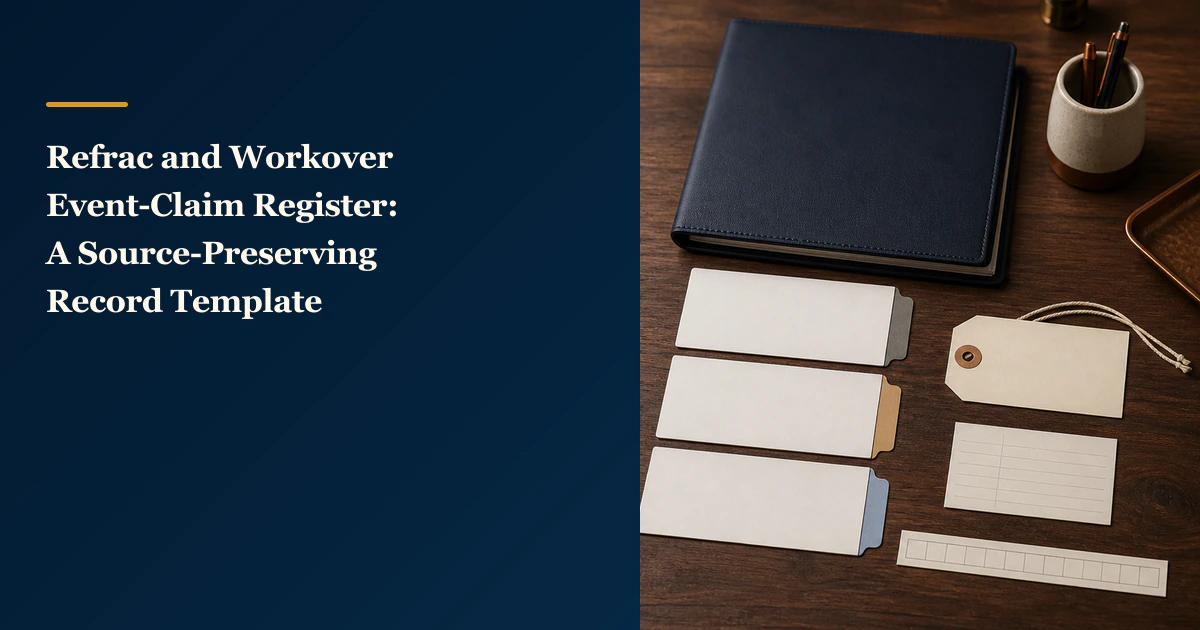
Direct answer for mineral owners
Create one row per unverified event claim. Copy the source wording, identifiers, source, and dates; use a limited property-connection label; record displayed post-claim periods without causation; and assign gaps to a follow-up owner. The register does not confirm an intervention, interpret filing content, analyze production, estimate reserves, or determine value.
Key takeaways for mineral owners
- Treat refrac, workover, and recompletion as source-stated claims, not MRX findings.
- Keep every source in its own row with exact identifiers, dates, wording, and a stable locator.
- Record displayed post-claim reporting periods only as non-causal observations.
- Mark property connection, conflicting sources, and missing identifiers as controlled unknowns.
- Stop before engineering interpretation, decline-curve work, reserves, valuation, or an offer decision.
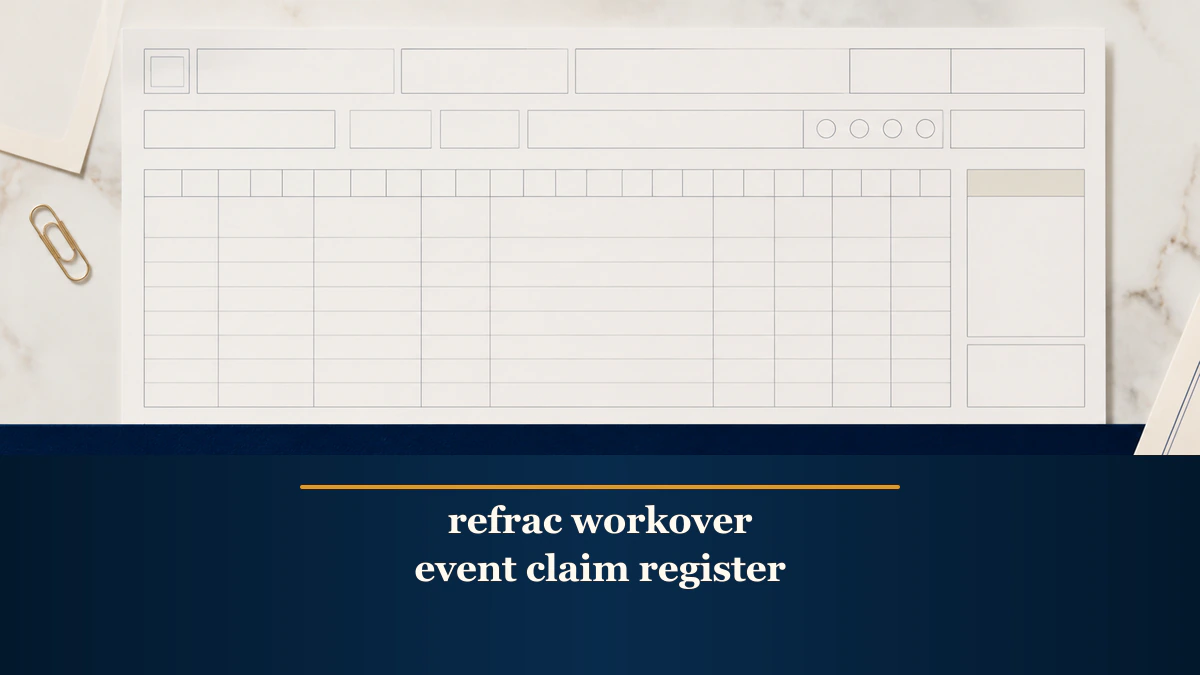
Source-preserving boundary. This register organizes unverified event claims, source wording, identifiers, dates, reported periods, unknowns, conflicts, and follow-up assignments. It does not confirm or interpret a refrac, workover, recompletion, filing, or operator statement; establish a property connection; infer causation; analyze production; build or segment a decline curve; estimate reserves, upside, cash flow, present value, or value; compare offers; decide ownership, title, lease, operating, or payment status; or provide legal, tax, title, land, engineering, accounting, appraisal, investment, or financial advice. MRX provides educational information and resources only and does not buy mineral rights.
A refrac workover event claim register is a source log, not an event finding. Give every claim its own row. Copy the event term exactly as the source states it, record the well or record identifier if shown, preserve the source and dates, list displayed post-claim reporting periods without attributing a cause, and route each unknown to a follow-up owner.
The register is complete when another reviewer can locate every source and see every unresolved item. It is not complete because someone has decided that an intervention occurred or changed production or value.
Start with one row per event claim
One well may appear in a regulator record, an operator release, a presentation, an owner email, and a production query. Those sources may use different terms or dates. Do not compress them into one confident statement.
Create a separate row whenever the file contains a distinct:
- source-stated event term;
- well, lease, API/UWI, or other identifier;
- source document, filing, page, exhibit, release, portal entry, or correspondence item;
- source publication date, retrieval date, or claimed event date;
- operator name or originating party;
- property-connection label;
- displayed reporting period; or
- conflict or missing item that needs a different records custodian.
Use a neutral register ID such as EVENT-CLAIM-01. Do not put a Social Security number, bank account, taxpayer number, signature, login credential, or other sensitive identifier into a worksheet that may be shared. Use the document redaction checklist before sending source copies.
Use only the locked register fields
The register needs thirteen controlled fields:
| Field | What to record | What not to decide |
|---|---|---|
| Register ID and status | Neutral row ID plus open, source located, conflict noted, or routed | Whether the event is verified |
| Source-stated event type | Exact wording such as refrac, workover, or recompletion when the source uses it | Whether the terms mean the same thing |
| Well or record identifier | Well name, API/UWI, lease, field, permit, filing, or source-provided identifier | Whether the identifier proves a property connection |
| Source document or channel | File name, URL, portal, filing, release, presentation, email, or query | Whether the source is conclusive |
| Publisher or custodian | Name exactly as shown | Whether the party is correct or current |
| Source and retrieval dates | Publication or filing date plus the date the source was obtained | Whether a claim remains current |
| Claimed event date | Date or date range only when expressly stated | When work actually began or ended |
| Operator name | Name exactly as shown in that source | Current operator status or legal responsibility |
| Property-connection status | Unverified, possible, confirmed by separate record, or not applicable | Ownership, title, or acreage |
| Post-claim reporting periods | Displayed months or periods and the query source | Whether the event caused a change |
| Exact excerpt and locator | Short quotation or precise paraphrase plus page, section, exhibit, or timestamp | What the passage means technically |
| Unknowns and conflicts | Missing identifiers, different dates, different terms, or inconsistent sources | A guessed resolution |
| Follow-up | Responsible person, requested record, and next action date | The eventual professional conclusion |
Keep event claim in the heading. That label prevents a copied phrase from looking like a verified MRX statement.
Preserve the source’s language
Do not replace a source’s word with a term that seems more precise. If one document says recompletion and another says workover, make two source rows. If a source uses a broader phrase such as well intervention, copy that phrase and do not silently convert it to refrac.
For each source, capture:
- the displayed publisher, custodian, filer, or originating party;
- the complete document, form, filing, or page identity;
- the publication, filing, effective, or retrieval dates that are actually shown;
- the exact identifier needed to find the item again;
- a short excerpt or precise locator for the event wording; and
- whether a newer, older, or conflicting item is already present.
The RRC oil and gas well-records page describes record channels that may include drilling permits, completion or recompletion reports, plugging reports, logs, and miscellaneous records. Use it to locate a record and preserve the request or retrieval details. Do not interpret the file or treat its presence as proof of the event claim.
The RRC online well-records page explains how lease PDFs can contain several record types. Record the PDF identity, profile, well or lease reference, page, and retrieval date. Do not cite the entire file as though every page supports the same statement.
Keep form identity separate from form meaning
The RRC oil and gas forms page lists official form names and revisions. Some titles refer to completion, recompletion, or re-entry. A form title can help you identify what to request or how to label a source. It does not by itself establish what occurred at a specific well.
When a form appears in the file, record:
- the exact form name and number;
- the revision date shown on the form, if any;
- the filing, received, or approved date only when displayed;
- the API, lease, field, permit, or other identifier shown;
- the page or section containing the source-stated event term; and
- any missing page, attachment, signature, or identifier as an unknown.
Do not decide whether filing material was required, complete, timely, technically accurate, or legally effective. Route those questions to the appropriate regulator, records custodian, or qualified professional.
Record a property connection as a limited status
An event claim may name a county, operator, field, lease, unit, or well that looks familiar. Similarity is not a confirmed connection to the owner’s interest.
Use only four connection labels:
unverifiedwhen no separate matching record is attached;possiblewhen one or more identifiers may match but the connection remains unresolved;confirmed by separate recordwhen the register identifies that separate record and its locator; ornot applicablewhen the source is retained only as general operator or market context.
Do not change possible to confirmed based on proximity, a similar well name, the same operator, or a map impression. The offset activity property-connection cross-check owns the separate matching workflow. This register only records its result and source reference when one exists.
Keep reported periods non-causal
The RRC production-data page links to official production-query channels. If a dated query displays periods before or after a claimed event date, the register may preserve the query date, lease or well identifier, product, reporting periods, and saved result location.
Write reported periods observed; no cause assigned in the row. Do not write production increased because of the workover or the refrac restored the well. A change may reflect reporting timing, corrections, downtime, allocation, commingling, another well, market constraints, or facts outside the register. This worksheet neither selects an explanation nor analyzes the series.
The live decline-curve guide explains why operational and reporting discontinuities need careful treatment in a separate technical analysis. This register does not clean data, fit a curve, choose a segment, forecast production, or estimate reserves.
Log company filings and operator materials by exact identity
The SEC filing-search page provides access to public-company filings and search tools. When a filing mentions an intervention program or operating activity, record the filer, form, filing date, accession or stable filing reference, exact passage locator, and retrieval date.
A public-company filing may discuss a basin, program, group of wells, budget, or company-wide activity. Do not turn broad language into a claim about the owner’s property. Use not applicable or unverified for the property-connection field unless a separate identified record supplies the link.
Treat a first-party operator release, presentation, operating update, portal item, or owner-relations response the same way:
- preserve the exact page or file identity;
- record the issuer and displayed date;
- quote only the relevant event wording or provide a precise locator;
- keep marketing, forward-looking, and historical language in its source context; and
- write every missing property identifier or date as an unknown.
The register does not judge the credibility of a source, reconcile company statements with regulator records, or determine whether a statement is technically or legally sufficient.
Preserve conflicts instead of merging them
When two sources differ, keep both rows. Link them with the same conflict reference, such as CONFLICT-03, and describe the difference neutrally.
Useful unknowns include:
Which source identifies the API number for this claim?Which record states the event date rather than the publication date?Does a separate record connect this well to the owner's tract or interest?Why do the two sources use different event terms?Which records custodian can supply the missing attachment or page?Which qualified reviewer should assess the conflicting technical descriptions?
Avoid conclusions such as operator record is wrong, the filing proves a refrac, or production confirms the workover. The register shows the conflict and assigns the next request. It does not resolve the conflict in advance.
A blank event-claim template
Copy these fields into one spreadsheet row or document section for each event claim. Keep every field blank until a source supplies the information, so no fictional well, operator, event, or production fact looks like a real record.
- Register ID and status:
__________ - Source-stated event type:
__________ - Well or record identifier:
__________ - Source document or channel:
__________ - Publisher or custodian:
__________ - Source and retrieval dates:
__________ - Claimed event date:
__________ - Operator exactly as shown:
__________ - Property-connection status:
__________ - Non-causal reporting periods:
__________ - Excerpt and locator:
__________ - Unknowns or conflicts:
__________ - Follow-up owner, request, and date:
__________
If a field does not apply, write not applicable and identify who made that administrative choice. If the answer is absent, write unknown. Do not leave a blank that another reader could mistake for a completed review.
Stop before analysis, valuation, or a decision
The register is ready to share when:
- every claim has a distinct row and neutral record ID;
- every event term is copied from an identified source;
- every source has a date, locator, and retrieval reference;
- well, lease, API/UWI, and operator identifiers appear only when a source shows them;
- property connection uses one of the four limited labels;
- any displayed reporting periods are explicitly non-causal;
- conflicting sources remain separately visible;
- every unknown has a follow-up owner, requested record, and next action date; and
- sensitive information has been reviewed before sharing.
Stop if the next step would require confirming an event, interpreting filing content, resolving property identity, assigning causation, cleaning or segmenting production history, forecasting production, estimating reserves, choosing DCF or discount-rate assumptions, valuing the interest, analyzing an offer, or recommending a transaction.
An agency records custodian, operator, qualified petroleum engineer, attorney, landman, title professional, accountant, tax adviser, appraiser, or financial professional may be appropriate depending on the question. The completed register helps that person locate the claims and gaps. It does not replace their work.
Source scope and research boundaries
- RRC oil and gas well records supports locating well-file channels and request identifiers.
- RRC online well records supports preserving the exact PDF, record profile, well or lease reference, page, and retrieval date.
- RRC oil and gas forms supports recording official form names and revisions without interpreting filing content.
- RRC production data supports logging dated reported periods as non-causal observations.
- SEC filing search supports preserving filer, form, filing date, accession or stable reference, and exact passage location.
These sources support record-location and source-identity logistics only. They do not confirm an intervention, establish a property connection, attribute a production change, interpret filing content, forecast production, estimate reserves or value, or determine an offer or transaction outcome.
Frequently asked questions
Does an event-claim register prove that a refrac or workover occurred?
No. It preserves what an identified source states and how to find that source again. Confirmation requires the appropriate records and qualified review.
Does higher production after a claimed event prove that the event caused the increase?
No. The register may list displayed reporting periods and the source that supplied them, but it does not attribute a change to the claimed event or analyze production behavior.
What should I record if the source does not include an API number or event date?
Write the missing identifier or date as unknown, preserve every identifier the source does provide, and assign the next record request to a named follow-up owner.
Should I change recompletion to refrac when the terms seem related?
No. Copy the source wording exactly and keep different terms in separate source rows. The register does not normalize or interpret operational terminology.
Can this register be used to estimate reserves, upside, or mineral-rights value?
No. It is a pre-analysis records tool. It does not build a decline curve, forecast production, estimate reserves, select valuation assumptions, calculate value, or assess an offer.
Sources reviewed for this article
- Railroad Commission of Texas, oil and gas well records (accessed 2026-08-23)
- Railroad Commission of Texas, online well records (accessed 2026-08-23)
- Railroad Commission of Texas, oil and gas forms (accessed 2026-08-23)
- Railroad Commission of Texas, production data (accessed 2026-08-23)
- U.S. Securities and Exchange Commission, filing search (accessed 2026-08-23)
Related mineral-rights articles
How to Inventory Mixed-Status Mineral Interests Before a Valuation Review
A mixed-status inventory gives every tract or interest its own dated row, preserves the label found in the file, links supporting evidence, and assigns unresolved follow-up without deciding status or value.
Read the post →
Offset Activity Records: Building a Property-Connection Cross-Check
An offset activity property-connection cross-check compares one regulatory record with your property documents without treating proximity as proof of development, ownership, or value.
Read the post →
Existing Wells vs. Future Locations in a DCF Model
A mineral-rights DCF should keep observed producing-well cash flow separate from uncertain future-location scenarios until their evidence, timing, and risks are explicit.
Read the post →
Decline Curves and Future Royalty Cash Flow
A decline curve estimates a future production path. A royalty cash-flow scenario adds separately documented price, ownership, deduction, tax, timing, and discounting assumptions.
Read the post →A practical next step
Put your mineral rights in context.
Every mineral interest, royalty history, and written offer is different. Start with a question, or share what you have for a free underwriter review.
- Free
- Confidential
- No obligation to sell
Ready for a closer look?
Request an Underwriter ReviewGet a directional range with the assumptions clearly stated.
