
MRX Learning Center
How to Inventory Mixed-Status Mineral Interests Before a Valuation Review
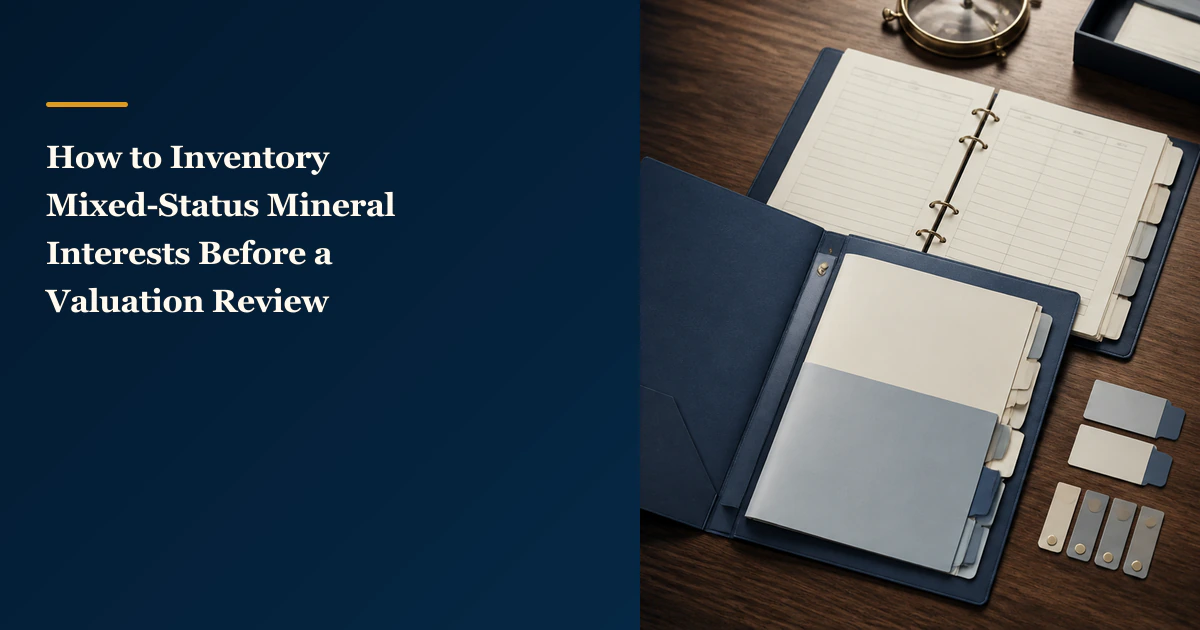
A mixed-status inventory gives every tract or interest its own dated row, preserves the label found in the file, links supporting evidence, and assigns unresolved follow-up without deciding status or value.
Direct answer for mineral owners
Create one dated row for every tract or interest. Copy the claimed status exactly as it appears in an owner-provided or located record, identify that record and its date, record the named payer or operator and the last payment or production month if shown, preserve every unknown, and assign a follow-up owner. The inventory organizes evidence; it does not verify ownership, determine operating or payment status, interpret documents, or estimate value.
Key takeaways for mineral owners
- Use one row per tract or interest so a mixed portfolio is not reduced to one broad status label.
- Label every status as claimed and record the as-of date and evidence document that supplied the label.
- Record payer, operator, and last payment or production month only when a dated record states them.
- Preserve unknowns instead of deciding what a deed, lease, check detail, production record, or notice means.
- Assign each missing record or unanswered question to a named follow-up owner before a separate review.
Administrative-only boundary. This worksheet organizes labels, dates, documents, identifiers, unknowns, and follow-up assignments. It does not verify ownership, determine whether an interest is producing, non-producing, in suspense, shut in, or otherwise classified, interpret a deed, lease, division order, check detail, notice, or production record, establish payment entitlement, estimate value, compare offers, or provide legal, title, land, tax, accounting, engineering, appraisal, investment, or financial advice. MRX provides educational information and resources only and does not buy mineral rights.
A mixed-status mineral interest inventory gives every tract or interest its own dated row. Copy the status label exactly as it appears in the owner-provided or located record, identify that evidence, preserve anything unknown, and assign the next record request or question to a follow-up owner.
Do not use one label for an entire inheritance file or portfolio when its components differ. The inventory is complete when each component has a traceable row and every gap has an owner. It is not complete because someone has decided what the records mean.
Start with one row per tract or interest
A portfolio may contain interests acquired at different times, in different counties, under different instruments, or associated with different payers and operators. One broad line labeled producing or non-producing can hide those differences.
Create a separate row whenever the file identifies a distinct:
- county, survey, abstract, block, section, tract, unit, lease, API number, or other record identifier;
- ownership fraction or interest description;
- payer or operator;
- document source;
- claimed status; or
- unresolved question that may require a different records custodian or reviewer.
Use a neutral row identifier such as TX-MIDLAND-A12-01. Do not put a Social Security number, bank account, taxpayer number, signature, or other sensitive identifier into a worksheet that may be shared. The document redaction checklist explains the separate pre-sharing review.
Use only the locked inventory fields
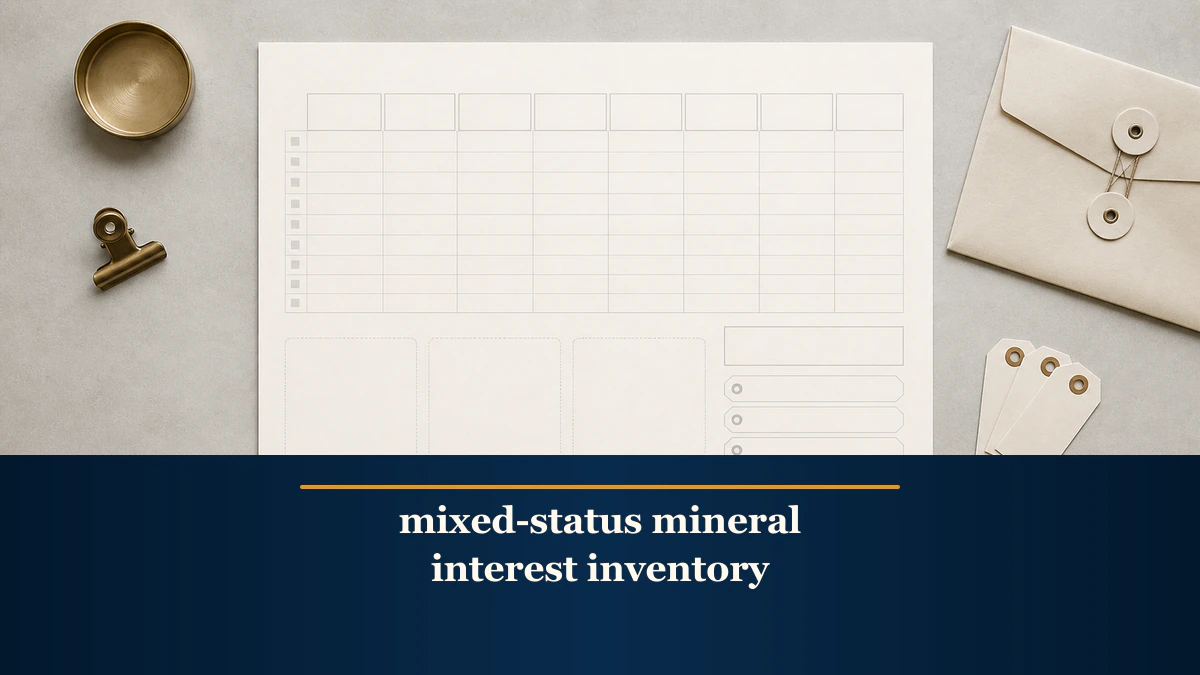
The worksheet needs eight fields:
| Field | What to record | What not to decide |
|---|---|---|
| Tract or interest identifier | Neutral internal row ID plus the exact public or document reference | Whether the identifier proves ownership or acreage |
| Claimed status | Label copied from a dated owner-provided or located record | Whether the status is legally or operationally correct |
| As-of date | Date shown on the source or the date the query or response was obtained | Whether the label remains current |
| Evidence document | File name, record type, page, query result, URL, or correspondence reference | What the document means |
| Payer or operator | Name exactly as shown in the evidence | Whether the entity currently owes payment or operates the interest |
| Last payment or production month | Month shown in the dated statement or public result | Why activity or payment changed |
| Unknown field | Missing, conflicting, or unclear item written as a neutral question | A guessed answer |
| Follow-up owner | Person responsible for requesting the record or routing the question | The professional conclusion |
Keep claimed status in the column heading. That phrase prevents a copied label from looking like an MRX finding.
Preserve the source of every claimed status
Write the label found in the file, not the label you expect. Examples may include producing, non-producing, suspense, shut-in, or unknown, but a label alone does not establish what is happening.
For every claimed label, capture:
- the exact document or record that supplied it;
- the document date or query date;
- the page, row, lease, well, account, owner, or reference number needed to find it again;
- who supplied or located the record; and
- whether a newer or conflicting record is already present.
If two records use different labels, do not overwrite one. Preserve both evidence references and write an unknown such as: Which record custodian can confirm the current administrative label and effective date?
The live guide to producing and non-producing mineral interests explains why different evidence may be available. This worksheet does not repeat that comparison or decide which valuation inputs apply.
Record official query results without turning them into conclusions
The Railroad Commission of Texas production-data page links to production queries and describes the results as production information reported to the Commission by operators. The Commission’s production-data FAQ also notes timing and revision limits. Use a result to record the query date, lease or well reference, reported period, and saved location. Do not use it to prove ownership, payment entitlement, or current status.
The RRC Public GIS Viewer can help locate survey, lease, API, well, and map references. The Commission expressly warns that GIS information is not an authoritative public record for a geographic location and has no legal force or effect. A GIS result belongs in the evidence-document field with its retrieval date and identifier.
The RRC oil and gas well-records page describes available well-file channels and the identifiers useful when requesting records. Log what was requested, the date, the identifying information supplied, and the response location. Do not interpret a filing or infer a mineral-interest status from it.
Add state-land and unclaimed-property searches only when relevant
The Texas General Land Office energy page provides state-land, lease, scanning, and mapping resources. If a file may concern state land or a state lease, record the GLO mineral-file, lease, tract, map, or request reference and the date located. Do not use the inventory to construe the state record or decide what rights it creates.
Texas Unclaimed Property provides the state’s search and claim channel. If an owner or decedent name is searched, record:
- the exact name used;
- the date searched;
- the result or claim reference;
- the holder name shown, if any; and
- the person assigned to contact the program or holder.
A result is a lead for follow-up. It is not proof that the person owns a mineral interest, that royalties are in suspense, or that funds are payable.
Keep payer and operator evidence in its own lane
If the file contains a first-party payer statement, operator portal document, owner-relations response, check detail, or correspondence, record its exact issuer, date, account or reference number, and saved location.
Do not translate a payer or operator label into a legal or operational conclusion. Do not decide why a payment stopped, whether deductions are valid, whether a division order is correct, or whether a lease remains effective. Turn the issue into a record request or a question for an appropriate reviewer.
For example:
Request the statement covering March through June from the named payer.Ask owner relations which record contains the current owner number.Route the conflicting lease identifiers to the qualified title reviewer.Ask the records custodian for the source and effective date of the claimed status.
Use unknowns as routing fields
An unknown is not a failure. It is a controlled field that prevents a guess from becoming a fact.
Write one question per unknown. Avoid conclusions such as well is inactive or royalties are suspended. Prefer:
Which dated record supports the claimed status?Does the payer have a statement for the missing month?Which API, lease, unit, or owner number belongs to this row?Which records custodian can confirm the source of this label?Which qualified professional should review the conflicting instruments?
Then assign a follow-up owner and target date. The owner may be the mineral owner, a family point person, the named payer or operator, a government records custodian, or an appropriately qualified professional. The field routes the task; it does not assign a conclusion in advance.
A blank inventory template
Copy this structure into a spreadsheet or document. Keep example rows blank so no fictional fact looks like a real property record.
| Tract or interest ID | Claimed status | As-of date | Evidence document | Payer or operator | Last payment or production month | Unknown field | Follow-up owner |
|---|---|---|---|---|---|---|---|
If an item does not apply, write not applicable and identify who made that administrative choice. If the answer is absent, write unknown. Do not leave a blank that another reader might mistake for a completed review.
Stop before interpretation or valuation
The inventory is ready to share when:
- every tract or interest has its own row;
- every claimed status is linked to a dated evidence reference;
- payer, operator, payment month, and production month appear only when a source states them;
- conflicting records remain separately visible;
- every missing item is written as a neutral question;
- each question has a follow-up owner; and
- sensitive information has been reviewed before sharing.
Stop if the next step would require interpreting title, a deed, lease, division order, probate record, suspense notice, shut-in clause, check detail, production record, or owner-relations response. Also stop before deciding ownership, status, payment entitlement, deductions, economics, valuation inputs, value, or an offer result.
A qualified attorney, landman, title professional, accountant, tax adviser, petroleum engineer, appraiser, financial professional, agency custodian, payer, or operator may be appropriate depending on the question. The completed inventory helps that person see the file structure and unresolved items. It does not replace their work.
Source scope and research boundaries
- RRC production data supports identifying the official production-query channel and preserving query references and dates.
- RRC Public GIS Viewer supports locating map, survey, lease, API, and well identifiers while preserving the Commission’s no-legal-force warning.
- RRC oil and gas well records supports logging record-request channels and identifiers.
- Texas GLO energy resources supports locating state-land and state-lease record references when applicable.
- Texas Unclaimed Property supports logging a dated owner-name search and result or claim reference.
These sources support record-location logistics only. They do not verify private mineral ownership, determine operating or payment status, interpret instruments or correspondence, establish entitlement, or estimate mineral-rights value.
Frequently asked questions
What does mixed-status mean in this inventory?
It means the owner file contains more than one claimed or unknown label across its tracts or interests, such as producing, non-producing, suspense, shut-in, or unknown. The worksheet records those labels without deciding whether they are correct.
Can this worksheet prove that I own a mineral interest?
No. It records documents and identifiers already located or requested. Ownership and title questions require review of the applicable instruments and records by appropriately qualified professionals.
Should I change a claimed status when public production data looks different?
No. Keep the original claimed status and its source in one field, record the dated public query as separate evidence, and write the apparent difference as an unresolved follow-up question.
Does an unclaimed-property result prove that royalties are in suspense?
No. Record the name searched, search date, result reference, and follow-up contact. A search result does not by itself prove mineral ownership, suspense status, or payment entitlement.
Can I use the completed inventory to estimate mineral-rights value?
No. The inventory is a records-preparation aid. A separate review would need to define the interest, evidence, assumptions, limitations, and appropriate professional scope before reaching any value-related conclusion.
Sources reviewed for this article
- Railroad Commission of Texas, oil and gas production data (accessed 2026-08-23)
- Railroad Commission of Texas, Public GIS Viewer (accessed 2026-08-23)
- Railroad Commission of Texas, oil and gas well records (accessed 2026-08-23)
- Texas General Land Office, energy and mapping resources (accessed 2026-08-23)
- Texas Comptroller, Texas Unclaimed Property (accessed 2026-08-23)
Related mineral-rights articles

Converting Monthly Royalty History Into a Valuation Baseline
A useful royalty-history baseline preserves each production month, property, product, decimal, price, tax, deduction, adjustment, and net payment before summarizing cash flow.
Read the post →
How to Locate an Unanswered Question in a Mineral Rights Worksheet
A mineral rights worksheet question locator points a reviewer to one exact unanswered item without changing or evaluating the worksheet.
Read the post →
Texas Mineral Rights: Producing vs. Non-Producing
Producing interests can be reviewed from payment and production history, while non-producing interests usually depend more on acreage, location, lease terms, and development uncertainty.
Read the post →
Mineral Rights Document Redaction Checklist Before You Share Records
A mineral-rights document redaction checklist separates preserved originals from limited share copies and records what was withheld without recording the sensitive value.
Read the post →A practical next step
Put your mineral rights in context.
Every mineral interest, royalty history, and written offer is different. Start with a question, or share what you have for a free underwriter review.
- Free
- Confidential
- No obligation to sell
Ready for a closer look?
Request an Underwriter ReviewGet a directional range with the assumptions clearly stated.
