
MRX Learning Center
Mineral Rights Document Redaction Checklist Before You Share Records
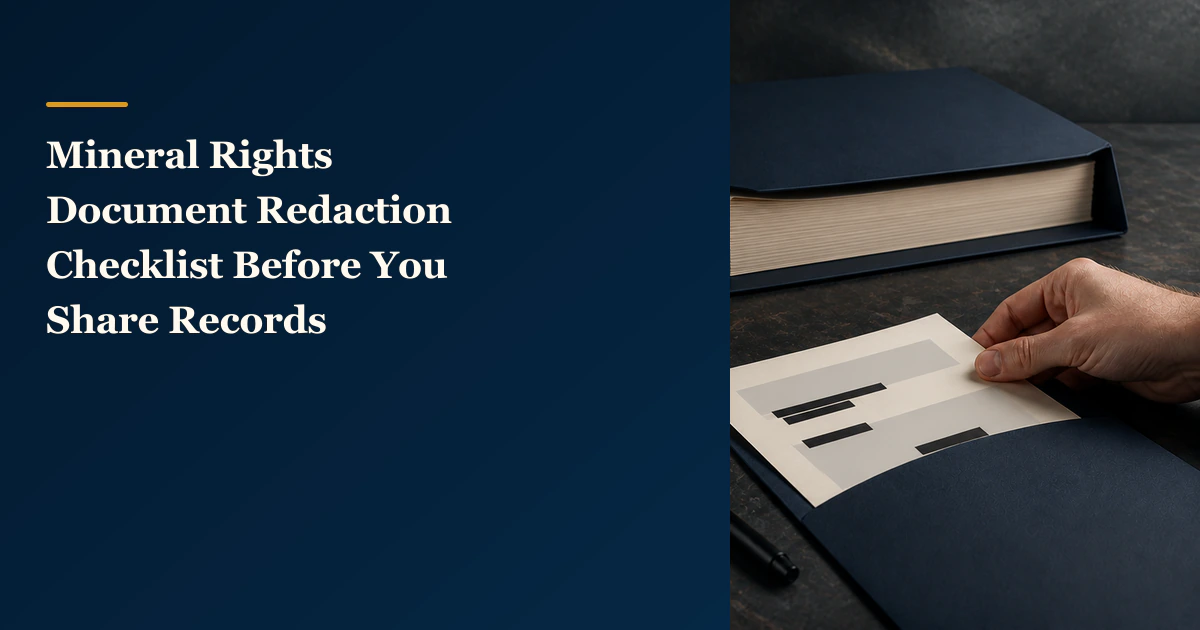
A mineral-rights document redaction checklist separates preserved originals from limited share copies and records what was withheld without recording the sensitive value.
Direct answer for mineral owners
Keep the original mineral-rights record unchanged. Make a separate share copy for one defined request, remove only fields that are unnecessary for that request, and record each withheld field type, page, reason, copy version, and date in a redaction log without copying the sensitive value into the log. If a field may be required for a transaction, tax, title, legal, or regulatory purpose, stop and get recipient-specific instructions or qualified advice before omitting it.
Key takeaways for mineral owners
- Never redact or annotate the original record; work only from a separate copy.
- Define the recipient and purpose before deciding which fields are necessary in the share copy.
- Log the field type and reason for each redaction without repeating the hidden value.
- A redacted copy is a preparation tool, not a confidentiality promise, recipient verification, legal conclusion, or substitute for a required complete record.
Document-preparation boundary. This article explains an owner-controlled way to preserve an original record, make a separate limited share copy, and document redactions. It does not promise confidentiality or security, verify a recipient, interpret privacy or tax law, determine what a person is entitled to receive, or advise concealing a material fact. It is not legal, tax, title, cybersecurity, fraud, or transaction advice. A complete unredacted record may be required for a defined closing, payment, tax, title, legal, court, agency, or regulatory purpose. Obtain recipient-specific instructions and qualified advice when that question arises. MRX provides educational information and resources only and does not buy mineral rights.
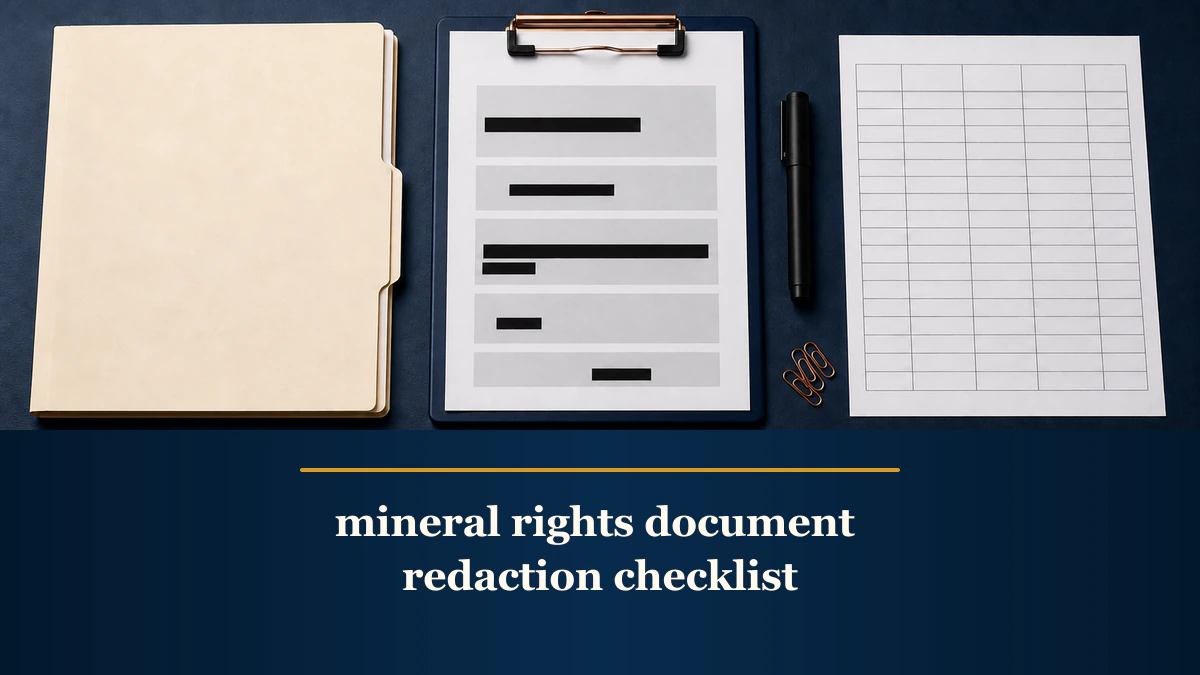
A mineral rights document redaction checklist has three separate parts: the preserved original, a purpose-limited share copy, and a redaction log. The original never changes. The share copy contains the information needed for one defined request. The log records what field type or area was withheld, why, and from which copy without repeating the sensitive value.
That separation matters. It lets an owner limit unnecessary information in one working copy without silently changing the historical record or pretending that a redacted copy is complete for every later purpose.
Define the request before touching a copy
Write one sentence that names the intended recipient, the requested task, and the records being considered. For example: “Prepare a royalty-statement copy for a reviewer to match the payor, owner number, lease, well, production month, and payment lines.”
The sentence is a scope control, not proof that the recipient is legitimate or entitled to the record. Recipient verification belongs in a separate process. If a request arrived unexpectedly, the Federal Trade Commission advises contacting the organization through a phone number or website you already know is real rather than relying on the link or contact details in the message. Use the separate offer-sender identity cross-check when identity is unresolved.
List the fields the stated task actually needs. A property-scope question may need the county, legal description, survey or abstract, recording reference, owner name, lease, well, unit, or payor identifier. A payment-line question may need the statement period, product, volume, price, deductions, decimal, and net payment. Do not remove those fields merely because they are personal to the owner’s case.
Then list fields that appear unrelated to the stated task. The distinction is purpose-specific. A bank account number may be unnecessary for an initial property-document review but later required by a verified payor through its defined payment setup. A completed tax form may be inappropriate in a general file packet but required by a person with an information-reporting purpose.
Preserve the original unchanged
Keep the original paper or digital file in its established record location. Do not mark it with a redaction pen, overwrite it, crop it, flatten it, rename it as though it were still the original, or discard pages. If the file already contains annotations, preserve that state and record where it came from.
Create a separate duplicate. Give the duplicate a version label that does not disclose sensitive information, such as a stable document ID plus “share-copy-v1.” Keep the original filename or archive reference in a private index so the copy can be traced back without pretending the copy is the controlling record.
Open the duplicate before editing. Confirm the page count, orientation, and legibility. After redaction, inspect the duplicate again. This is a visual quality check, not a security certification; different file formats and tools can preserve hidden layers or metadata in different ways. When that matters, use a qualified document-security process.
Build the redaction log first
Create one row for each field or area you may withhold:
| Log field | What to record |
|---|---|
| Document ID and page | Stable reference to the preserved original and exact page |
| Field type or area | “TIN field,” “bank-routing field,” or another neutral label |
| Purpose test | Why the field is not needed for this defined share-copy request |
| Recipient question | Any unresolved question about whether the field is required |
| Share-copy version | The exact working-copy version containing the redaction |
| Date and preparer | When the copy was prepared and by whom |
Do not copy the hidden number, signature, password, account credential, or other sensitive value into the log. The log should say what kind of field was withheld, not preserve the field’s content in another document.
If you cannot state why a field is unnecessary for the defined request, mark it needs recipient-specific instructions. Do not guess.
Apply a minimum-necessary test to the share copy
The current MRX privacy policy says owners may choose to provide mineral-interest facts, legal descriptions, chat messages, and PDF or image files they are authorized to share. It also tells users not to upload Social Security numbers, full bank or payment details, passwords, or information not needed for the question. The policy notes that OCR can reproduce sensitive text and that no system is perfectly secure.
The MRX terms separately require users to keep sign-in links secure and upload only files they are authorized to share. Those rules govern MRX’s first-party service; they do not decide what another recipient may need.
NIST SP 800-122 gives federal agencies context-based guidance for identifying personally identifiable information and selecting protections appropriate to the situation. This private-owner checklist borrows only the general discipline of identifying the field and considering context. The NIST publication is not a private mineral transaction rule and does not make every name, address, identifier, or record subject to the same treatment.
For an initial working copy, ask whether the defined task needs:
- a Social Security number, taxpayer identification number, or other government identifier;
- bank account, routing, card, or full payment details;
- passwords, security answers, one-time codes, or sign-in links;
- a signature image when the task does not require an executed instrument;
- unrelated family, beneficiary, tenant, employee, or contact information;
- unrelated account history or property records; or
- an attachment that belongs to a different owner, property, period, or purpose.
“Not needed for this copy” is not the same as “never required.” It means the field remains in the protected original while the owner confirms the next purpose and recipient.
Keep property and transaction facts that the task needs
Over-redaction can make a copy unusable or misleading. Do not remove a legal description, recording reference, lease or well identifier, owner name, authority reference, payment line, effective date, exhibit, signature, or other material fact when the defined task depends on it.
Do not create a redacted excerpt that makes a proposal, deed, lease, division order, statement, or tax form appear complete when material pages or terms are missing. If the recipient needs the complete instrument, the answer may be a verified controlled delivery process rather than a more heavily redacted copy.
This checklist does not decide whether a field is legally material or must be disclosed. When that question affects a sale agreement, title review, payment instruction, tax form, court record, agency filing, or professional engagement, stop and ask the appropriate recipient or qualified professional.
Treat completed tax forms as a separate stage
The IRS says Form W-9 is used to provide a correct taxpayer identification number to a person required to file an information return. The current form contains name, address, tax classification, account information when supplied, a Social Security number or employer identification number, and certifications.
That makes a completed W-9 different from a routine property-record share copy. Do not place a completed W-9 in a broad initial packet merely because it appears somewhere in the owner’s archive. Do not use this article to alter a form that a verified requester needs. Confirm the requester, reporting purpose, timing, and intended delivery method, and use a qualified tax professional for an owner-specific completion or disclosure question.
Inspect the finished share copy
Review every page of the copy, not just the page where you applied a redaction:
- confirm the original remains unchanged and separately stored;
- confirm the share-copy version matches the redaction log;
- verify each redaction fully covers only the intended field or area in the visible copy;
- check headers, footers, exhibits, marginal notes, and repeated identifiers;
- confirm required property, recording, production, payment, and transaction context remains legible;
- remove unrelated pages only when the recipient does not need them, and record the omission;
- make sure the log contains field types, not hidden values; and
- label unresolved necessity questions for follow-up.
Do not describe this inspection as proof that the file is secure, that hidden data cannot be recovered, or that delivery is confidential. It is a preparation check for the visible working copy.
Use a separate recipient and delivery check
A redaction decision answers “what appears in this copy?” It does not answer “who is asking?” or “how should the file be sent?”
The FTC’s phishing guidance explains that unexpected messages may seek passwords, account numbers, Social Security numbers, links, or attachments. Its identity-theft guidance supplies general consumer context for why unnecessary personal identifiers deserve care. Neither source proves that a particular mineral-rights request is fraudulent, and redaction does not prevent misuse.
Before delivery, use a known first-party channel, confirm that the intended recipient and request match the separate identity record, and retain the transmission receipt or confirmation with the correspondence index. Do not place passwords or one-time codes in the document package or redaction log.
Fictional royalty-statement redaction example
Assume an owner wants a reviewer to match one royalty statement to an offer’s property schedule. The statement contains the payor, owner number, lease and well identifiers, production month, decimal, product, volume, price, deductions, and net payment. It also contains a bank suffix and an unrelated mailing note.
The owner preserves the original statement unchanged. A separate share copy keeps the property and payment fields required for the match. The owner withholds the bank field and unrelated note, then creates two log rows:
- document ID and page, field type “bank field,” reason “not needed for property-and-payment match,” share-copy version, date; and
- document ID and page, field type “unrelated mailing note,” same purpose test, version, and date.
The log does not contain the bank digits or note text. The copy does not prove ownership, payment accuracy, offer quality, or the recipient’s legitimacy. It simply limits one working copy to the stated comparison task.
Checklist before sharing mineral records
Before sharing, confirm:
- the preserved original is unchanged and separately stored;
- the share copy has a distinct version;
- the intended recipient, request, and purpose are recorded;
- every withheld field has a log row;
- the log does not repeat a hidden value;
- information required for the defined task remains visible;
- unresolved disclosure questions are marked for recipient-specific instructions or qualified advice;
- a completed W-9 or other sensitive form is not included casually in a broad packet;
- recipient verification and delivery controls are handled separately; and
- no one describes the copy as a guarantee of confidentiality, security, legal compliance, or fraud prevention.
A useful mineral rights document redaction checklist is deliberately narrow. It protects the integrity of the original, limits one working copy to one defined purpose, and leaves a reproducible record of what was withheld and why. It does not decide what must be disclosed or replace professional advice when a complete record is required.
Frequently asked questions
Should I redact the original mineral-rights document?
No. Preserve the original unchanged. Create a separate working copy, confirm that the copy opens and remains legible, and apply any limited redactions only to that copy. Keep the original in its existing record location.
Which information can I remove from an initial share copy?
Start with the defined request. Social Security or taxpayer identification numbers, bank and routing details, passwords, one-time codes, unrelated account numbers, and unrelated personal information often fall outside an initial property-record question. Do not remove a field that may be required for the stated transaction, tax, title, legal, or regulatory purpose without recipient-specific instructions or qualified advice.
Should a redaction log include the hidden number or text?
No. Record the document ID, page, field type or area, reason, copy version, and date. Writing the concealed Social Security number, bank number, signature, or other sensitive value into the log would defeat the purpose of withholding it from the share copy.
Can I redact a completed Form W-9 before sending it?
Do not use this checklist to decide how to complete or alter a required tax form. The IRS says Form W-9 provides a taxpayer identification number to a requester with an information-reporting purpose. Confirm the requester, purpose, timing, and delivery method, and ask a qualified tax professional about an owner-specific question.
Does a redacted share copy guarantee confidentiality or safe delivery?
No. Redaction can limit what appears in one copy, but it does not verify the recipient, secure a device or channel, prevent copying, satisfy privacy law, or guarantee confidentiality. Use the intended channel and apply separate recipient and security checks.
Sources reviewed for this article
- Mineral Rights Xchange, Privacy Policy (accessed 2026-08-22)
- Mineral Rights Xchange, Terms of Use and AI Disclosure (accessed 2026-08-22)
- NIST SP 800-122, Guide to Protecting the Confidentiality of Personally Identifiable Information (accessed 2026-08-22)
- Federal Trade Commission, How To Recognize and Avoid Phishing Scams (accessed 2026-08-22)
- Federal Trade Commission, What To Know About Identity Theft (accessed 2026-08-22)
- Internal Revenue Service, About Form W-9 (accessed 2026-08-22)
- Internal Revenue Service, Form W-9 (Rev. March 2024; accessed 2026-08-22)
Related mineral-rights articles
How to Build a Mineral Rights Sale Document Package Index
A mineral-rights sale document package index reconciles every source file, page, exhibit, schedule, addendum, signature copy, and replacement without interpreting the documents.
Read the post →
How to Build a Mineral Rights Offer Correspondence Index
A mineral rights offer correspondence index records the identity and relationship of written messages and attachments without interpreting the offer or prescribing a response.
Read the post →
How to Build a Mineral Rights Offer Sender Identity Cross-Check
A sender identity cross-check organizes seven stated details across three evidence columns and labels each result only match, mismatch, or unverified.
Read the post →
Get a Free Mineral Rights Valuation Review Today
A free MRX valuation review organizes property, ownership, production, royalty, and offer evidence into a directional range with explicit assumptions and limits.
Read the post →A practical next step
Put your mineral rights in context.
Every mineral interest, royalty history, and written offer is different. Start with a question, or share what you have for a free underwriter review.
- Free
- Confidential
- No obligation to sell
Ready for a closer look?
Request an Underwriter ReviewGet a directional range with the assumptions clearly stated.