
MRX Learning Center
Winkler CAD 2025-2026 Mineral Reports: Recipients vs. Intended Users
The Winkler CAD contractor plan distinguishes receiving a mineral report from being identified as an intended user and limits the section to Pritchard & Abbott work.
Direct answer for mineral owners
The Winkler CAD 2025-2026 contractor plan says intended users are typically the clients under direct contract. It also says that taxpayers, agents, disclosure recipients, and people who obtain copies through open-records requests do not become intended users merely because they receive a report. Assignment-specific identification still matters.
Key takeaways for mineral owners
- The official source is a 30-page contractor plan printed in July 2024 for the 2025-2026 plan period.
- Whole-PDF page 19, printed page 17, says intended users are typically direct-contract clients.
- Receiving a report by law, courtesy, disclosure, or open-records request does not by itself establish intended-user status.
- The page separately describes potential other users without deciding who is an intended user in a particular assignment.
- The report section does not apply to mineral property appraised outside Pritchard & Abbott services.
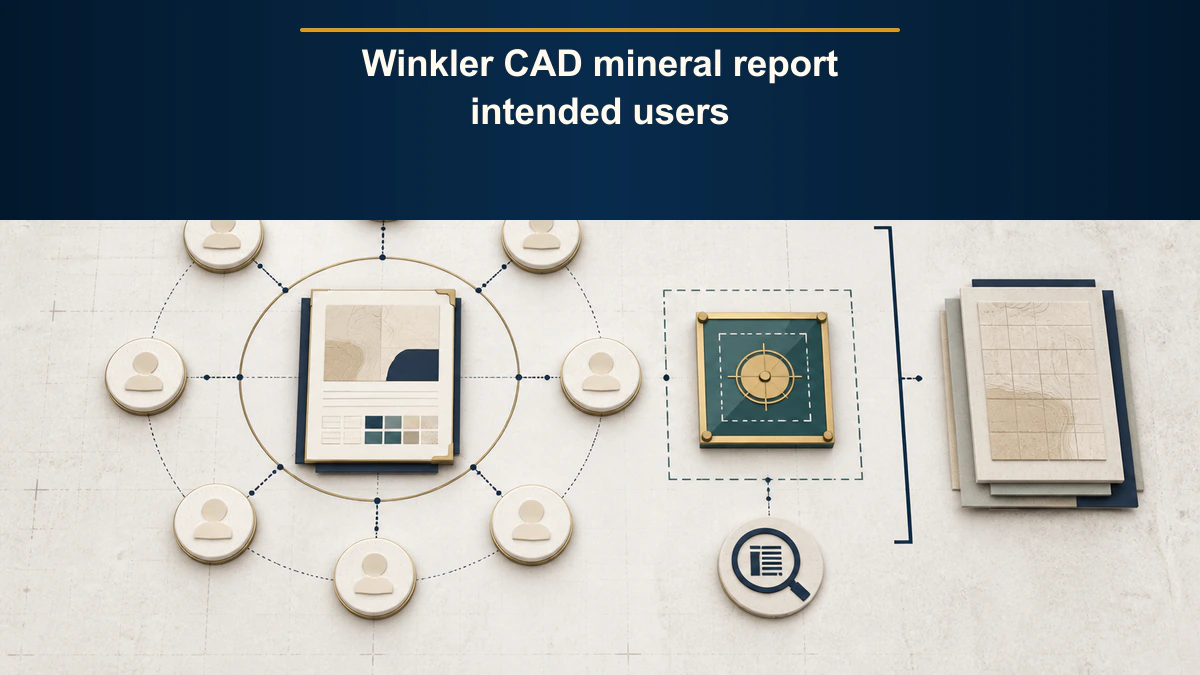
Published source map, not an assignment-specific determination. This page reports what an official Winkler CAD contractor plan says about report recipients and intended users. It does not decide who is an intended user for a particular assignment, interpret professional appraisal standards, validate a report, establish title or taxability, determine private mineral-rights value, or provide a transaction recommendation. Any later MRX assessment is directional only and is not an appraisal performed by a state-licensed or state-certified real estate appraiser. This page is not individualized legal, tax, title, accounting, engineering, or investment advice. MRX provides educational information and resources only and does not buy mineral rights.
The direct answer is: the Winkler CAD contractor plan says intended users are typically the clients for which Pritchard & Abbott is under direct contract. It also says that receiving a report does not automatically make a taxpayer, agent, disclosure recipient, or open-records recipient an intended user. The appraiser’s assignment-specific identification still matters.
That distinction appears on whole-PDF page 19, printed page 17 of the 2025-2026 Biennial Reappraisal Plan. The document was printed in July 2024. The 2025-2026 label is the plan period, not the print date.
The recipient and intended-user map
| Category described on the page | What the plan says | What this article does not conclude |
|---|---|---|
| Direct-contract client | Intended users are typically the clients for which Pritchard & Abbott is under direct contract. | That every client is an intended user for every report. |
| Taxpayer or taxpayer agent | These parties often receive reports by law or as a courtesy. Receipt does not automatically confer intended-user status. | Whether a named taxpayer or agent was specifically identified in an assignment. |
| Disclosure recipient | A party receiving a copy to satisfy disclosure requirements does not become an intended user unless the appraiser specifically identifies the party as one. | The legal effect of disclosure or whether a specific disclosure was sufficient. |
| Potential other user | The page lists dispute participants, reviewing governmental agencies, and private open-records recipients as potential other users. | That every person in a listed category is an intended user. |
| Property outside Pritchard & Abbott services | The page says this report section does not apply and directs readers to the appraisal district overall appraisal-standard report. | Which report controls a particular property without source-specific review. |
The table preserves the verbs used by the source. Typically, often receive, does not automatically, unless specifically identified, and potential do different work. Collapsing them into one label would remove the main information on the page.
Controlled source identity
The reviewed object is the official Winkler CAD 2025-2026 Biennial Reappraisal Plan.
| Control | Recorded value |
|---|---|
| Publisher route | Winkler County Appraisal District |
| Document heading | Reappraisal Plan of Mineral, Industrial, Utility and Related Personal Property |
| Plan period | Tax years 2025 and 2026 |
| Footer date | Printed July 2024 |
| Complete-file size | 378,650 bytes |
| Complete-file SHA-256 | 91df8414af2aee0c7609545f4a31385f54f46f06e980a87e89d9a99a8f85dff6 |
| Total PDF pages | 30 |
| Relevant locator | Whole-PDF page 19, printed page 17 |
| Retrieval and visual review | August 31, 2026 |
The Winkler CAD Data and Records page supplies the current official index route and labels the file as the 2025-2026 Biennial Reappraisal Plan. The index proves where the district listed the file when checked. It does not prove that future bytes, links, or practices will remain unchanged.
Why receiving a copy is not the same classification
The page separates delivery from assignment identity. A taxpayer might receive a report because a rule requires delivery or because a client or appraiser provides it as a courtesy. A private party might obtain a copy through an open-records request. Those are delivery paths.
The intended-user statement is narrower. The page ties the typical category to direct-contract clients and says a disclosure recipient becomes an intended user only when the appraiser specifically identifies that party as one. This article reports that distinction. It does not interpret the standard, decide whether a report satisfies it, or infer rights or obligations from the label.
For general questions about formal valuation work, the mineral-rights valuation near you guide explains why intended use, required credentials, effective date, workfile, and named users should be checked before work begins. That broader guide does not replace the exact Winkler page record here.
Potential other users are a separate source category
The page identifies three groups as potential other users:
- people involved in adjudicating valuation disputes, with examples such as review board members, lawyers, and judges;
- governmental agencies that periodically review appraisals for statutory purposes, with the Texas Comptroller’s Office as an example; and
- private parties who may obtain copies through open-records requests to governmental agencies.
The word potential prevents an automatic conclusion. The page does not say that every review board member, lawyer, judge, agency employee, or open-records requester is an intended user of every report. An assignment-specific report and its identification language would be needed before making a narrower statement.
The service-scope exception on the same page
The plan adds a separate scope boundary. It says this professional-standards report section from Pritchard & Abbott does not apply to mineral or mineral-interest property that an appraisal district appraises outside Pritchard & Abbott services. In that situation, the page directs readers to the appraisal district overall appraisal-standard report.
That statement changes the first source to inspect. It does not tell a reader which organization appraised a specific account, validate a report, or resolve a disagreement. Preserve the property reference and locate the applicable district or contractor report before relying on this section.
A four-field reading worksheet
Use four separate fields when reviewing a public mineral appraisal report:
| Field | Record | Stop condition |
|---|---|---|
| Report identity | Publisher, exact title, reporting period, page count, and file hash | Stop if the file or report identity is uncertain. |
| Delivery path | Law, courtesy, disclosure, open-records request, or another documented route | Do not treat delivery alone as intended-user identification. |
| Identification language | Exact client and intended-user language in the applicable assignment or report | Stop if the controlling assignment-specific text is missing. |
| Service scope | Whether the property falls within the contractor section or a district report | Stop before assigning the wrong report to a property. |
This worksheet is an evidence organizer. It is not a legal analysis, appraisal review, records request, or opinion about a specific report.
Claim, evidence, and limit register
The page uses eight stable claims:
- C314-01 · SOURCE-IDENTITY: the reviewed official PDF has 30 pages, the recorded byte count, and the recorded SHA-256. This does not prove future publisher bytes are identical.
- C314-02 · DATE-ROLES: the plan covers 2025-2026 and was printed in July 2024. The plan period is not the print date.
- C314-03 · TYPICAL-USERS: whole-PDF page 19 says intended users are typically direct-contract clients. It does not identify users for a particular assignment.
- C314-04 · TAXPAYER-RECEIPT: the page says taxpayers or agents may receive reports by law or courtesy without automatically becoming intended users.
- C314-05 · DISCLOSURE-RECEIPT: the page says disclosure receipt alone does not create intended-user status unless the appraiser specifically identifies the party.
- C314-06 · POTENTIAL-USERS: the page lists dispute participants, governmental reviewers, and private open-records recipients as potential other users. It does not make the category universal.
- C314-07 · SERVICE-SCOPE: the section does not apply to property appraised outside Pritchard & Abbott services. This article does not determine who appraised a specific property.
- C314-08 · INFERENCE-LIMIT: the page does not establish title, taxability, private value, report validity, professional-standard compliance, or a legal consequence.
Stable claim IDs let a later editor update one statement without silently changing the entire answer. A source update should preserve the new retrieval date, file identity, page locator, wording change, and conclusion limit.
Source age and known unknowns
The source is a July 2024 contractor plan for tax years 2025 and 2026. It is useful evidence for what that document says. It is not automatic proof of a later assignment, a later report, or current district practice after the plan period.
This source does not resolve:
- whether a particular taxpayer, agent, lawyer, agency, or requester was specifically identified as an intended user;
- which report applies to a specific mineral account;
- whether a report complied with a professional standard;
- whether a disclosure was legally sufficient;
- whether a public copy is complete or current; or
- any title, tax, valuation, protest, or transaction conclusion.
Those are stop conditions, not gaps to fill with assumptions.
How Article 314 differs from the adjacent Winkler article
The Winkler CAD mineral-data source-chain article owns RRC files, operator inputs, taxpayer records, monthly cadence, and related privacy limits on whole-PDF pages 23-24. This article owns the recipient-versus-intended-user boundary on whole-PDF page 19.
The two pages answer different questions:
- Article 313 asks where the plan says mineral appraisal inputs come from.
- Article 314 asks what the plan says about receiving a report and intended-user identification.
Neither article determines private mineral-rights value or interprets a property-specific report.
A citation-ready answer
The Winkler CAD contractor plan printed in July 2024 says intended users are typically direct-contract clients. It also says taxpayers, agents, disclosure recipients, and private parties obtaining copies through open-records requests do not become intended users merely by receiving a report. The plan preserves assignment-specific identification and a separate scope rule for property appraised outside Pritchard & Abbott services.
This answer states the document, time, categories, and limit. It does not promise search ranking, indexing, retrieval, or citation by an answer engine.
Questions to ask before relying on a report label
- Which exact report and assignment are you reading?
- Who is identified as the client?
- Which parties are specifically identified as intended users?
- How did the recipient obtain the copy?
- Does the contractor section apply to the property, or should the district overall report be used?
- Is a qualified appraisal or legal professional needed for the intended use?
For county-level context, use the Texas mineral-rights guide. For a transaction-specific question, book a confidential directional review while keeping report delivery, intended-user identification, service scope, title evidence, tax questions, and private value in separate lanes.
Frequently asked questions
Who are the typical intended users named in the Winkler CAD contractor plan?
The plan says intended users are typically the clients for which Pritchard & Abbott is under direct contract. That is a source-attributed plan statement, not a determination for a particular report or assignment.
Does receiving a mineral report make a taxpayer an intended user?
Not automatically. The plan says taxpayers or their agents may receive reports by law or courtesy, but receipt alone does not make them intended users as defined in the plan.
Does a disclosure recipient become an intended user?
The plan says a party receiving a copy to satisfy disclosure requirements does not become an intended user unless the appraiser specifically identifies the party as one. This article does not decide whether that occurred in any particular assignment.
What does the plan say about people who obtain reports through open-records requests?
It lists private parties who obtain copies through open-records requests among potential other users. The page does not establish intended-user status for every requester.
Does this article interpret professional appraisal standards or a specific mineral appraisal report?
No. It maps the wording and page location in one official plan. A qualified professional should address assignment-specific standards, compliance, or legal consequences.
Sources reviewed for this article
- Winkler CAD 2025-2026 Biennial Reappraisal Plan, printed July 2024 and accessed August 31, 2026. Recipient and intended-user discussion: whole-PDF page 19, printed page 17.
- Winkler CAD Data and Records, accessed August 31, 2026.
Frequently asked questions
Who are the typical intended users named in the Winkler CAD contractor plan?
The plan says intended users are typically the clients for which Pritchard & Abbott is under direct contract. That is a statement about the plan, not a determination for a particular report or assignment.
Does receiving a mineral report make a taxpayer an intended user?
Not automatically. The plan says taxpayers or their agents may receive reports by law or courtesy, but receipt alone does not make them intended users as defined in the plan.
Does a disclosure recipient become an intended user?
The plan says no, unless the appraiser specifically identifies that party as an intended user. This article does not decide whether that happened in any particular assignment.
What does the plan say about people who obtain reports through open-records requests?
It lists private parties who obtain copies through open-records requests among potential other users. That category does not establish intended-user status for every recipient.
Does this article interpret professional appraisal standards or a specific mineral appraisal report?
No. It maps the wording and page location in one official plan. A qualified professional should address assignment-specific standards or legal consequences.
Sources reviewed for this article
Related mineral-rights articles
Winkler CAD 2025-2026 Mineral Data Chain: RRC Files, Operator Inputs, and Taxpayer Records
The Winkler CAD contractor plan describes monthly RRC/operator files, supplemental appraisal inputs, ownership-information sources, and record-review roles.
Read the post →
Midland CAD Open Records Page: Mineral Files, Rolls, and Notices as Separate Source Routes
Midland CAD places its preliminary mineral roll, certified mineral roll, and mineral notices in different Open Records sections. Those routes do not validate a property record.
Read the post →
Understanding Mineral Rights Valuation Near You
The useful meaning of “near me” is a review tied to the mineral property’s jurisdiction, records, formation, and purpose, not simply the reviewer’s driving distance from the owner.
Read the post →
Winkler CAD 2025-2026 Mineral Appraisal: Why Cost Is Not Used and Market Is Rare
The Winkler CAD contractor plan explains why cost is generally not employed, a rigorous market approach is rare, and income is predominantly relied upon.
Read the post →A practical next step
Put your mineral rights in context.
Every mineral interest, royalty history, and written offer is different. Start with a question, or share what you have for a free underwriter review.
- Free
- Confidential
- No obligation to sell
Ready for a closer look?
Open the Texas Mineral Rights GuideGet a directional range with the assumptions clearly stated.
