
MRX Learning Center
Winkler CAD 2025-2026 Mineral Data Chain: RRC Files, Operator Inputs, and Taxpayer Records
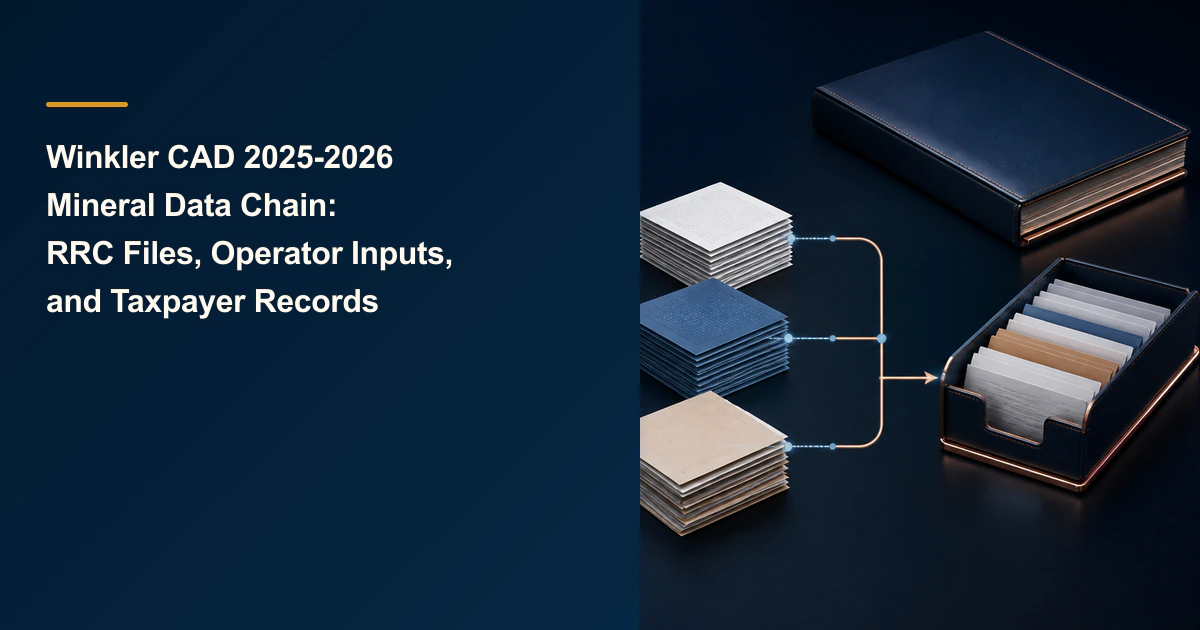
The Winkler CAD contractor plan describes monthly RRC/operator files, supplemental appraisal inputs, ownership-information sources, and record-review roles.
Direct answer for mineral owners
The July 2024 Winkler CAD contractor plan says its main mineral-property source is Railroad Commission of Texas data reported by operators and received monthly. It also describes fieldwork, operator financial data, local officials, publications, public tips, disbursing entities, and taxpayer records. Those inputs are appraisal-process sources, not proof of title, ownership, current production, private value, or an appraisal outcome.
Key takeaways for mineral owners
- The official 30-page source was printed in July 2024 for the 2025-2026 plan period.
- The plan describes monthly updated and new well and production files from RRC data reported by operators.
- It separately lists fieldwork, operator financial data, local officials, publications, newspapers, and public tips as supplemental inputs.
- The plan describes ownership-information inputs from disbursing entities under a confidentiality promise and from taxpayer-filed deeds or correspondence.
- A source category in an appraisal plan does not prove title, ownership, taxability, private value, production, reserves, model validity, or an outcome.
Published process description, not a property-specific conclusion. This page reports source categories and workflow statements from an official Winkler CAD contractor plan. It does not establish an owner’s identity, title, taxability, tax liability, private mineral-rights value, current production, reserves, model validity, an appraisal result, a protest result, or a transaction recommendation. Any later MRX assessment is directional only and is not an appraisal performed by a state-licensed or state-certified real estate appraiser. This page is not individualized legal, tax, title, accounting, engineering, or investment advice. MRX provides educational information and resources only and does not buy mineral rights.
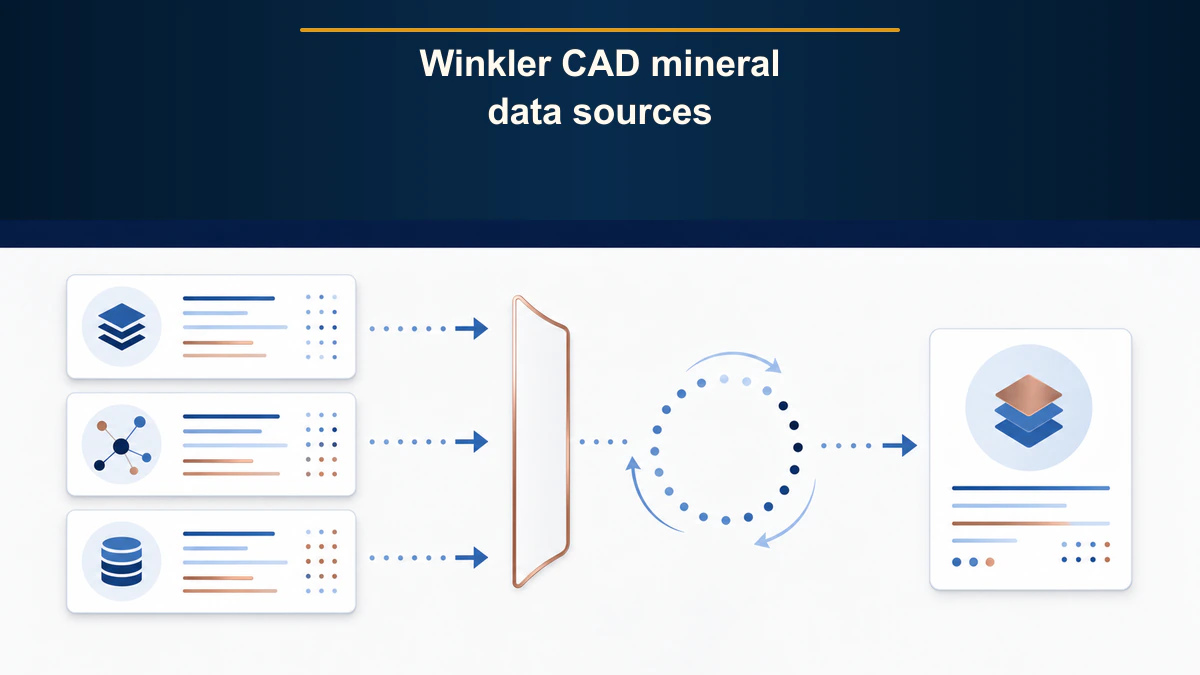
The direct answer is: the Winkler CAD contractor plan says its main mineral-property data source is Railroad Commission of Texas data as reported by operators, with updated and new well and production files received monthly. It also describes appraiser fieldwork, operator financial data, information from chief appraisers and tax assessors, trade publications, local newspapers, and facts supplied by members of the public.
For ownership information, the plan separately names pipeline purchasers or other entities that disburse income, including operators, and says those requests are made under a promise of confidentiality concerning owners’ personal information. It also names taxpayer-filed deeds of ownership transfer and direct correspondence from taxpayers.
These are source categories stated in a July 2024 plan for the 2025-2026 plan period. They do not prove that a particular person owns an interest, that a particular record is complete, or that a public appraisal input produces a private mineral-rights value.
Start with the exact source and date
The controlled source is the Winkler CAD 2025-2026 Biennial Reappraisal Plan. Its cover identifies tax years 2025 and 2026, while its footer says it was printed in July 2024. Keep those roles separate: 2025-2026 is the plan period, not the publication date.
The source-control record is:
- Publisher: Winkler County Appraisal District.
- Document: contractor biennial reappraisal plan for mineral, industrial, utility, and related personal property.
- Plan period: tax years 2025 and 2026.
- Printed: July 2024.
- PDF retrieved: August 31, 2026.
- PDF pages: 30.
- PDF bytes: 378,650.
- Complete-file SHA-256:
91df8414af2aee0c7609545f4a31385f54f46f06e980a87e89d9a99a8f85dff6. - Primary evidence page: whole-PDF page 23, printed page 21.
- Continuation page: whole-PDF page 24, printed page 22.
The hash identifies the exact complete-file object reviewed. It does not prove that the publisher will always serve the same bytes or that every process described in 2024 remains current. The Winkler CAD Data and Records page supplies the current official index route and lists the plan; it does not independently verify every workflow statement inside the PDF.
The main source and monthly cadence
Whole-PDF page 23, printed page 21, states that the main source of property data is Railroad Commission of Texas data as reported by operators. The plan then says its data-processing department receives updated and new well and production data in tapes or electronic files as a monthly activity.
That wording supports a narrow four-part statement:
- the named public agency is the Railroad Commission of Texas;
- the data are described as operator-reported;
- the files contain updated and new well and production data; and
- the stated receipt cadence is monthly.
The plan does not identify a specific file schema, query interface, retrieval timestamp, lease, well, operator, or account on that page. It also does not say that every operator report is complete, error-free, final, or sufficient for another purpose. Article 313 therefore reports the category and cadence without turning the statement into a record-level quality guarantee.
For practical RRC retrieval mechanics, use the separate Texas RRC production-data provenance worksheet. That article owns query identity and retrieval evidence. This one owns only the source role described in the Winkler plan.
Supplemental discovery inputs
The plan lists other discovery tools after the main RRC/operator source. They are separate categories with different evidentiary roles:
- Appraiser fieldwork: the plan names direct field activity as a discovery tool. It does not disclose a visit log or prove inspection of a specific property.
- Financial data from operators: the plan names operator financial information. It does not publish a property-level operating statement on the cited page.
- Chief appraisers and tax assessors: the plan names information from local appraisal and tax officials. It does not assign every fact to a particular office.
- Trade publications: the plan names industry publications as discovery inputs. It does not identify an article, issue, or fact used for a particular account.
- City and local newspapers: the plan names local news sources. A news item would still require its own date, publisher, claim, and verification.
- Members of the public: the plan says members of the public often provide information about new wells and other useful facts. A supplied fact is an input, not automatic verification.
Putting these categories on one list does not make them interchangeable. A public-agency regulatory record, an operator submission, a field observation, a local-government communication, a publication, and a public tip can differ in authority, granularity, timing, confidentiality, and error risk.
Ownership-information sources and the privacy boundary
The same page describes another source lane for ownership information. It says mineral leases are commonly fractionated among several or many owners, then identifies two pathways.
First, the plan describes requesting information from pipeline purchasers or other entities, such as operators, that disburse income to mineral-interest owners. It expressly pairs that request with a promise of confidentiality concerning owners’ personal information.
Second, the plan identifies taxpayers who file deeds of ownership transfer or correspond with the contractor or appraisal district directly.
The safe conclusion is limited: the plan describes those entities and taxpayers as ownership-information inputs within its process. This article does not claim that the inputs are public, that MRX has access to them, that MRX reviewed them, or that a reader can retrieve them through the public Data and Records page.
It also does not elevate an appraisal-system input into a title conclusion. A taxpayer submission, deed copy, operator record, purchaser record, pay-deck record, division order, and recorded instrument can serve different purposes. Ownership and title questions require the controlling recorded documents, relevant chain of title, and qualified professional review.
Statewide downloads and individual record enrichment
The plan distinguishes two collection scales. It says production and price data for the entire state are downloaded into the computer system together. It then says appraisers individually gather and record specific information in appraisal-file records.
That distinction matters:
- Statewide collection supplies broad production and price inputs across the company’s work.
- Property-specific collection adds particular information to an appraisal file.
The plan does not publish the complete field list, transformation logic, error-resolution rules, or contents of any specific appraisal file on the cited page. It therefore cannot support a claim that an individual file contains every record needed for title, tax, production, reserve, or private-value analysis.
The related CAD account, RRC lease ID, and operator number crosswalk explains why identifiers from different record systems should not be treated as interchangeable. An identifier can help join evidence without proving that two systems define the same property, owner, or legal interest.
What the plan says about review
After its collection discussion, whole-PDF page 23 moves into model calibration and individual value review. It says schedules or software are reviewed or enhanced annually and tested before appraisal work. It also describes appraiser review of model indicators, taxpayer opportunities to review appraised values, and operator meetings that may provide inputs not readily available through public or commercial sources.
The review sentence continues onto whole-PDF page 24, printed page 22, where the plan says values remain subject to the ordinary protest and appraisal review board process. That page then begins a separate performance-test section.
Article 313 uses those statements only to show that collection is followed by review steps. It does not test the software, audit an input, validate a model, score appraisal quality, predict a notice, determine a protest result, or endorse a process. Performance-test language is context, not proof of property-specific accuracy.
The Upton CAD mineral appraisal review-chain article owns a separate district’s source-to-calibration-to-performance-study job. This Winkler article stays focused on data-source categories and their boundaries.
What the source chain cannot prove
The presence of a source category in a public plan cannot by itself establish:
- the identity or decimal interest of an owner;
- whether a deed, lease, or transfer is valid or controlling;
- whether a particular account is taxable or correctly classified;
- the completeness or accuracy of an operator or public record;
- current production, reserves, decline, expenses, or future development;
- a public appraisal result or likely protest result;
- the private-sale value of mineral rights;
- whether an offer is fair; or
- a legal, tax, title, accounting, engineering, or investment recommendation.
Each conclusion needs its own evidence, effective date, purpose, and qualified reviewer. The public plan is useful for understanding a described workflow, not for filling gaps in a property-specific evidence package.
Source age and refresh rules
The plan was printed in July 2024 for tax years 2025 and 2026. It was retrieved on August 31, 2026. That timing makes it useful for documenting what the plan says about its own period, but it is not proof of a later tax year’s process.
On refresh:
- redownload the file from the official Winkler CAD index;
- record the new byte count and complete-file hash;
- verify the plan period and July 2024 print statement;
- recheck whole-PDF page 23, printed page 21, for source and cadence language;
- recheck whole-PDF page 24, printed page 22, for the review continuation; and
- separate any new plan, contractor revision, or later district statement from this historical object.
If the publisher serves different bytes, do not silently carry forward the old page map. Preserve the earlier object identity and review the new file as a new source version.
Claim, evidence, and limit map
The article uses eight stable claims:
- C313-01 · SOURCE-IDENTITY: the reviewed PDF has 30 pages and the recorded byte count and SHA-256. This does not prove later publisher bytes are identical.
- C313-02 · DATE-ROLES: the plan covers 2025-2026 and was printed in July 2024. The plan period is not its print date.
- C313-03 · MAIN-SOURCE: page 23 says the main source is RRC data reported by operators. This does not establish record-level completeness.
- C313-04 · MONTHLY-CADENCE: page 23 describes monthly receipt of updated and new well and production files. It does not prove the current cadence after the plan period.
- C313-05 · SUPPLEMENTAL-SOURCES: the plan lists fieldwork, operator financial data, local officials, publications, newspapers, and public tips. Each remains a separate input category.
- C313-06 · OWNERSHIP-INPUTS: the plan describes disbursing entities under a confidentiality promise and taxpayer submissions. This does not imply MRX access or prove title.
- C313-07 · COLLECTION-SCALES: the plan distinguishes statewide downloads from specific information added to appraisal files. It does not disclose a complete file schema.
- C313-08 · REVIEW-LIMIT: pages 23-24 describe later review activity. This does not validate a model, appraisal outcome, or protest result.
Stable claim IDs make a later update auditable. If the source changes, revise only the affected claim after preserving the new retrieval date, file identity, page location, and source-specific limit.
A citation-ready answer
The Winkler CAD contractor plan printed in July 2024 says its main mineral-property source is Railroad Commission of Texas data reported by operators, with updated and new well and production files received monthly. It also lists fieldwork, operator financial data, local officials, publications, public tips, specified disbursing entities, and taxpayer records. These are appraisal-process inputs, not proof of title, private value, production, reserves, or an appraisal outcome.
This answer identifies the plan period, source categories, cadence, and inference stop without implying access to confidential data or turning public-process evidence into a private valuation.
Questions to ask before relying on a source input
- Which exact source supplied the fact: public agency file, operator submission, fieldwork, local official, publication, public tip, disbursing entity, or taxpayer record?
- What retrieval, effective, reporting, or filing date belongs to that source?
- Is the information public, commercially licensed, confidential, or property-owner supplied?
- Which identifier connects the record to a lease, well, account, tract, or interest?
- Does the intended conclusion require title, tax, engineering, appraisal, or other qualified professional review?
For broader context, use the Texas mineral-rights guide. For a transaction-specific question, book a confidential review and keep public appraisal-process inputs separate from title, tax, production, private-value, and offer evidence.
Frequently asked questions
What is the main mineral-property data source named in the Winkler CAD plan?
The plan says the main source is Railroad Commission of Texas data as reported by operators. It says updated and new well and production files are received monthly.
What other data sources does the plan describe?
It lists appraiser fieldwork, operator financial data, chief appraisers, tax assessors, trade publications, city and local newspapers, and information from members of the public.
Where does the plan say ownership information comes from?
It describes requests to pipeline purchasers or other disbursing entities such as operators under a confidentiality promise, plus taxpayer-filed deeds of transfer and direct taxpayer correspondence.
Does MRX have access to the confidential inputs described by the plan?
This article makes no such claim. It reports what the public plan says and does not imply that MRX possesses, reviewed, can retrieve, or can disclose confidential appraisal inputs.
Do these source categories prove what my mineral rights are worth?
No. They do not establish title, ownership, taxability, private value, current production, reserves, model validity, an appraisal result, or a protest outcome.
Sources reviewed for this article
- Winkler CAD 2025-2026 Biennial Reappraisal Plan, printed July 2024 and accessed August 31, 2026. Data source and review discussion: whole-PDF pages 23-24, printed pages 21-22.
- Winkler CAD Data and Records, accessed August 31, 2026.
Frequently asked questions
What is the main mineral-property data source named in the Winkler CAD plan?
The plan says the main source is Railroad Commission of Texas data as reported by operators. It says updated and new well and production files are received monthly.
What other data sources does the plan describe?
It lists appraiser fieldwork, operator financial data, chief appraisers, tax assessors, trade publications, local newspapers, and information from members of the public.
Where does the plan say ownership information comes from?
It describes requests to pipeline purchasers or other disbursing entities such as operators under a confidentiality promise, plus taxpayer-filed deeds of transfer and direct taxpayer correspondence.
Does MRX have access to the confidential inputs described by the plan?
This article makes no such claim. It reports what the public plan says and does not imply that MRX possesses, reviewed, can retrieve, or can disclose confidential appraisal inputs.
Do these source categories prove what my mineral rights are worth?
No. They do not establish title, ownership, taxability, private value, current production, reserves, model validity, an appraisal result, or a protest outcome.
Sources reviewed for this article
Related mineral-rights articles
Upton CAD 2025-2026 Mineral Appraisal Review Chain: Sources, Calibration, and PVS
Follow the Upton CAD plan’s printed sequence from source categories and calibration to individual review and its stated state performance test.
Read the post →
CAD Account Number, RRC Lease ID, and Operator Number in Texas Mineral Records
A CAD account number, API number, RRC lease or gas-well ID, district, and P-5 operator number identify different record objects and should not share one field.
Read the post →
Texas RRC Production Data Query Retrieval Provenance Worksheet
A PDQ retrieval provenance worksheet preserves one official path, controlled criteria, displayed state, retained reference, and bounded result without interpreting production data.
Read the post →
Upton CAD 2026 Mineral Data Files: 2,260-Byte TXT Records and a Nested CSV Header
Treat Upton CAD’s TXT and CSV members as separate source objects, preserve exact bytes, and stop before owner-row inspection or unsupported schema conclusions.
Read the post →A practical next step
Put your mineral rights in context.
Every mineral interest, royalty history, and written offer is different. Start with a question, or share what you have for a free underwriter review.
- Free
- Confidential
- No obligation to sell
Ready for a closer look?
Open the Texas Mineral Rights GuideGet a directional range with the assumptions clearly stated.
