
MRX Learning Center
Upton CAD 2025-2026 Mineral Appraisal Review Chain: Sources, Calibration, and PVS
Follow the Upton CAD plan’s printed sequence from source categories and calibration to individual review and its stated state performance test.

Direct answer for mineral owners
The Upton CAD 2025-2026 plan presents a source-reading sequence from data collection through model calibration, individual value review, and a stated Comptroller performance test. That section order is not proof of an account-specific workflow, and the plan’s PVS language must remain separate from current Comptroller SDPVS and ADRS terminology.
Key takeaways for mineral owners
- Physical pages 21-24 correspond to printed pages 19-22 in the reviewed plan.
- The plan lists data-source categories before describing model calibration and individual review.
- The plan’s performance-test section uses a Property Value Study label; current Comptroller pages distinguish SDPVS from ADRS.
- Section order does not prove which sources were used for an account or that every account followed the same chronology.
- The plan does not establish a reader’s title, appraisal correctness, tax, private mineral value, offer, or transaction result.
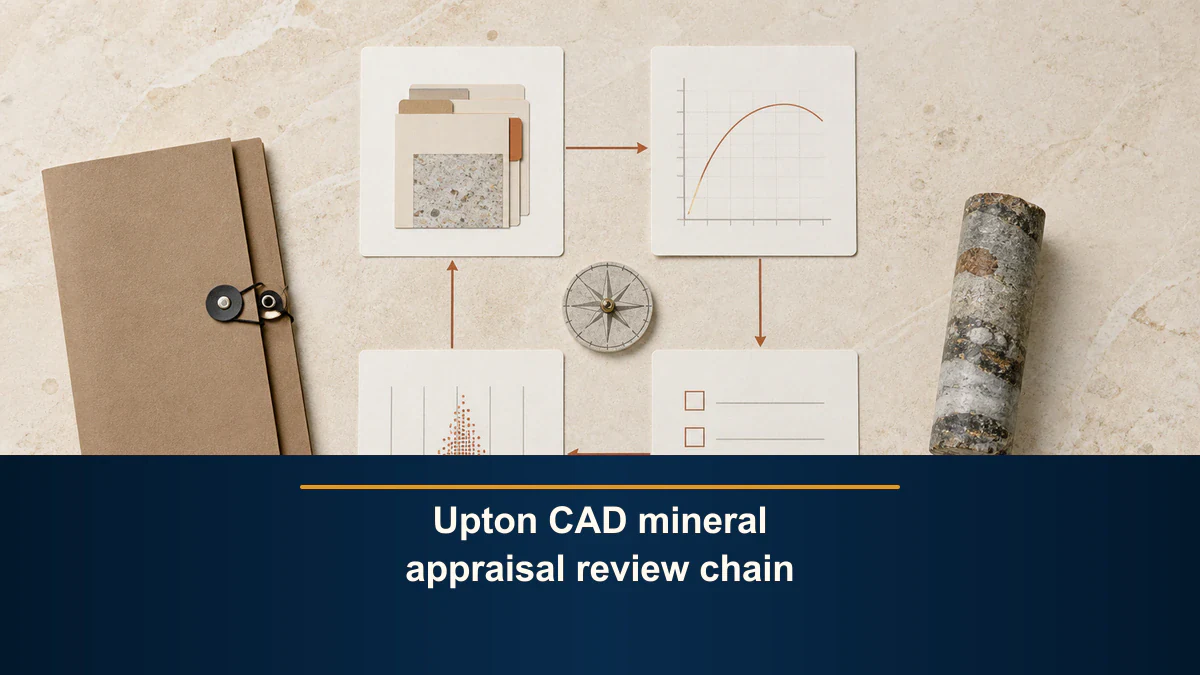
Source map, not an account audit. This page maps four adjacent sections in one Upton County Appraisal District reappraisal plan. It does not prove that every account followed the sections in chronological order; identify a person, account, lease, well, or property; show which source was used for a particular account; validate an appraisal method or result; recommend a protest action; or establish title, ownership, tax, legal effect, private mineral value, an offer, or a transaction result. MRX provides educational information and resources only and does not buy mineral rights.
The direct answer is: the reviewed Upton CAD plan moves from source categories to model calibration, then to individual value review, and finally to a stated Comptroller performance test. Those sections appear on physical pages 21 through 24, which are printed pages 19 through 22 inside the document.
That is a reading sequence, not evidence about one account. The official Upton CAD 2025-2026 Reappraisal Plan describes general source categories and procedures. It does not disclose which inputs were used for a reader’s property, whether an input was complete or corrected, or whether a resulting value was accurate.
Use both page locators
The PDF contains introductory material before the relevant printed pages. Preserve both locator systems so another reader can reach the same section.
| Review stage | Physical PDF page | Printed page | Safe reading job |
|---|---|---|---|
| Appraisal resources and model specification | 21 of 94 | 19 | Identify source categories and the start of the approach discussion |
| Approach discussion | 22 of 94 | 20 | Record the plan’s stated market-data limits and predominant approach |
| Data collection, calibration, and individual review | 23 of 94 | 21 | Separate general source, calibration, and review statements |
| Performance tests | 24 of 94 | 22 | Preserve the plan’s state-test wording and measures |
The Upton CAD Data and Records page is the official publisher route and displays the plan link. A publisher route establishes provenance. It does not establish that the plan remains unchanged, that every stated procedure was applied to every account, or that an account result is correct.
Stage 1: identify source categories without claiming account use
Physical page 21 / printed page 19 says historical production, price, and expense data are collected from various sources and entered into a computer system. It names state agencies and commercial data firms as examples and says property characteristics drive a computer-assisted mass-appraisal approach.
Physical page 23 / printed page 21 supplies more source categories. It names Railroad Commission data as reported by operators, updated well and production files, fieldwork, operator financial data, chief appraisers, tax assessors, trade publications, local news sources, public information, pipeline purchasers or operators for ownership information, taxpayer-filed deeds, and correspondence.
| Claim ID | Source statement preserved | Inference stop |
|---|---|---|
| C306-01 | The plan lists multiple government, commercial, operator, taxpayer, and public source categories. | Do not say a listed source was used for a particular account. |
| C306-02 | The plan describes electronic and field collection plus account-specific file records. | Do not publish a record or infer completeness, ownership, or accuracy. |
The word source does not mean verified fact. A source can be outdated, incomplete, corrected later, mapped to the wrong period, or unsuitable for a specific conclusion. The article therefore records the plan’s categories without validating the underlying data.
Stage 2: keep calibration statements as attribution
Physical page 23 / printed page 21 says schedules or discounted-cash-flow software are revised or enhanced annually and tested before appraisals. It describes multiple tests with varying inputs and names several benchmark indicators. It also says that disclosed, verifiable market transactions may be analyzed and compared with industry benchmarks before being incorporated into calibration.
| Claim ID | Plan-attributed observation | What it does not prove |
|---|---|---|
| C306-03 | The plan describes annual model revision or enhancement and multiple calibration tests. | It does not expose the tested inputs, approve a model, or prove an account result. |
| C306-04 | The plan describes a conditional comparison with disclosed and verifiable transactions. | It does not establish that a transaction was available, comparable, used, or correctly interpreted. |
The preceding page says the contractor generally relies predominantly on an income approach for mineral interests. Preserve that as the contractor’s statement in this plan. It is not an MRX recommendation, a universal appraisal rule, or a shortcut for estimating a private mineral-rights sale value.
Stage 3: separate individual review from protest rights
The Individual Value Review Procedures section on physical page 23 / printed page 21 says individual property values are reviewed several times. It describes generated benchmark indicators, appraiser review, taxpayer opportunities to review appraised values, operator meetings, and the normal protest and Appraisal Review Board process.
That paragraph combines several review contexts. Keep them separate.
| Claim ID | Review context | Boundary |
|---|---|---|
| C306-05 | Internal appraiser and benchmark review | Not proof that a specific field or result was checked correctly |
| C306-06 | Taxpayer or operator review opportunity | Not proof that a meeting occurred or changed a value |
| C306-07 | Normal protest and ARB procedures | Not legal advice, a deadline, an eligibility decision, or a protest recommendation |
For a source-focused reading of review limits in another county plan, use the Pecos CAD oil-and-gas review guide. It retains the Pecos-specific job. This page retains only the Upton plan sequence.
Stage 4: preserve the plan’s test label and check current terms
Physical page 24 / printed page 22 says the State Comptroller conducts an independent appraisal-performance test through an annual Property Value Study for school-funding purposes. The paragraph mentions uniformity, median level of appraisal, coefficient of dispersion, preliminary appeals, and a published report.
The plan was printed in July 2024. Current Comptroller pages use more specific labels. The Property Tax Assistance Division overview distinguishes the School District Property Value Study (SDPVS) from the Appraisal District Ratio Study (ADRS). The current reports page describes ADRS as measuring appraisal-district uniformity and median appraisal levels and lists median, coefficient-of-dispersion, and other published measures.
| Claim ID | Terminology layer | Safe conclusion |
|---|---|---|
| C306-08 | July 2024 Upton plan | The plan uses a Property Value Study label in its performance-test section. |
| C306-09 | Current Comptroller overview | SDPVS and ADRS are separate studies with different purposes. |
| C306-10 | Current Comptroller reports page | ADRS reporting includes median level, coefficient of dispersion, and other measures. |
Do not silently relabel the older paragraph as only SDPVS or only ADRS. The better source-control response is to preserve the plan’s wording, show the current distinction, and stop before a current Upton result unless a separately verified current result is in scope.
Discrepancy register
| Register ID | Observed difference or uncertainty | Required handling |
|---|---|---|
| D306-01 | The plan is for tax years 2025-2026 but says it was printed in July 2024. | Label both the covered years and print date. |
| D306-02 | The plan uses a broad Property Value Study label; current Comptroller pages distinguish SDPVS and ADRS. | Preserve both layers and do not treat the labels as interchangeable. |
| D306-03 | The plan lists source categories but no account-specific source manifest. | Do not claim source use for a person, property, or account. |
| D306-04 | Section order appears in the document, but account chronology is not proven. | Describe a reading sequence, not a universal workflow. |
Preserve the exact source object
The controlled plan copy was retrieved on August 31, 2026. It is 7,275,413 bytes, contains 94 physical PDF pages, and has SHA-256 216ea3d58ddc8117385a8c8338250460d39bcc91020f2306affeaf59cd071daf. The PDF is a scan without an extractable text layer, so the relevant pages were rendered and visually inspected.
The hash identifies the reviewed bytes. It does not prove authorship, completeness, current application, account treatment, appraisal accuracy, or legal effect. If the publisher replaces the file, record the new bytes, hash, date, page locators, and affected claims as a new source state.
Stable claims and source evidence
| Claim ID | Supported statement | Stop state |
|---|---|---|
| C306-01 | The plan lists multiple data-source categories. | Do not claim account-specific use. |
| C306-02 | The plan describes general collection procedures. | Do not infer source completeness or ownership. |
| C306-03 | The plan describes annual model revision and calibration tests. | Do not approve a model or calculate value. |
| C306-04 | Disclosed, verifiable transactions may enter a conditional comparison. | Do not infer availability, comparability, or use. |
| C306-05 | The plan describes internal review. | Do not certify a result. |
| C306-06 | The plan describes taxpayer and operator review opportunities. | Do not infer that a meeting occurred. |
| C306-07 | The plan references protest and ARB procedures. | Do not give legal advice or recommend a protest. |
| C306-08 | The plan uses a Property Value Study label. | Do not silently rewrite the source. |
| C306-09 | Current Comptroller pages distinguish SDPVS and ADRS. | Do not collapse the studies into one label. |
| C306-10 | Current ADRS materials describe published statistical measures. | Do not infer a current Upton result. |
Frequently asked questions
What is the Upton CAD mineral appraisal review chain?
It is a reading map for four adjacent plan sections: sources of data, model calibration, individual value review, and the plan’s stated performance test. It is not an account audit or proof of chronological execution.
Where are the four sections in the PDF?
They run from physical pages 21 through 24, corresponding to printed pages 19 through 22.
Does the plan say which source was used for a particular account?
The cited pages list source categories and general procedures. This article does not claim that a particular source was used for a particular account.
Are PVS, SDPVS, and ADRS interchangeable labels?
No. This article preserves the plan’s Property Value Study wording while using current Comptroller pages to distinguish the School District Property Value Study from the Appraisal District Ratio Study.
Does the plan determine a private mineral-rights sale value?
No. It is a tax-appraisal plan. This article does not calculate or validate a private sale value, offer, tax result, or transaction outcome.
Practical conclusion for mineral owners
The citation-ready answer is bounded: physical pages 21 through 24 move from general source categories to calibration, individual review, and a stated Comptroller performance test. Preserve the plan’s section order, print date, page locators, exact source identity, and PVS wording. Then keep that older wording separate from current Comptroller SDPVS and ADRS terminology. Stop before account chronology, source-use claims, personal data, model approval, protest advice, current Upton findings, title, tax, private value, an offer, or a transaction result.For the wider ownership and transaction framework, continue with the Texas Mineral Rights Guide. Search visibility, answer-engine retrieval, and LLM citations are dated distribution outcomes if later observed; they do not validate a plan statement or an account-specific conclusion.
Sources
- Upton CAD 2025-2026 Reappraisal Plan, accessed August 31, 2026.
- Upton County Appraisal District Data and Records, accessed August 31, 2026.
- Texas Comptroller Property Tax Assistance About Us, accessed August 31, 2026.
- Texas Comptroller Property Tax Data Reports and Surveys, accessed August 31, 2026.
Frequently asked questions
What is the Upton CAD mineral appraisal review chain?
It is a reading map for four adjacent plan sections: sources of data, model calibration, individual value review, and the plan’s stated performance test. It is not an account audit or proof of chronological execution.
Where are the four sections in the PDF?
The reviewed material runs from physical pages 21 through 24, corresponding to printed pages 19 through 22.
Does the plan say which source was used for a particular Upton account?
The cited pages list source categories and general procedures. This article does not claim that a particular source was used for a particular account.
Are PVS, SDPVS, and ADRS interchangeable labels?
No. This article preserves the older plan’s Property Value Study wording while using current Comptroller pages to distinguish the School District Property Value Study from the Appraisal District Ratio Study.
Does the plan determine a private mineral-rights sale value?
No. The article records a tax-appraisal plan’s statements. It does not calculate or validate a private sale value, offer, tax result, or transaction outcome.
Sources reviewed for this article
Related mineral-rights articles
Upton CAD 2026 Mineral Data Files: 2,260-Byte TXT Records and a Nested CSV Header
Treat Upton CAD’s TXT and CSV members as separate source objects, preserve exact bytes, and stop before owner-row inspection or unsupported schema conclusions.
Read the post →
Upton CAD Open Records Policy: Request, Response, Clarification, and Charge States
Read Upton CAD’s local policy and current Texas OAG guidance as separate layers, then preserve every request, response, clarification, and charge discrepancy.
Read the post →
Pecos CAD Oil and Gas Review: Infrequent Sales and Multi-Site Limits
Pecos CAD’s plan describes annual oil-and-gas appraisal review and explains why infrequent, nonpublic, bundled sales can limit appraisal-to-sales analysis.
Read the post →
Winkler CAD 2025-2026 Mineral Appraisal: Why Cost Is Not Used and Market Is Rare
The Winkler CAD contractor plan explains why cost is generally not employed, a rigorous market approach is rare, and income is predominantly relied upon.
Read the post →A practical next step
Put your mineral rights in context.
Every mineral interest, royalty history, and written offer is different. Start with a question, or share what you have for a free underwriter review.
- Free
- Confidential
- No obligation to sell
Ready for a closer look?
Open the Texas Mineral Rights GuideGet a directional range with the assumptions clearly stated.
