
MRX Learning Center
Understanding the Mineral Rights Assessment Errors
Assessment errors become easier to correct when each mismatch has a detection test, containment action, correction record, and limited rerun scope.

Direct answer for mineral owners
Common assessment errors include reviewing the wrong interest, mixing units or dates, mismatching production and payments, blending current and future scenarios, substituting benchmarks for owner economics, confusing gross range with owner net, and losing source or version control. Classify each issue, contain it, correct it with evidence, rerun only affected outputs, and preserve the comparison.
Key takeaways for mineral owners
- An assessment error is a traceable mismatch; an evidence gap and a reasonable scenario difference are separate conditions.
- Each suspected error needs a detection test, containment action, correction record, affected-output list, and reset trigger.
- Operator-reported production, owner statements, benchmark prices, title records, and transaction documents answer different questions and should not be substituted for one another.
- Preserve the prior and corrected versions so a reviewer can see why the range or confidence changed instead of silently overwriting the file.
This article is educational and does not provide legal or tax guidance, a title opinion, a reserve report, engineering conclusions, or a formal valuation engagement. A corrected assessment is still conditional on its defined interest, evidence, date, assumptions, scenarios, and purpose. It does not guarantee ownership, value, future production, transaction terms, closing, proceeds, or tax treatment.
Direct answer for mineral owners
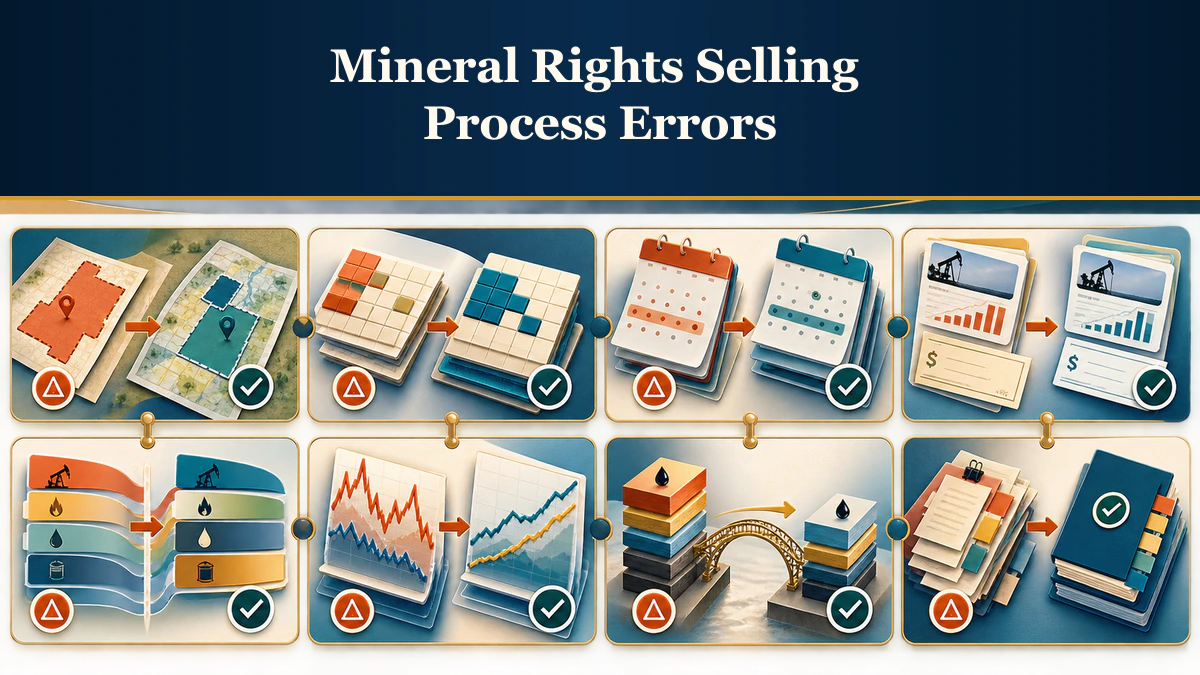
The most consequential mineral-rights assessment errors usually are not difficult arithmetic. They are scope and evidence mismatches that allow a correct calculation to answer the wrong question.Eight error classes deserve an explicit check:
- the wrong interest, tract, depth, formation, product, or transaction scope;
- mixed acres, fractions, percentages, royalty rates, or payment decimals;
- production, payment, benchmark, and assessment dates that do not align;
- owner payments matched to the wrong lease, well, product, operator, or reporting level;
- current production and conditional future development blended into one unlabeled case;
- benchmark prices or generic deductions substituted for property-specific owner economics;
- gross assessment range, proposal price, adjustments, and expected owner net collapsed into one number; and
- sources, assumptions, formulas, or document versions changed without a traceable record.
Do not correct a suspected error by quietly replacing a value. First classify the issue. Then contain it, identify every dependent output, record the evidence and correction, rerun only the affected parts, compare prior and corrected results, and state what remains unresolved.
First classify the issue correctly
Not every difference is an error. A useful review separates three conditions.
Error
An error is a demonstrable mismatch between the assessment question and the subject, evidence, units, dates, assumptions, formula, scenario, or output used. Examples include treating a royalty percentage as a decimal without conversion, using production from a different lease, or calling a gross range an expected owner net.
An error should have a correction record and a defined rerun scope.
Evidence gap
An evidence gap means the file does not yet support a material input or conclusion. A missing deed, unclear depth reservation, absent statement month, unmatched lease identifier, or unknown transaction adjustment can create a gap without proving that the existing input is false.
A gap should remain visible. Depending on materiality, it may widen a range, require separate scenarios, lower the evidence-confidence label, exclude a component, or pause the assessment.
Reasonable scenario difference
A reasonable scenario difference exists when more than one bounded assumption can be tested without claiming that one is a verified fact. Examples can include different decline cases, development timing, commodity assumptions, discount rates, or treatment of an unresolved component.
Scenario differences belong in separately labeled cases with shared and differing assumptions shown. They should not be described as data errors merely because their outputs differ.
This classification matters. Calling a gap an error can create false certainty. Calling an error a scenario choice can hide a correctable defect. Calling every difference an error can make a useful range look unreliable when it is actually reporting uncertainty honestly.
Build an assessment error register before changing the model
An error register turns a suspicion into a reviewable correction. Give each issue a stable ID and record:
- the assessment version and effective date;
- the exact field, formula, source, or output questioned;
- the suspected error class;
- the observed value and where it came from;
- the detection test and test result;
- whether the issue is confirmed, rejected, unresolved, or professionally referred;
- the containment action taken before further use;
- the corrected value, source, source date, and access date, if confirmed;
- every dependent scenario and output;
- the limited rerun performed;
- the prior and corrected result or confidence label;
- the reviewer and review date; and
- the event that would reopen the issue.
Use source-status labels such as owner-provided, payor-provided, operator-reported, regulator-hosted, benchmark-level, contract-specific, assumed, inferred, conflicted, missing, or professional-review-needed. These labels describe provenance and limits; they do not decide whether the underlying fact is legally or technically conclusive.
Error 1: the assessment is measuring the wrong interest
The first check is not “what is it worth?” It is “what exactly is being assessed?”
An identity error can occur when the file mixes:
- counties, surveys, sections, blocks, abstracts, tracts, or units;
- surface acreage and mineral acreage;
- full ownership and a fractional interest;
- mineral, royalty, overriding royalty, executive, leasehold, or other rights;
- producing and non-producing components;
- oil, gas, condensate, or other products;
- different depths, formations, or reservations;
- one owner’s interest and a family, trust, estate, or entity interest; or
- the full retained interest and the narrower rights described in a proposed conveyance.
Detection test
Build a one-line subject key for every modeled component: owner or stated claimant, county, legal description, tract or unit, depth or formation scope, interest type, stated quantity, lease status, product, producing status, and proposed transaction scope. Then require every source and output to map to that key.
A matching owner name or lease name is not enough. Similar names can cover different interests, and one instrument can reserve or convey less than the visible summary suggests.
Contain and correct
Quarantine unmatched components. Do not let their cash flow, acreage, wells, or development context remain in a combined result. Reconcile instruments, statements, operator or regulator identifiers, and the proposed conveyance with qualified review where necessary.
If the subject key changes, reset every dependent area: acreage and decimal, cash-flow history, production match, scenarios, range, proposal comparison, and expected owner net. This is usually a broad rerun, not a label-only correction.
Error 2: units, fractions, percentages, or decimals are mixed
Mineral files often use similar-looking quantities that are not interchangeable: gross acres, net mineral acres, net royalty acres, ownership fraction, lease royalty fraction, division-order decimal, percentages, basis points, barrels, thousand cubic feet, million British thermal units, monthly amounts, and annualized amounts.
A basic stated-acreage relationship is:
stated net mineral acres = stated gross tract acres x stated mineral ownership fraction
That arithmetic can reveal a mismatch. It cannot resolve title, prior reservations, probate, pooling, depth severances, non-participating interests, or deed and lease interpretation.
Detection test
Give every numeric field a unit, period, source, and precision. Recalculate fractions independently. Test whether percentages were converted to decimals exactly once. Reconcile displayed rounding to the stored value. Check that barrels are not combined with gas-volume units and that monthly figures are not multiplied or annualized twice.
For a payment decimal, compare the stored value with the owner statement and the exact property and period. Treat the comparison as an exception test, not a title conclusion.
Contain and correct
Stop using any unlabeled numeric column. Correct the unit or conversion in one controlled input, then rerun every formula that depends on it. If a decimal or acreage field materially defines the economic interest, reopen the subject-identity check as well.
Preserve both the original and corrected values in the error register. “Fixed decimal” is not a sufficient audit trail.
Error 3: dates and periods do not align
An assessment can mix internally correct records from incompatible periods. Common examples include:
- a royalty statement covering one production month but paid in another month;
- regulator-hosted production that is still subject to reporting lag or later correction;
- a trailing cash-flow period that omits an adjustment or includes a catch-up payment;
- a benchmark price from a different day or month than the modeled production;
- a proposal date compared with an assessment using later evidence; or
- an annualized month that included downtime, a workover, suspense release, or prior-period correction.
The Railroad Commission’s PDQ FAQ says operator reports are due after the production month, online production has a lag, records reflect a snapshot, and revised, corrected, or delinquent reports can change the data. That makes the as-of date and production month separate fields, not clerical details.
Detection test
For every series, store the production or service period, statement period, payment date, source update date, access date, and assessment effective date. Build a calendar reconciliation that exposes overlaps, gaps, late adjustments, and mixed cutoffs.
Contain and correct
Do not fill missing periods by copying a nearby month. Mark them missing or estimated and keep those labels through the output. When a revised record arrives, update the affected period, restate any trailing baseline, and rerun dependent forecasts and range outputs.
If the assessment date moves, treat that as a new version with a new evidence cutoff rather than editing the old date in place.
Error 4: production and owner payments are mismatched
Regulator-hosted production and a royalty statement do not report the same thing. The Railroad Commission describes its production data as compilations and summaries of information reported by Texas operators. Its PDQ FAQ explains that Texas oil production can be reported at the lease level rather than by individual well, while gas leases contain one gas well per lease.
An owner statement can include a payor property, product, volume, price, deductions, taxes, adjustments, decimal, and net payment. It does not automatically identify the same reporting level or prove how a regulator-hosted volume should be allocated to that owner.
Detection test
Match, when available:
- district, county, field, operator, lease or gas-well ID, API number, unit, well, and product;
- production month and statement period;
- oil, gas, condensate, natural-gas liquids, or other product treatment;
- reported gross volume and the level at which it is reported;
- payor property and owner statement identifiers;
- the owner decimal used on that statement; and
- adjustments, suspense releases, reversals, deductions, and taxes.
The Commission’s online research queries provide separate query systems and update schedules for production, permits, completions, wellbores, proration, and other records. The same record name appearing in two places is not a complete identifier match.
Contain and correct
Keep unmatched production out of property-level owner economics. Keep unmatched payments out of a well or lease production baseline. Use an exception table until the identifiers, reporting level, product, and period reconcile.
After correction, rerun the affected production-to-payment bridge and any current-production forecast. Do not conclude that a mismatch proves underpayment, title ownership, reserves, or wrongdoing.
Error 5: current production and future development are blended
Observed production, permitted activity, completed wells, nearby operations, and speculative future locations have different evidence status. Combining them in one unlabeled base case can make a range impossible to audit.
Detection test
Require each cash-flow component to identify whether it comes from:
- current producing wells with matched history;
- a subject well with a dated operational change;
- a permitted or completed subject well not yet reflected in owner payments;
- activity on related acreage with an explained relationship;
- nearby analogue activity; or
- a purely conditional timing and development assumption.
For future development, record the tract, unit, formation, depth, operator, evidence date, relationship to the subject interest, assumed timing, probability treatment, production analogue, costs, burdens, and removal trigger.
Contain and correct
Separate current-production and conditional-development cases. Do not repair the file by merely renaming the combined output. Remove the blended components, rebuild each scenario, and then reconcile the total range as separately labeled parts.
New activity can move a scenario up, down, later, or out. A permit or nearby well does not guarantee drilling, production, ownership, payment, or value for the subject interest.
Error 6: a benchmark is substituted for owner economics
The U.S. Energy Information Administration publishes dated series for crude-oil spot prices and the Henry Hub natural-gas spot price. Those series can support market context or a stated model assumption. They do not establish the price reported on an owner’s statement.
Owner economics can differ because of product, quality, location, contract, index, timing, transportation, gathering, processing, differentials, deductions, taxes, adjustments, and statement treatment.
Detection test
For every price and deduction input, record whether it is:
- a benchmark observation;
- a benchmark-based scenario assumption;
- a realized price reported on an owner statement;
- a contract-specific term;
- a historical average or forecast assumption; or
- an unresolved placeholder.
Then test whether the label survives into the formula and output. A benchmark column renamed “owner price” is still a substitution error.
Contain and correct
Restore separate benchmark and realized-economics fields. Reconcile historical owner statements by property, product, and period. If property-specific economics remain missing, label the assumption and use bounded scenarios rather than implying an observed fact.
Rerun affected historical cash-flow normalization, forecast cases, and range outputs. Preserve the commodity-source date because a valid assumption can become stale without becoming an arithmetic error.
Error 7: gross range, proposal, and expected owner net are conflated
A gross conditional assessment range, a written transaction proposal, and expected owner net answer different questions.
- Gross conditional range: modeled economics for the defined interest under stated scenarios.
- Written proposal: the rights, consideration, conditions, adjustments, timing, and obligations actually documented by a counterparty.
- Expected owner net: a transaction-specific bridge after stated adjustments, costs, liabilities, taxes, timing, and unresolved items.
The MRX methodology presents a discounted-cash-flow framework and describes the role of production, decline, commodity assumptions, discounting, lease terms, title confidence, development context, and offer terms. Its output remains dependent on the subject and assumptions used.
Detection test
Trace the label on every displayed number back to its source and calculation. Check whether a proposal’s headline amount is fixed or adjustable, which rights are included, what conditions apply, and whether any expected-net bridge has open items.
Tax questions require separate property- and taxpayer-specific analysis. IRS Publication 544 addresses sales and other dispositions of assets, but a general publication does not decide an owner’s basis, characterization, holding period, allocation, reporting, or resulting liability.
Contain and correct
Restore three distinct outputs. Do not repair the page by adding “approximately” to a conflated number. Rebuild the proposal comparison from the complete written terms and keep tax treatment open unless a qualified professional has addressed the owner’s facts.
The expected owner net should show unresolved items as unresolved, not as zero.
Error 8: source and version control are lost
An assessment may become unreproducible even when every input was reasonable at the time. This happens when a source is replaced without an access date, a formula changes without a change note, a document arrives under the same filename, an old scenario is overwritten, or the reviewed proposal differs from the version later signed.
The Texas Comptroller’s Manual for Discounting Oil and Gas Income is a purpose-specific public document. A purpose-specific method or table should remain identified by issuing body, edition, intended use, and date; it should not be treated as a universal private-sale conclusion.
Detection test
Require every material source to have a stable name, issuer, document or record date, access date, identifier, and stored checksum or immutable copy where permitted. Require every model version to have:
- a version ID and effective date;
- a frozen input register;
- formula or method version;
- scenario definitions;
- source list;
- error and change log;
- reviewer and review date; and
- output checksum or preserved PDF/export.
Contain and correct
Freeze the disputed version. Reconstruct the last reproducible state before changing inputs. Compare the source and formula differences, correct only the supported fields, and issue a new version with a reason for change.
If the original source or formula cannot be reconstructed, label the prior output non-reproducible. Do not invent a clean lineage after the fact.
Use a limited-rerun protocol
The correction should be broad enough to catch every dependency and narrow enough to preserve an understandable comparison.
- Label or access-date error: rerun the source register, citations, and confidence note. Reset more broadly if the source content or effective date also changed.
- Period or one-month adjustment: rerun the historical series, trailing baseline, and dependent forecast. Reset more broadly if the assessment cutoff or multiple periods changed.
- Price or deduction classification: rerun the owner-economics bridge, affected scenarios, and range. Reset more broadly if the product, property, contract, or realized-price match changed.
- Production identifier match: rerun the production-payment bridge, decline input, and affected scenarios. Reset more broadly if the subject lease, well, unit, or product changed.
- Decimal, acreage, or interest quantity: rerun cash flow, production allocation, scenarios, and range. Reset more broadly if the underlying tract, title, depth, or transaction scope changed.
- Current-versus-future classification: rerun scenario components, timing, and the range bridge. Reset more broadly if subject identity or development evidence changed materially.
- Proposal or owner-net treatment: rerun the proposal grid and owner-net bridge. Reset more broadly if rights conveyed, adjustment terms, or the approved document version changed.
- Subject-interest identity: perform a full assessment reset. This is already the broadest reset.
After the rerun, perform three reconciliations:
- Input reconciliation: which fields changed and why?
- Output reconciliation: which ranges, scenarios, confidence labels, or comparisons changed?
- Residual-risk reconciliation: which gaps, conflicts, assumptions, and professional questions remain?
If the correction changes nothing material, record that result. A detected data-quality issue can still be important even when the bounded range does not move.
Owner challenge questions for an assessment review
Use these questions to test whether an assessment can be reproduced:
- What exact interest, tract, depth, formation, product, and effective date does this assessment cover?
- Which acreage, fraction, royalty rate, and decimal were used, and in what units?
- Which source supports each material input, and what is its status and date?
- How were owner statements matched to regulator-hosted production and reporting level?
- Which months are missing, adjusted, estimated, or affected by suspense or downtime?
- Which price inputs are benchmarks, owner-reported realized prices, or assumptions?
- Are current production and conditional future development shown separately?
- Which components are facts, professional conclusions, assumptions, inferences, conflicts, or gaps?
- Is the displayed number a gross range, a written proposal, or expected owner net?
- What changed from the prior version, and which outputs were rerun?
- What event would reset the assessment?
- Which questions remain for a land professional, attorney, tax professional, accountant, engineer, reserve specialist, or qualified valuation professional?
A reviewer who cannot answer every question immediately can still provide a useful response: identify the missing evidence, keep the affected output conditional, and state the next verification step.
When the assessment should pause
Pause rather than forcing a correction when:
- the subject interest or authority to act cannot be reconciled;
- material deeds, probate records, trust or entity authority, leases, amendments, division orders, or statements conflict;
- the acreage, decimal, depth, formation, product, or rights conveyed remain materially uncertain;
- production and payments cannot be matched to the same subject and period;
- a future-development component is driving the result without a stated conditional basis;
- the written proposal, adjustment mechanics, deed, funding, delivery, or recording sequence is incomplete or inconsistent;
- tax, accounting, legal, engineering, reserves, or certified-appraisal conclusions are being inferred from general educational sources; or
- the reviewed source and model version cannot be reproduced.
The MRX FAQ and terms describe the service and its boundaries. An educational or underwriter review can organize records, assumptions, scenarios, and questions. It does not replace owner-specific professional work where that work is required.
The practical correction standard
A mineral-rights assessment does not become reliable because it contains more pages or a more precise number. It becomes more useful when another reviewer can trace the result from the question to the subject interest, evidence, units, periods, assumptions, scenarios, and output, then see exactly what happened when a mismatch was found.
The practical standard is therefore:
- classify the issue as an error, gap, or scenario difference;
- contain it before the result is used;
- test and document it;
- correct only with supported evidence;
- rerun every dependent output;
- reconcile prior and corrected versions; and
- leave unresolved professional questions open.
That process will not eliminate uncertainty. It prevents uncertainty from being disguised as a corrected fact.
Source scope and research boundaries
- MRX published methodology: public framework and stated model inputs; not a property-specific value, title, reserves, or transaction conclusion.
- MRX frequently asked questions: service process and boundaries; not a substitute for professional review.
- MRX terms of use: platform and AI-use boundaries.
- Railroad Commission of Texas production data: operator-reported Texas production compilations and queries.
- Railroad Commission Production Data Query FAQ: reporting level, lag, revision, and query context.
- Railroad Commission online research queries: query types, update schedules, and public-data limitations.
- EIA crude-oil spot prices: benchmark market series; not an owner’s realized price.
- EIA Henry Hub natural-gas spot price: benchmark market series; not an owner’s realized price.
- Texas Comptroller Manual for Discounting Oil and Gas Income: purpose-specific public guidance that should retain its intended-use boundary.
- IRS Publication 544: federal educational material on asset dispositions; not an owner-specific tax conclusion.
Frequently asked questions
Does a changed assessment range prove the first range was wrong?
No. A range may change because an error was corrected, missing evidence arrived, the assessment date moved, or a reasonable assumption changed. The change log should identify which condition occurred and which outputs were rerun.
Can a royalty statement prove the production volume used in an assessment?
A statement can support what a payor reported for a property and period. It should be matched to the correct product, identifiers, dates, decimal, prices, deductions, and adjustments; it does not by itself establish regulator-reported production, title, or reserves.
Should the whole assessment be rebuilt after one error is found?
Not automatically. Contain the error, identify every dependent field and output, rerun those parts, and then perform reconciliation checks. A subject-identity or ownership-scope error may require a broader reset than a corrected access date or label.
Is using an EIA oil or gas price an assessment error?
Not when it is clearly labeled as dated benchmark context or a model assumption. It becomes a substitution error when the benchmark is presented as the owner’s realized price or used without the relevant product, location, timing, differential, deduction, and scenario context.
When should an owner pause instead of trying to correct the file alone?
Pause when the issue affects ownership, authority, deed or lease meaning, tax treatment, accounting, reserves, engineering, a formal valuation engagement, material transaction terms, payment security, or another question requiring qualified professional review.
Sources reviewed for this article
- Mineral Rights Xchange, Published DCF Methodology (accessed 2026-08-12)
- Mineral Rights Xchange, Frequently Asked Questions (accessed 2026-08-12)
- Mineral Rights Xchange, Terms of Use (accessed 2026-08-12)
- Railroad Commission of Texas, Oil and Gas Production Data (accessed 2026-08-12)
- Railroad Commission of Texas, Production Data Query System FAQ (accessed 2026-08-12)
- Railroad Commission of Texas, Online Research Queries (accessed 2026-08-12)
- U.S. Energy Information Administration, Spot Prices for Crude Oil and Petroleum Products (accessed 2026-08-12)
- U.S. Energy Information Administration, Henry Hub Natural Gas Spot Price (accessed 2026-08-12)
- Texas Comptroller of Public Accounts, Manual for Discounting Oil and Gas Income (accessed 2026-08-12)
- Internal Revenue Service, Publication 544, Sales and Other Dispositions of Assets (accessed 2026-08-12)
Related mineral-rights articles

Understanding the Key Factors That Affect Your Mineral Rights Assessment Price
A suggested mineral-rights assessment price should be traceable through the interest, owner economics, production, development, dated assumptions, and transaction scope used.
Read the post →
Understanding Mineral Rights: Your Essential Selling Guide
A seller avoids preventable problems by advancing only when the current stage has a named output, supported evidence, and no unresolved stop condition.
Read the post →
Top Five Missteps to Avoid for a Successful Mineral Rights Sale
Five preventable process mistakes can leave an owner comparing the wrong asset, relying on incomplete evidence, or reaching closing without the needed controls.
Read the post →
Understanding Mineral Rights Valuation: Determine the Fair Assessment for Your Interests
A mineral interest fits a fair assessment when the owner’s decision, asset scope, evidence, and review method point to the same bounded output.
Read the post →A practical next step
Put your mineral rights in context.
Every mineral interest, royalty history, and written offer is different. Start with a question, or share what you have for a free underwriter review.
- Free
- Confidential
- No obligation to sell
Ready for a closer look?
Book a Free Underwriter ReviewGet a directional range with the assumptions clearly stated.