
MRX Learning Center
Texas RRC P-5 Renewal Status Query Retrieval Provenance Worksheet
A P-5 Renewal Status retrieval provenance worksheet preserves one official route, controlled criteria, retained reference, and bounded status without interpreting a result.
Direct answer for mineral owners
Give one official P-5 Renewal Status Query attempt a neutral ID. Record the directory, menu, and application routes; exact labels; controlled criteria; access timestamp and timezone; displayed state; retained reference; source limitations; and only located, not located, or unverified. This proves how the retrieval was attempted; it does not establish filing or renewal status, operator or inactive-well status, compliance, a violation, an extension, property facts, value, or a transaction fact.
Key takeaways for mineral owners
- Keep the P-5 Renewal Status, Inactive Well Aging Report, Inactive Well, and Organization P-5 routes distinct.
- Record source-displayed criteria and filter labels as interface state, not findings.
- Keep actual operator, API, lease, well, field, result, form, and status details in an authorized controlled location.
- Capture access time, timezone, navigation, displayed state, retained reference, and source limitations.
- Use only located, not located, or unverified, then stop before regulatory, legal, operational, valuation, or transaction conclusions.
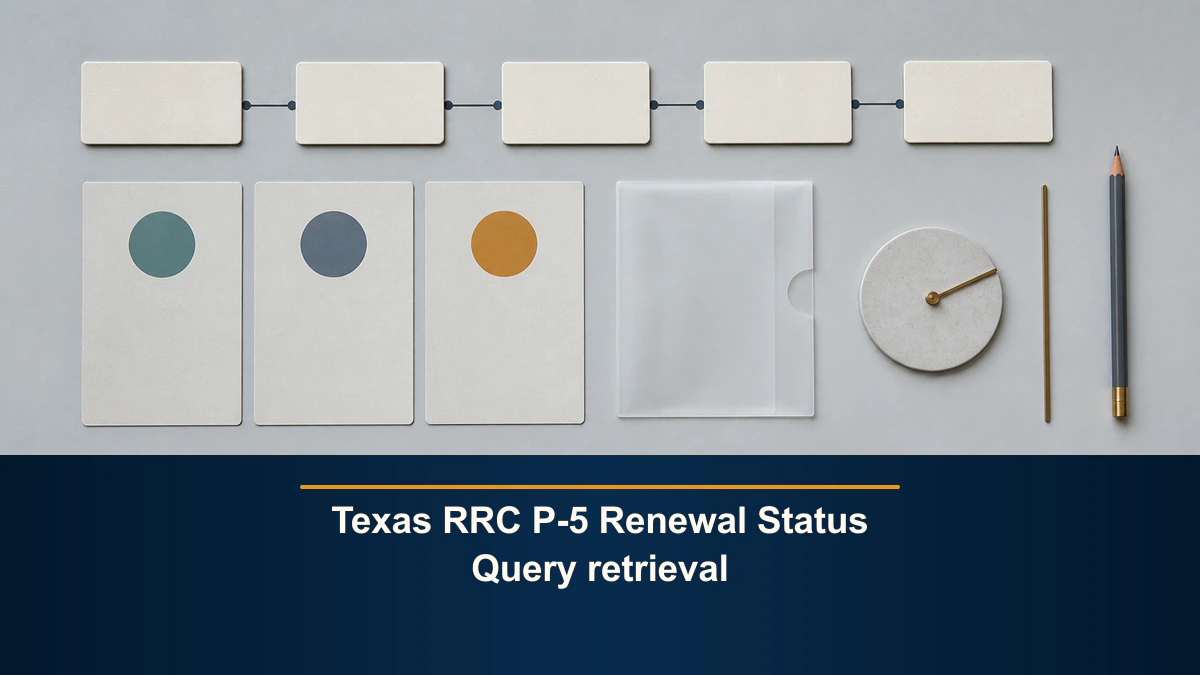
Public-record retrieval boundary. This article records one Texas RRC P-5 Renewal Status Query attempt. It does not interpret a criterion, filter, form, filing, renewal, operator, inactive well, result, compliance field, violation, extension, financial-assurance matter, plugging duty, cost field, shut-in date, lease, well, county, district, or field. It does not establish property connection, title, ownership, acreage, lease effect, production, reserves, cash flow, value, offer quality, legal effect, or a transaction result. It does not provide legal, title, land, tax, accounting, appraisal, engineering, geological, environmental, regulatory, or financial advice. MRX provides educational information and resources only and does not buy mineral rights.
A Texas RRC P-5 Renewal Status Query retrieval worksheet answers one narrow question: exactly how was one official retrieval attempt performed? Record the official entry routes, exact source-displayed labels, access timestamp and timezone, controlled chosen criteria, navigation or displayed state, authorized retained reference, source limitations, and one bounded retrieval status.
Use only located, not located, or unverified. Those words describe the retrieval attempt. They do not decide whether a Form P-5 filing or renewal has a particular status, whether an operator or well is compliant, whether a displayed form or extension condition is satisfied, or whether a record applies to a private mineral interest.
Start with the exact renewal-status route
The Railroad Commission of Texas Research Queries directory lists the agency’s online research tools. The official Oil & Gas Data Query menu separately links P-5 Renewal Status Query, Inactive Well Aging Report Query, Inactive Well Query, and Organization (P-5) Query. Preserve the full route and exact menu label instead of reducing them all to a generic phrase such as RRC P-5 search.
The launched P-5 Renewal Status Query uses inactiveWellStatusQueryAction.do and currently displays P-5 Renewal Status Query in both its HTML title and visible heading. The IWAR route uses inactiveWellQueryAction.do, the general Inactive Well route uses inactiveWellAllQueryAction.do, and the Organization (P-5) route uses organizationQueryAction.do. A shared operator, API, lease, district, field, well, inactive-well, or P-5 label does not merge those systems or prove that their returned information has the same scope, timing, meaning, or private-property relationship.
For broader source orientation, use Texas Railroad Commission: How to Use Public Records to Understand Your Mineral Rights. For the nearby route, use the Texas RRC Inactive Well Aging Report Retrieval Provenance Worksheet. Do not combine the attempt records.
Create an attempt header before entering criteria
Give the attempt a neutral ID such as TX-P5RS-RET-01. That identifier labels a retrieval session, not an operator, filing, renewal, well, violation, extension, property, mineral interest, finding, or transaction. Record:
- the Research Queries directory route and exact directory label;
- the Oil & Gas Data Query menu route and exact menu label;
- the launched application route, HTML title, and visible heading;
- access date, time, and timezone;
- preparer role and worksheet version;
- stated purpose, limited to P-5 Renewal Status retrieval;
- source-stated access, display, search, download, update, and result limitations; and
- the controlled location where real criteria and retained evidence will be stored.
Create a new attempt ID for every rerun. Do not replace an earlier query record because a label, criterion, result, page state, help screen, or access condition changed.
Record the route through help and query pages
The official P-5 Renewal Status Query Help page separates the query, results, download, and contact-help topics. If help was opened, record the exact help route and topic used. Opening a help page is navigation evidence; it is not evidence that any operator, filing, renewal, well, form, extension, or compliance condition exists.
Preserve the route as a sequence:
Research Queries directory → Oil & Gas Data Query menu → P-5 Renewal Status Query → controlled criteria → displayed validation, result, error, download, or next-navigation state
For each step, record the complete controlled route reference, exact displayed label, action taken, access time and timezone, whether the page loaded or changed, and the next step selected. If a session ended, a constraint appeared, the page did not expose the narrow reference sought, or the attempted relationship remained unclear, use not located or unverified.
Do not extend that status to an operator, form, filing, renewal, well, violation, extension, property, mineral interest, or compliance question.
Preserve criteria without publishing identifiers
The current application exposes source-displayed criteria for an operator, API unique number, oil wells, gas wells, or both, lease, district, and field. The official P-5 Renewal Status Query How To page describes an operator path and an other-criteria path, plus separate operator and lease selectors. Record only the criteria actually used, the exact source labels, whether a value was entered or selected, and the controlled reference where the value is retained.
Do not populate a reusable public example with a real operator name or number, API number, lease name or number, gas-well identifier, district, field, well, result, form, extension, or violation. A locator input is not proof that a returned record applies to a mineral owner, tract, lease, title chain, or transaction.
If an operator or lease selector was opened, preserve that navigation as its own step. Record the displayed search mode, the controlled criterion, selected-row reference, return path, and time. Do not treat a selection list as a P-5 renewal-status result.
Treat filter labels as interface state
The current query page displays the filter labels Show 2259 Non-Compliant, Show Extension Status Violations, and Show All. The How To page describes how those choices affect which matching rows are displayed. In a provenance worksheet, record the exact label selected and whether it was selected by the user or appeared as the page’s default.
Do not shorten a label to non-compliant, violation, or all without preserving the source wording and context. More importantly, do not convert a selected filter into a statement about an operator, well, renewal, form, extension, or compliance condition. A filter records how the interface was asked to limit a query. It is not a verified finding about a private interest.
Record result fields without interpreting them
The official P-5 Renewal Status Query About page names information that may appear in the query’s header and results. The official results help describes result columns, pagination, sorting, detail links, tabs, and a download option under stated conditions.
A retrieval worksheet may record that a named header, column, link, tab, page control, or download control appeared. It may also preserve an authorized retained reference to the state displayed. It must not interpret an operator-status field, renewal date, form field, compliance field, extension field, shut-in date, cost calculation, lease or well detail, or any linked screen. Those topics require a separately scoped review with the appropriate current sources and professional context.
Record the displayed state in neutral terms:
- query page displayed with no result action taken;
- validation or constraint displayed;
- result page displayed;
- result table displayed with or without the sought reference;
- result detail or tab navigation displayed;
- download control displayed or not displayed;
- error, timeout, session, or access state displayed; or
- source state could not be verified.
Do not copy a source-displayed substantive label into a public worksheet as an MRX conclusion.
Retain evidence in a controlled location
The reusable worksheet should contain a controlled reference, not the sensitive evidence itself. A retained-evidence record can identify:
- attempt ID and worksheet version;
- authorized repository, case system, or evidence-vault location;
- capture or export filename;
- capture timestamp and timezone;
- file SHA-256 or other integrity reference;
- source route and displayed page label;
- access role and retention rule; and
- whether a later reviewer independently repeated the retrieval.
Do not publish credentials, session tokens, cookies, private correspondence, personal contact details, actual operator or property identifiers, result rows, screenshots, downloads, form details, or internal case notes.
Assign only a bounded retrieval status
Choose one status after the attempt:
- Located: the recorded route exposed the specific controlled reference sought.
- Not located: the recorded attempt did not expose that reference using the stated criteria.
- Unverified: the route, criteria, displayed state, retained reference, or source limitation was not captured well enough to reproduce the attempt.
Located does not authenticate a record, establish that it applies to a mineral interest, or interpret any field. Not located does not prove absence. Unverified is the correct status when the evidence trail is incomplete.
End with one neutral next question, such as whether another separately named official route should be searched or whether an authorized reviewer should compare the retained reference with a separately obtained record. Do not end with a conclusion about filing or renewal status, compliance, ownership, value, an offer, or a transaction.
Keep adjacent RRC jobs separate
- The Inactive Well Aging Report Query uses
inactiveWellQueryAction.doand has its own attempt-level worksheet. Its current HTML-title mismatch does not combine it with this route. - The Inactive Well Query uses
inactiveWellAllQueryAction.doand owns the general inactive-well retrieval job. - The Organization (P-5) Query uses
organizationQueryAction.doand owns organization-directory retrieval. - The Wellbore Query and other EWA routes have their own routes, criteria, result structures, limitations, and provenance records.
If a research question crosses those boundaries, create separate attempts and link the controlled references. Do not merge source systems into one status narrative.
Protect the mineral owner’s information
Store real operator, API, lease, well, district, county, field, result, form, status, violation, extension, cost, shut-in date, screenshot, export, property, title, payment, and correspondence details in an access-controlled location. Share only records you are authorized to provide and disclose why each record is requested.
MRX provides educational information and resources only and does not buy mineral rights. A provenance worksheet improves reproducibility; it does not make MRX a public agency, title examiner, attorney, engineer, geologist, accountant, appraiser, regulator, or neutral fiduciary.
Final retrieval check
Before closing the attempt, confirm that the worksheet preserves the complete official route, every exact source label, access time and timezone, controlled criteria, user-selected or default filter state, navigation that occurred, displayed result or error state, retained reference, source limitation, bounded status, and a neutral next question. If one item is missing, use unverified until the retrieval record is complete.
Stop there. The next step may be another official-source retrieval or an appropriately scoped professional review. It is not a conclusion about a form, filing, renewal, operator, inactive well, compliance field, violation, extension, plugging duty, production, property connection, title, ownership, acreage, legal effect, value, offer quality, or a transaction.
Frequently asked questions
Is the P-5 Renewal Status Query the same as the Inactive Well Aging Report Query?
No claim of equivalence should be made. The official menu links inactiveWellStatusQueryAction.do for P-5 Renewal Status and inactiveWellQueryAction.do for the Inactive Well Aging Report. This worksheet records only the first route.
Is the P-5 Renewal Status Query the same as the Organization (P-5) Query?
No. The official menu links the Organization (P-5) Query through organizationQueryAction.do. That route owns organization-directory retrieval; this worksheet owns only the separate renewal-status route.
Does a located result prove that an operator, filing, renewal, well, or extension is compliant?
No. Located means only that the recorded official attempt exposed the identified result reference. The worksheet does not interpret a filter, form, status field, violation, renewal, extension, compliance condition, or legal effect.
Does not located mean that no P-5 renewal-status record exists?
No. Not located describes one attempt using stated criteria at a stated time. Criteria, interface state, coverage, updates, access limits, or another official route may require a separate retrieval step.
Can a reusable worksheet publish real operator, API, lease, well, result, form, or violation details?
No. Keep actual identifiers, criteria, results, exports, screenshots, and form or status details in an authorized controlled location. Reusable public examples should remain blank.
Sources reviewed for this article
- Railroad Commission of Texas, Research Queries (accessed 2026-08-24)
- Railroad Commission of Texas, About Oil & Gas Data Queries (accessed 2026-08-24)
- Railroad Commission of Texas, Oil & Gas Data Query menu (accessed 2026-08-24)
- Railroad Commission of Texas, P-5 Renewal Status Query (accessed 2026-08-24)
- Railroad Commission of Texas, P-5 Renewal Status Query Help (accessed 2026-08-24)
- Railroad Commission of Texas, P-5 Renewal Status Query How To (accessed 2026-08-24)
- Railroad Commission of Texas, P-5 Renewal Status Query About (accessed 2026-08-24)
- Railroad Commission of Texas, P-5 Renewal Status Query Results Help (accessed 2026-08-24)
Related mineral-rights articles
Texas RRC Inactive Well Query Retrieval Provenance Worksheet
An Inactive Well Query provenance worksheet preserves one official Texas RRC route, criteria, retained reference, and bounded retrieval status without interpreting a result.
Read the post →
Texas RRC Organization (P-5) Query Retrieval Provenance Worksheet
An Organization (P-5) Query provenance worksheet preserves one official route, criteria, displayed labels, source limits, retained reference, and bounded retrieval status without interpreting an organization record.
Read the post →
Texas RRC Wellbore Query Retrieval Provenance Worksheet
A wellbore-query provenance worksheet preserves one official route, criteria, displayed result fields, source limits, retained reference, and bounded retrieval status without interpreting a well record.
Read the post →
Texas RRC Inactive Well Aging Report Retrieval Provenance Worksheet
An IWAR retrieval provenance worksheet preserves one official route, selected criteria, retained reference, and bounded status without interpreting an inactive-well result.
Read the post →A practical next step
Put your mineral rights in context.
Every mineral interest, royalty history, and written offer is different. Start with a question, or share what you have for a free underwriter review.
- Free
- Confidential
- No obligation to sell
Ready for a closer look?
Request an Underwriter ReviewGet a directional range with the assumptions clearly stated.