
MRX Learning Center
How to Keep an AI Source Trace for a Mineral Rights Review
A mineral rights AI source trace labels every material statement by origin and keeps unsupported output unresolved until a person checks the evidence.

Direct answer for mineral owners
For each material statement in an AI-assisted mineral-rights review, copy the statement into a trace row, label it owner-provided, public-source fact, or unresolved inference, record the exact document or URL and access date, and mark whether a human checked the underlying evidence. A citation or review mark does not prove the statement; conflicts, missing support, and unclear matches remain unresolved.
Key takeaways for mineral owners
- Trace one material statement per row instead of attaching one source list to an entire answer.
- Use only three origin labels: owner-provided, public-source fact, or unresolved inference.
- Record the exact document reference or URL, access date, and human-review status without inventing missing details.
- A source trace records provenance; it does not prove accuracy, title, value, ownership, legal effect, tax treatment, or a transaction decision.
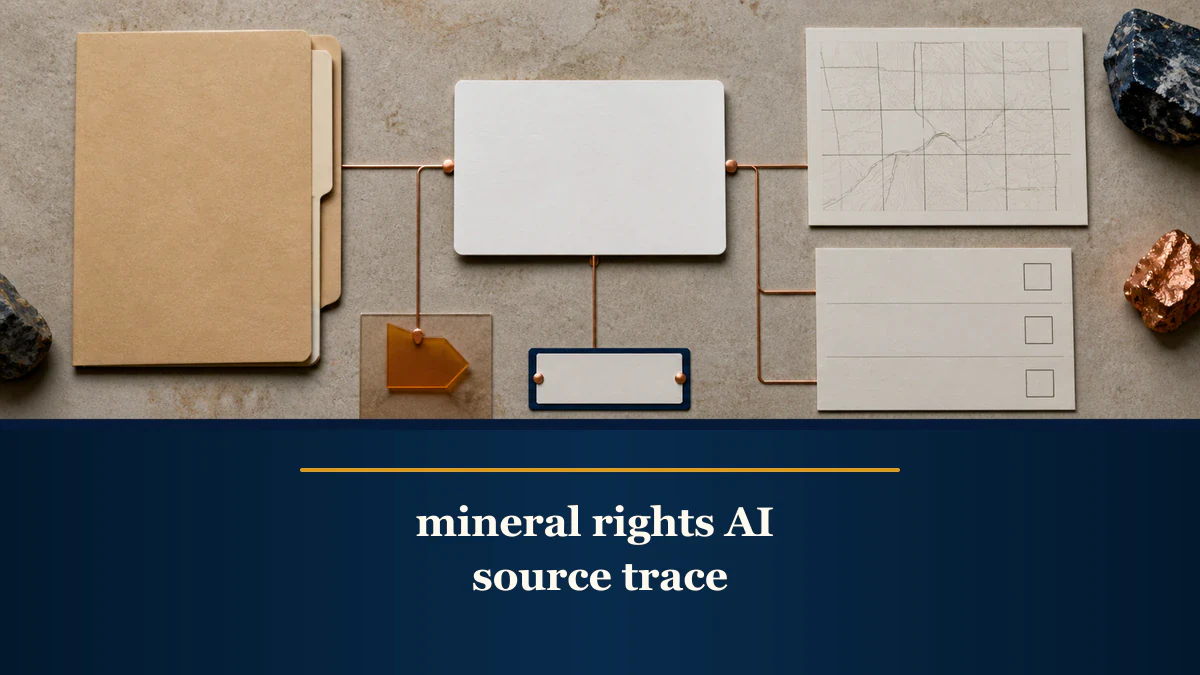
Method boundary. This article explains a narrow way to record the provenance of individual statements in an AI-assisted mineral-rights review. It does not evaluate an AI provider, validate an output, calculate value, determine ownership or title, interpret a document, provide individualized legal or tax guidance, recommend a transaction, or promise accuracy, completeness, reliability, safety, or reduced risk. A source trace is a review aid, not proof. MRX provides educational information and resources only and does not buy mineral rights.
A mineral rights AI source trace is a table with one material statement per row. Label the statement owner-provided, public-source fact, or unresolved inference. Then record the exact document reference or public URL, the date you accessed it, and the status of human review. If support is missing, conflicting, or unclear, leave the statement unresolved.
That is the whole job. The trace does not score an AI tool, compare providers, or prove a conclusion. It preserves enough context for a person to see where a statement came from and what still needs checking.
Start with seven fields
Use these columns for each material statement:
| Field | What to record |
|---|---|
| Statement ID | A stable row label, such as S-01 |
| Exact statement | The shortest complete statement being checked |
| Origin label | owner-provided, public-source fact, or unresolved inference |
| Source reference | A private document ID and page, or the exact public URL |
| Access date | The date the reviewer opened the cited source |
| Human-review status | not reviewed, supported, corrected, conflicted, or unresolved |
| Review note | A short explanation of the check, correction, conflict, or next evidence needed |
Do not place several independent claims in one row. “The tract is in County A, the owner has 20 acres, and the well is producing” contains at least three statements with potentially different sources and review results. Split them before applying a label.
Use the three origin labels consistently
Owner-provided
Use owner-provided when the statement comes from the owner’s message, memory, uploaded record, or other owner-supplied material. Record the private document ID, page, message date, or conversation reference that lets a reviewer locate it.
The label describes origin, not truth. A remembered acreage figure may be incomplete. A deed may concern a different tract. A royalty statement may use an owner number that does not answer an ownership question. Keep the label even when a later review corrects the statement; place the correction and result in the review columns.
The MRX privacy policy describes source citations and structured owner facts with source and confidence information as part of the information created while assisting an owner. It also limits uploads to files the owner is authorized to share and tells users not to upload Social Security numbers, full bank or payment details, passwords, or information unnecessary for the question. A trace should therefore point to a stable private reference without copying sensitive contents into a second record.
Public-source fact
Use public-source fact only when the row identifies the specific public source that supports the statement. Store the exact URL, the publisher or agency, and the access date. If the statement depends on a particular table, page, query result, report period, or record identifier, include that locator in the review note.
Do not cite a search-results page when the underlying agency or first-party page is available. Do not treat a source as current merely because the URL still opens. The MRX terms state that sources can be incomplete, delayed, or changed and that users should verify material facts. Record the access date so a later reviewer can see when the source was checked.
A public record can support what that record reports. It may not establish how the record applies to a specific owner, tract, instrument, payment, or transaction. If matching the record to the owner’s interest requires an unstated step, separate the reported fact from that matching inference.
Unresolved inference
Use unresolved inference when the AI connects facts, fills a gap, summarizes beyond the cited text, selects between conflicting records, or states something without clear support. The label is also appropriate when a source exists but the tract, owner, date, legal description, well, lease, or record scope does not clearly match.
Do not soften this label into “likely fact” merely because the output sounds confident. Record the missing evidence or conflict in the review note. A useful next-step note might say, “Need the referenced exhibit,” “County record and owner document use different legal descriptions,” or “Public page reports the well, but the interest match is not established.”
Build the trace while reviewing, not afterward
First, freeze the exact AI-assisted answer being reviewed. Give it a version and date so later edits do not silently change the subject of the trace.
Second, mark each statement that could affect the owner’s understanding or next question. Definitions, property identifiers, dates, ownership descriptions, production statements, document summaries, and claimed source facts usually deserve separate rows. This does not mean the trace decides their legal or economic importance.
Third, apply one origin label. If you cannot choose between owner-provided and public-source fact because the sentence combines both, split the sentence. If the support is indirect, absent, or ambiguous, use unresolved inference.
Fourth, open the underlying evidence. Copy the private document reference or public URL and add the access date. A citation supplied by an AI is not enough; the reviewer needs to confirm that the cited page exists and actually supports the narrow statement.
Fifth, record human-review status. Use supported only for the narrow source match. Use corrected when the evidence changes the statement, conflicted when sources disagree, and unresolved when the available material does not settle the match. Keep the prior row or version so the correction remains traceable.
Keep the source trace separate from a valuation input register
The source trace asks, “Where did this statement come from, and has someone checked that source match?” A valuation input register asks different questions about a model input, unit, effective date, transformation, scenario, and sensitivity. A document-package index asks which files and pages are present. None of those tools should silently substitute for another.
If a statement later becomes a valuation input, move it through the separate valuation-review controls. Do not add a price, acreage calculation, royalty decimal, production forecast, discount rate, owner net, or offer recommendation to this trace and call it reviewed merely because the source row is complete.
Treat human review as a recorded event, not a badge
A human-review mark should identify what happened: who performed the assigned review, when it occurred, which evidence was opened, and whether the narrow statement was supported, corrected, conflicted, or left unresolved. It should not say “approved” without explaining the scope.
The NIST AI Risk Management Framework is a voluntary framework organized around Govern, Map, Measure, and Manage functions. Its Generative AI Profile provides additional voluntary context for generative-AI risks and risk-management actions. This three-label worksheet is an MRX editorial method, not a NIST requirement, certification, or assurance that those broader risks have been managed.
The Federal Trade Commission’s final Workado order required evidence for specified AI accuracy or efficacy claims. That enforcement action concerns the company and claims described by the FTC. The narrow lesson here is to avoid turning the existence of a trace into an unsupported claim that an AI output is accurate, effective, or reliable.
Review the trace before using the answer
Run a final row-by-row check:
- every material statement appears in its own row;
- every row has exactly one origin label;
- owner-provided rows point to a stable private reference without copying unnecessary sensitive content;
- public-source rows point to the underlying source, not a search result or the AI answer;
- every source has an access date;
- every unresolved match, conflict, missing page, or unsupported step remains labeled unresolved;
- corrections preserve the earlier version and identify what changed; and
- human-review status describes the narrow source check rather than implying professional approval.
If the answer would affect ownership, title, legal rights, tax treatment, payment entitlement, value, or a transaction decision, route the actual records and question to the appropriate qualified person. The trace helps that reviewer find the evidence and open questions. It does not provide the conclusion.
Source notes and research limitations
- MRX terms support the AI-interface, educational-information, source-limitation, and material-fact verification boundaries.
- MRX privacy policy supports the description of source citations, structured owner facts, authorized sharing, AI-assisted processing, and sensitive-information limitations.
- NIST AI RMF 1.0 and the NIST Generative AI Profile provide voluntary risk-management context; neither mandates or certifies this worksheet.
- The FTC’s final Workado order supports only the boundary against unsupported AI accuracy or efficacy claims.
For the broader description of the platform and its limits, read What MRX AI Guides Can and Cannot Do. To prepare private records separately, use the mineral rights document redaction checklist. When a human underwriter should review the organized question, request an underwriter review.
Frequently asked questions
What is a mineral rights AI source trace?
It is a statement-level provenance note. Each row records one material statement, its origin label, the exact supporting document reference or public URL when one exists, the date the source was accessed, and whether a human checked the evidence. It is not an appraisal, title report, legal conclusion, or accuracy certification.
Does owner-provided mean the statement is verified?
No. Owner-provided identifies where the statement came from. It does not establish that the memory, message, document, acreage, decimal, name, date, or other detail is correct or controlling. Record conflicts and send material questions to the appropriate human reviewer.
Can an AI summary be labeled as a public-source fact?
Only the underlying statement can receive that label, and only when the row points to the specific public source that supports it. The AI summary itself is not the source. If the source is missing, does not match, or requires interpretation, use unresolved inference.
Does human reviewed mean approved or correct?
No. Human reviewed records that a named review step occurred. It should also capture the date and result, such as supported, corrected, conflicted, or still unresolved. The mark is not a professional opinion unless the qualified professional expressly provides one.
Should private documents be copied into the source trace?
Use a stable private document reference rather than copying sensitive contents into the trace. Share only files you are authorized to provide, keep unnecessary sensitive identifiers out of uploads, and follow the intended record-handling process. The trace should contain enough reference detail to find the source without becoming a second copy of it.
Sources reviewed for this article
- Mineral Rights Xchange, Terms of Use and AI Disclosure (accessed 2026-08-22)
- Mineral Rights Xchange, Privacy Policy (accessed 2026-08-22)
- NIST, AI Risk Management Framework 1.0 (accessed 2026-08-22)
- NIST, AI Risk Management Framework: Generative Artificial Intelligence Profile (accessed 2026-08-22)
- Federal Trade Commission, Final Workado AI Accuracy Order (accessed 2026-08-22)
Related mineral-rights articles
What MRX AI Guides Can and Cannot Do
A plain-language explanation of what the MRX AI-first workflow does, what remains for human review, and which limitations owners should understand.
Read the post →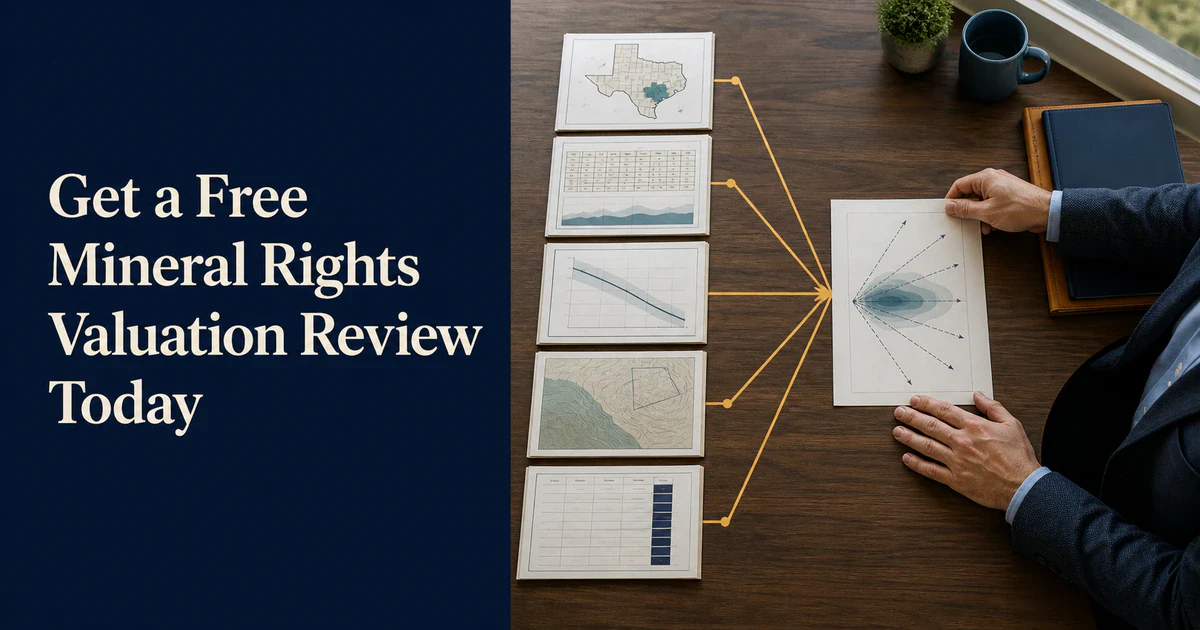
Get a Free Mineral Rights Valuation Review Today
A free MRX valuation review organizes property, ownership, production, royalty, and offer evidence into a directional range with explicit assumptions and limits.
Read the post →
What a Mineral Rights Assessment Does and Does Not Tell You
A directional mineral-rights assessment should identify its subject, date, evidence, assumptions, scenario range, limitations, and reset triggers without posing as title, appraisal, legal, tax, or transaction advice.
Read the post →
Mineral Rights Document Redaction Checklist Before You Share Records
A mineral-rights document redaction checklist separates preserved originals from limited share copies and records what was withheld without recording the sensitive value.
Read the post →A practical next step
Put your mineral rights in context.
Every mineral interest, royalty history, and written offer is different. Start with a question, or share what you have for a free underwriter review.
- Free
- Confidential
- No obligation to sell
Ready for a closer look?
Request an Underwriter ReviewGet a directional range with the assumptions clearly stated.