
MRX Learning Center
How to Build a Mineral Rights Valuation Evidence-Cutoff Log
An evidence-cutoff log records the sources, identifiers, covered periods, access dates, last-included evidence dates, and gaps present in a review file at one stated point in time.
Direct answer for mineral owners
Give the file one review ID and one stated evidence cutoff. For every source, record the source class, identifier, version or query, covered period, access or receipt date, last evidence date actually included, inclusion status, retained locator, limitation, and unresolved gap. Keep source records separate from working notes and later outputs. The log shows file contents at one point in time; it does not determine value, validate an assessment, or decide whether a review should be refreshed.
Key takeaways for mineral owners
- Use one file ID and one evidence cutoff instead of mixing records gathered at different times.
- Separate covered-through dates, access dates, release dates, receipt dates, and dates actually used.
- Preserve source identity and limitations without converting a public record into a property-specific conclusion.
- Label late, missing, conflicting, or locator-only records instead of silently treating them as included.
- Stop before valuation methods, inputs, outputs, accuracy judgments, offer advice, or transaction decisions.
Evidence-control boundary. This article organizes source metadata in a dated review file. It does not determine value, worth, price, fairness, expected owner net, offer quality, title, ownership, acreage, royalty decimal, lease effect, production status, payment entitlement, property connection, regulatory status, or a transaction result. It does not validate a source, method, input, assumption, calculation, assessment, or conclusion; decide whether a review should be revised or relied upon; or provide legal, title, land, tax, accounting, appraisal, engineering, geological, reserve, investment, or financial advice. MRX provides educational information and resources only and does not buy mineral rights.
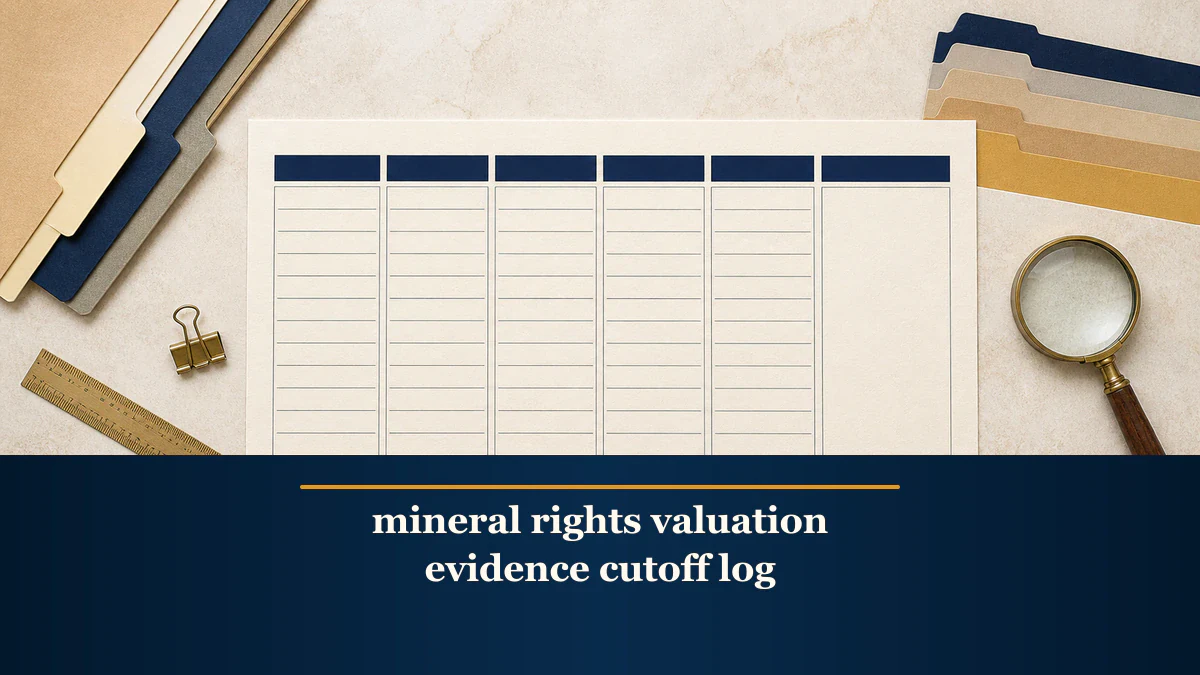
A mineral rights valuation evidence cutoff log answers one narrow question: what identified material was in this review file at this stated point in time? Give the file a stable ID. State one evidence cutoff. Then record each source, its version or query, what period it covers, when it was accessed or received, the last evidence date actually included, and any unresolved gap.
That log does not say the file is complete, the source is correct, or a valuation is current. It preserves timing and provenance so a later reviewer does not confuse a record found afterward with evidence that was available earlier.
Start with one file ID and one cutoff statement
Create a file ID that does not expose a real owner name, account number, instrument number, or property identifier. A neutral pattern such as REVIEW-FILE-01 works in a shared template. Keep the private crosswalk in a controlled location.
Write a cutoff statement before adding rows:
- File ID: the stable review-file label.
- Evidence cutoff: the date and time after which newly received material belongs in a later-evidence lane.
- Purpose: source inventory only, stated without a value or transaction objective.
- Custodian: the person or controlled system responsible for the working copy.
- Version: the version number of the log itself.
- Timezone: the timezone used for timestamps.
Do not backdate the cutoff to make a file appear more complete. If the cutoff changes, preserve the old version and create a new version with a reason for the change. A later version can reference the same source, but it should not erase the earlier record of what was available.
Use one row for each source object
A source object is the specific item a reviewer could find again. RRC production is too broad. A better row identifies the system, query type, search field, displayed identifier, covered period, access date, and retained output locator.
Record these fields:
- Source class: private instrument, owner statement, correspondence, regulatory query, public series, map, working note, or later professional output.
- Source name: the official system, document name, or neutral private-file label.
- Identifier: the query field, document ID, file ID, series code, or other reproducible locator.
- Version or edition: the document version, amendment, query path, report edition, or page revision when stated.
- Covered period: the time span the source says it represents.
- Access or receipt date: when the file custodian obtained or viewed it.
- Release or update date: the source-stated publication or update date, if available.
- Last included evidence date: the latest dated evidence from that object actually placed in the review file.
- Inclusion status: included, locator only, received after cutoff, missing, unreadable, version conflict, or needs qualified review.
- Retained locator: where the authorized copy, screenshot, export, correspondence, or private document can be found.
- Source limitation: the publisher limitation or a neutral note about what the row does not establish.
- Unresolved gap: a factual request stated without assuming the answer.
Use not stated, not located, or not applicable to this source instead of guessing. A blank can be mistaken for an oversight. A controlled label shows that the field was considered.
Keep the dates separate
Review files often collapse several dates into one. That makes later comparison unreliable. Preserve each date for its own role.
- Execution or document date belongs to the document itself.
- Covered-through date describes the period represented by a statement, dataset, or report.
- Release or update date is the date the publisher says an edition or page was released or refreshed.
- Access date is when the custodian viewed or downloaded the source.
- Receipt date is when a private record or correspondence reached the file.
- Last-included evidence date is the latest evidence date the file actually used.
- Cutoff date is the boundary for that version of the inventory.
These dates can differ without any error. A source accessed after the cutoff may describe an earlier period. A report released before the cutoff may not have reached the file until later. Record the distinction instead of moving dates into a single as of field.
Separate source records, working notes, and outputs
The National Archives Records Basics page discusses source records, working files, information-system inputs, system content, and outputs in the federal records context. That framework is useful only as an organizational analogy. It does not create a private mineral-owner retention rule, legal duty, or records disposition schedule.
Use separate lanes:
- Source lane: the authorized document, public query, dataset, statement, or correspondence and its locator.
- Working-note lane: neutral extraction notes, questions, and source limitations tied to a source row.
- Output lane: a later report, assessment, calculation, or professional conclusion with its own author, date, scope, and source list.
- Later-evidence lane: material received after the stated cutoff, linked without silently changing the earlier file.
Do not paste a conclusion into the source row. Do not label a working note as a fact from the publisher. Do not treat a later output as if it was an input available at the cutoff.
Log RRC records with their stated limitations
The Railroad Commission Research Queries page identifies production, permit, well-record, and other systems. It also states that online datasets are continually updated, are informational, are not authoritative public records, and have no legal force. A log row should preserve the exact system and query path rather than the general label RRC data.
The RRC Production Data page describes its compilations as production information reported to the Commission by Texas operators. Record the chosen compilation or query, identifier, period, access date, and retained locator. Do not turn that row into proof of owner payment, private property connection, production forecast, or value.
The Production Data Query System FAQs explain that Texas oil production can be reported at the lease level, reports arrive after the production month, displayed information can change with revised, corrected, or delinquent reports, and query results are a snapshot. They also identify the system coverage period and update frequency. Those facts justify separate fields for reporting level, covered period, access date, source update, and limitation.
Do not label a row complete because it returned a result. Use a neutral status such as query result retained; source limitations attached. Completeness, property connection, and suitability remain separate questions.
The RRC Oil and Gas Well Records page lists useful request fields such as county, approximate drilling date, lease or well name and number, operator, field, Commission identifier, and survey location. It also says the Commission lacks authority over private lease, royalty, payment, and property-right matters. Preserve a well-record locator without treating it as a private-rights conclusion.
Log a public economic series without adopting it
The EIA Spot Prices for Crude Oil and Petroleum Products page is a useful example of why public-series metadata matters. It identifies product, geography, unit, period, history route, release date, and source notes. A cutoff log can preserve those fields when a file references a public series.
Do not copy a displayed price into a private value conclusion. Do not assume the series equals an owner realized price, a forecast, a contract price, or a valuation input. The evidence row records what public series was present, which period and unit it displayed, when it was released and accessed, and what limitation accompanied it.
If the file contains a screenshot or export, record that object separately from the live page. A live page can update after the cutoff. The retained object and its timestamp help another reviewer understand which edition was actually present.
Handle private records without exposing them
A private source row can identify an authorized document without publishing its contents. Use neutral labels such as LEASE-01, STATEMENT-03, or CORRESPONDENCE-02. Keep names, addresses, signatures, account data, payment instructions, private amounts, legal descriptions, and instrument images out of a broadly shared template.
For a private document, preserve:
- the neutral document ID;
- document type and version relationship;
- execution, statement, or correspondence date;
- covered period when the document states one;
- receipt date and last-included evidence date;
- controlled locator and access restriction;
- whether the copy is complete, partial, unreadable, or in conflict with another version; and
- a neutral request for the missing item.
The log does not interpret the document. A lease row does not decide lease effect. A royalty statement row does not prove payment sufficiency. An offer row does not establish value or fairness.
Use status labels that preserve uncertainty
Use a small controlled vocabulary:
- Included: the identified object was present in the file by the cutoff.
- Locator only: a public or private reference was recorded, but the underlying object was not retained.
- Received after cutoff: the object belongs in the later-evidence lane.
- Missing: the row identifies a requested object that was not located.
- Unreadable: the retained copy cannot support reliable extraction.
- Version conflict: two objects claim a related role and the controlling version is unresolved.
- Needs qualified review: the source exists, but its meaning, connection, or effect is outside this administrative log.
These statuses describe file control, not truth. Included does not mean correct. Missing does not mean nonexistent. Version conflict does not decide which version controls.
Compare files without comparing values
Two cutoff logs can be compared at the source-object level:
- Was the same source class present?
- Was the same identifier or document version used?
- Did the covered period change?
- Was a later edition received?
- Did an unresolved gap receive a source response?
- Did a source move from locator only to retained?
Stop there. Do not infer that a different source set caused a different value, made a review more accurate, or requires a new conclusion. That connection belongs to the qualified reviewer responsible for the later work.
Use a blank evidence-cutoff template
- Review-file ID:
__________ - Log version:
__________ - Evidence cutoff and timezone:
__________ - Source row ID:
__________ - Source class and name:
__________ - Exact identifier or private document ID:
__________ - Version, edition, or query path:
__________ - Covered period:
__________ - Release or update date:
__________ - Access or receipt date:
__________ - Last included evidence date:
__________ - Inclusion status:
__________ - Controlled retained locator:
__________ - Publisher or source limitation:
__________ - Unresolved gap and requested source:
__________ - Later-evidence link:
__________
Keep the template blank when sharing it as an example. Store the completed version in a location appropriate for private records and limit access to people authorized to review it.
Evidence-cutoff log quality controls
Before handing the log to the next reviewer, confirm that:
- one file ID, cutoff, timezone, and log version are stated;
- every row identifies a reproducible source object or a clearly labeled missing request;
- covered periods and access, receipt, release, update, and last-included dates are not collapsed;
- source records, working notes, outputs, and later evidence remain separate;
- every RRC row includes the exact query or locator and the relevant source limitation;
- every public-series row includes product or series identity, geography, unit, period, edition, and access date when available;
- private identifiers and sensitive contents remain controlled;
- late, missing, unreadable, and conflicting records are labeled without conclusions;
- no row validates a valuation method, input, output, accuracy claim, offer, or transaction decision; and
- every unresolved gap is written as a source request rather than an assumed answer.
A disciplined cutoff log is intentionally modest. It shows what the file contained and when. That is enough to prevent later material from being mistaken for earlier evidence, without turning file administration into a valuation, legal conclusion, or transaction recommendation.
Frequently asked questions
Does an evidence-cutoff log prove that a mineral rights valuation is current or accurate?
No. It records which identified materials were present at a stated cutoff. It does not validate the source content, valuation method, assumptions, calculations, conclusions, or suitability of a review.
Is the access date the same as the last evidence date included?
Not necessarily. A page can be accessed today while displaying information through an earlier period. Record the access date, displayed coverage period, source release or update date when stated, and the last evidence date actually included as separate fields.
Should a record received after the cutoff be added to the old file?
Preserve it as a later-received item linked to the original file ID. Do not silently rewrite the old cutoff. A qualified reviewer can decide whether any later work should use it.
Can an RRC query row establish ownership or value?
No. RRC online datasets are informational and subject to accuracy, completeness, currency, and suitability limits. A query result does not establish private ownership, property connection, lease effect, payment entitlement, or value.
Does the log tell me whether to request a new valuation review?
No. It makes the source timing and gaps visible. It does not decide whether a review should be reset, revised, accepted, rejected, or relied upon.
Sources reviewed for this article
- Railroad Commission of Texas, Research Queries (accessed 2026-08-23)
- Railroad Commission of Texas, Oil and Gas Production Data (accessed 2026-08-23)
- Railroad Commission of Texas, Production Data Query System FAQs (accessed 2026-08-23)
- Railroad Commission of Texas, Oil and Gas Well Records (accessed 2026-08-23)
- U.S. National Archives, Records Basics (accessed 2026-08-23)
- U.S. Energy Information Administration, Spot Prices for Crude Oil and Petroleum Products (accessed 2026-08-23)
Related mineral-rights articles
How to Build a Mineral Rights Sale Document Package Index
A mineral-rights sale document package index reconciles every source file, page, exhibit, schedule, addendum, signature copy, and replacement without interpreting the documents.
Read the post →
How to Build a Mineral Rights Sale Decision Log
A mineral-rights sale decision log keeps scope changes, source records, document versions, open questions, referrals, decisions, and next actions in one dated audit trail.
Read the post →
How to Build a Mineral Rights Valuation Input Correction Packet
A mineral rights valuation input correction packet records a factual correction request and its source without recalculating value or implying a changed conclusion.
Read the post →
What a Mineral Rights Assessment Does and Does Not Tell You
A directional mineral-rights assessment should identify its subject, date, evidence, assumptions, scenario range, limitations, and reset triggers without posing as title, appraisal, legal, tax, or transaction advice.
Read the post →A practical next step
Put your mineral rights in context.
Every mineral interest, royalty history, and written offer is different. Start with a question, or share what you have for a free underwriter review.
- Free
- Confidential
- No obligation to sell
Ready for a closer look?
Request an Underwriter ReviewGet a directional range with the assumptions clearly stated.