
MRX Learning Center
How to Compare Public Oil and Gas Price Decks Without Mixing Assumptions
A field-by-field comparison keeps each public price deck in its own source lane so dates, commodities, geography, units, dollar basis, and stated purpose are not silently mixed.

Direct answer for mineral owners
Compare two published oil and gas price decks without combining them. Give each source its own column; record publisher, publication date, forecast-completion or effective period, commodity, benchmark, geography, unit, nominal-or-real basis, horizon, stated use case, and retrieval date exactly as disclosed. Mark absent or unclear fields as not stated or unresolved. Stop before creating, normalizing, selecting, or recommending a deck or using it to calculate property value.
Key takeaways for mineral owners
- Keep every source in a separate column and preserve its publication date, effective period, version, and retrieval date.
- Compare commodity, benchmark, geography, unit, nominal-or-real basis, time interval, horizon, and stated use case before comparing displayed values.
- Do not treat a public forecast, spot-price series, reserve-pricing rule, realized price, and property-specific price assumption as interchangeable.
- Write not stated or unresolved when a publication does not disclose a field; do not silently fill, convert, escalate, or normalize it.
- Use the completed matrix to ask neutral follow-up questions, not to choose a forecast or determine mineral-rights value.
Comparison-only boundary. This article explains how to compare the labels and disclosed assumptions in dated public oil and gas price-deck publications. It does not create, extend, convert, normalize, select, validate, or recommend a price deck; forecast commodity prices; calculate present value or mineral-rights value; interpret a reserve report or private instrument; or provide owner-specific engineering, appraisal, investment, legal, or tax guidance. MRX provides educational information and resources only and does not buy mineral rights.
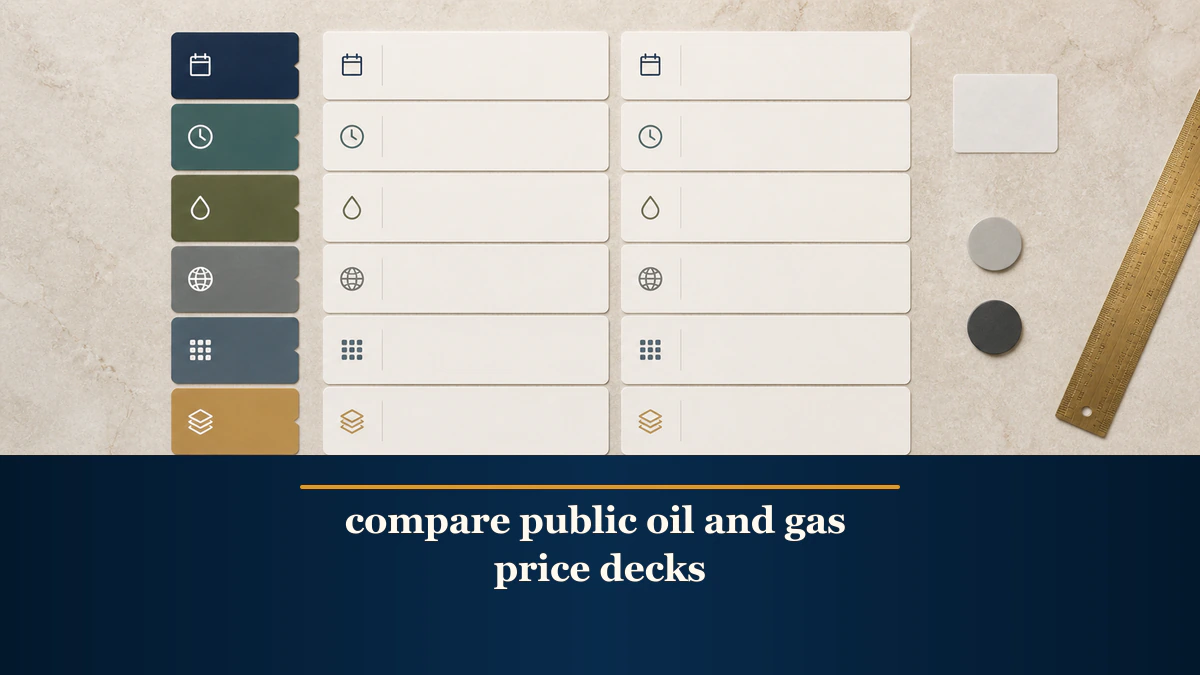
To compare public oil and gas price decks, place each publication in its own source column. Before looking at displayed prices, record the publisher, publication date, forecast-completion or effective period, version, commodity, benchmark, geographic basis, unit, nominal-or-real basis, time interval, horizon, stated use case, source URL, and retrieval date.
Compare only fields that have the same disclosed frame. If a field is absent or unclear, write not stated or unresolved. Do not fill the gap from another publication, convert a unit, extend a horizon, or silently substitute a newer version.
What this comparison does and what it does not do
A public deck comparison is a source-control exercise. It answers a narrow question: are the displayed observations framed the same way?
That is different from the one-variable sensitivity worksheet, which records an output supplied by an existing model while one documented input changes. It is also different from a discount-rate review, a property-level cash-flow forecast, an appraisal, or an offer analysis.
The comparison should not produce a blended price series. It should not decide that one publisher is more accurate, select a “conservative” case, or claim that a public outlook equals the price an owner will realize.
Preserve the publication identity first
The EIA Short-Term Energy Outlook is a useful example of why source identity matters. Its live page identifies a release date and forecast-completion date and provides access to current tables, data, and prior releases. A later release can change the displayed outlook while keeping a similar page title.
For each source, preserve:
- exact publication title and publisher;
- publication, release, or issue date;
- forecast-completion, data-through, effective, or reporting period when stated;
- edition, vintage, version, table, and page or section;
- stable URL or saved source file;
- access or retrieval date; and
- whether the source is a forecast, historical series, reserve-reporting method, scenario, survey, or another stated publication type.
Do not overwrite the publication date with the retrieval date. Do not cite only a landing page when the compared field came from a dated table or PDF; retain the table or file location too.
Build a field-by-field matrix
Use one row per comparison field and one column per source. A practical matrix looks like this:
| Comparison field | Source A | Source B | Review note |
|---|---|---|---|
| Publication identity | Exact title, publisher, version | Exact title, publisher, version | Same source type or different? |
| Dates | Release, completion, effective, and retrieval dates | Release, completion, effective, and retrieval dates | Do not collapse different dates |
| Commodity | Oil, natural gas, NGL, or another label exactly as stated | Exact stated commodity | Do not combine commodities |
| Benchmark or series | Exact named benchmark or source series | Exact named benchmark or source series | not stated if absent |
| Geographic basis | Country, region, hub, basin, delivery point, or other stated basis | Exact stated basis | Do not infer property location |
| Unit | Exact currency and physical unit | Exact currency and physical unit | Do not convert inside this matrix |
| Dollar basis | Nominal, real, constant-dollar base period, or not stated | Exact stated basis | Keep base periods visible |
| Time interval | Daily, monthly, quarterly, annual, average, or another label | Exact stated interval | Do not compare mismatched intervals as identical |
| Horizon | First and last displayed periods | First and last displayed periods | Do not extend missing periods |
| Stated use case | Publisher’s stated purpose | Publisher’s stated purpose | Keep forecast and disclosure rules separate |
| Assumptions and caveats | Exact section or concise sourced paraphrase | Exact section or concise sourced paraphrase | Preserve revision and uncertainty language |
The review-note column records only whether the frames match, conflict, or remain unresolved. It does not rate the sources or choose a winner.
Keep commodity, benchmark, and geography separate
“Oil” and “natural gas” are not complete comparison labels. Record the commodity and the named benchmark or series separately. Then record the location or geographic basis stated by the publisher.
A public benchmark is not automatically a property’s realized price. Location, quality, timing, contract terms, transportation, and other property-level facts may differ. The basis-differentials guide owns that separate market-versus-property distinction; this article only preserves the source labels.
If Source A names a national or benchmark series and Source B names a regional hub, mark the geographic basis different. Do not bridge the difference with an assumed differential.
Compare units before displayed values
EIA’s units and calculators overview explains that energy sources use different physical units and that conversion requires a defined method. Its natural-gas units FAQ distinguishes abbreviations such as cubic feet, Mcf, Btu, and MMBtu.
Copy the unit exactly as displayed, including the currency, denominator, and any scale prefix. For example, a per-barrel oil label and a per-MMBtu gas label belong in different commodity rows. A per-Mcf field and a per-MMBtu field should remain visibly different even when a separate analyst could convert them with additional assumptions.
Do not perform that conversion in the source matrix. A silent conversion can introduce a heat-content assumption, scale error, currency error, or base-period mismatch that the original publication never supplied.
Record nominal or real dollar basis
EIA’s nominal and real prices FAQ says its published prices are generally nominal unless otherwise noted and explains that real prices are adjusted for inflation. That distinction belongs in its own row.
Record one of these labels only when the source supports it:
nominal;real, with the stated base period;- another explicit constant-dollar convention; or
not stated.
Do not call a series real because it spans several years. Do not apply an inflation index, choose a base year, or restate one publication to match another inside this workflow. Those are new analytical choices and require separate documentation.
Do not mix forecast decks with reserve-pricing rules
The SEC’s Modernization of Oil and Gas Reporting final rule describes a 12-month average pricing mechanism for specified oil-and-gas reserve disclosures. It also discusses disclosure context and pricing mechanisms. That prescribed reporting frame is not interchangeable with a publisher’s future commodity outlook.
Label the source type before comparing it:
- public forecast or outlook;
- historical observation or spot-price series;
- scenario publication;
- reserve-disclosure pricing method;
- company or third-party planning deck; or
not stated.
If two documents serve different stated purposes, the matrix should show different use case. Do not splice periods from one into the other or describe the result as a single public price deck.
Use neutral status labels
Give each comparison row one status:
matched framewhen the disclosed commodity, benchmark, geography, unit, dollar basis, interval, horizon, and use case align;different framewhen one or more disclosed fields differ;missingwhen a cited field or referenced document is unavailable; orunresolvedwhen the available source does not support a reliable classification.
These labels describe the source frame only. Matched frame does not mean the displayed values are accurate, likely, appropriate for a property, or suitable for a decision. Different frame does not mean either source is wrong.
Ask source questions instead of filling gaps
Convert every gap into a neutral question:
- “Which dated edition supplied this field?”
- “What forecast-completion or data-through date applies?”
- “Which commodity, benchmark, and geographic basis does this row use?”
- “Is the displayed unit per barrel, per Mcf, per MMBtu, or another stated unit?”
- “Are the dollar amounts nominal or real, and what base period applies?”
- “Is this publication a forecast, historical series, reserve-reporting method, or internal planning case?”
- “Which source states the horizon and update convention?”
Do not answer a missing field with a value from a different publisher or vintage. Preserve the gap so a reviewer can see exactly what remains unsupported.
Stop before property-level analysis
The source matrix is complete when each publication has a stable identity and each comparison row has a copied field, source location, and status. Stop if the next step would require you to:
- create, extend, blend, interpolate, escalate, convert, or normalize a price series;
- select a base, upside, downside, conservative, or recommended deck;
- forecast oil, natural-gas, or NGL prices;
- apply a basis differential, quality adjustment, transportation assumption, or realized-price bridge;
- combine a deck with production, decline, development timing, costs, ownership, or discounting;
- calculate cash flow, present value, mineral-rights value, an offer, or a transaction result; or
- reach a conclusion about engineering, reserves, appraisal, investment, legal, or tax matters.
Those tasks require a separately controlled analysis and may call for a qualified petroleum engineer, reserves evaluator, appraiser, accountant, attorney, tax professional, financial professional, or other appropriate specialist. Give the reviewer the original publications and the completed comparison matrix, not only a blended summary.
A compact quality check
Before sharing the comparison, confirm that:
- every source has an exact title, publisher, date, version, location, and retrieval date;
- each source remains in its own column;
- commodity, benchmark, geography, unit, dollar basis, interval, horizon, and use case are separate rows;
- absent fields say
not stated,missing, orunresolved; - no unit conversion, inflation adjustment, interpolation, extension, or normalization was added;
- forecast, historical, scenario, and reserve-reporting sources are not mislabeled as interchangeable; and
- the document contains no property-level price forecast, value, offer, or recommendation.
That discipline makes the comparison reproducible. It does not make a public deck property-specific, and it does not determine what a mineral interest is worth.
Source scope and research boundaries
- EIA Short-Term Energy Outlook: supports preservation of release, forecast-completion, edition, table, data, and archive context for a dated public outlook.
- EIA nominal and real prices FAQ: supports keeping nominal and inflation-adjusted price bases distinct.
- EIA units and calculators and natural-gas units FAQ: support explicit unit labels and the warning against silent unit conversion.
- SEC Modernization of Oil and Gas Reporting final rule: supports identifying the prescribed reserve-disclosure pricing context separately from a forecast publication.
These sources support the comparison fields and source boundaries only. They do not select or validate a price deck, supply property-specific assumptions, predict realized prices, or determine cash flow, present value, mineral-rights value, an offer, or a transaction result.
Frequently asked questions
What is the first step when comparing public oil and gas price decks?
Save the exact publications and give each one a separate source column. Record the title, publisher, publication date, forecast-completion or effective period, version, stable URL, and retrieval date before copying any commodity field.
Can I place oil and natural gas prices in the same comparison row?
Only if the row keeps the commodity, benchmark, geographic basis, unit, period, and source explicit. A dollar-per-barrel oil field and a dollar-per-MMBtu gas field are different observations and should never be treated as directly interchangeable.
Should I convert nominal prices into real prices for comparison?
Not in this source-preserving workflow. Record the basis exactly as the publisher states it. If a conversion is required for a separate professional analysis, document the method, inflation series, base period, and reviewer outside this comparison.
Is an SEC reserve price the same as a public forecast deck?
No. The SEC reporting framework describes a prescribed pricing mechanism for specified reserve disclosures. A forecast publication has its own stated purpose, dates, assumptions, and horizon. Label them separately rather than blending them.
Does this comparison show which price deck is best for my mineral rights?
No. It shows whether two public sources use the same disclosed frame. Selecting or building a property-specific deck and applying it to production, differentials, costs, ownership, timing, discounting, or value requires a separately defined analysis and qualified review.
Sources reviewed for this article
- U.S. Energy Information Administration, Short-Term Energy Outlook (accessed 2026-08-23)
- U.S. Energy Information Administration, nominal and real prices FAQ (accessed 2026-08-23)
- U.S. Energy Information Administration, units and calculators (accessed 2026-08-23)
- U.S. Energy Information Administration, natural gas units FAQ (accessed 2026-08-23)
- SEC, Modernization of Oil and Gas Reporting final rule, 74 FR 2158 (accessed 2026-08-23)
Related mineral-rights articles

Mineral Valuation Sensitivity Analysis: A One-Variable Scenario Worksheet
A mineral valuation sensitivity analysis worksheet shows how one sourced input changes an existing model output while every other assumption stays fixed.
Read the post →
How Much Are Mineral Rights Worth: Due Diligence In 2026
A 2026 mineral-rights review is only as current as its effective dates, observed-through dates, source updates, correction checks, and assumption vintages.
Read the post →
Discount Rates in Mineral Rights DCF: A Plain-Language Guide
A mineral-rights DCF converts a forecast of future owner cash flows into a present-value indication. The discount rate matters, but it must match the cash-flow definition and the risks not already modeled elsewhere.
Read the post →
Basis Differentials and Mineral Rights Cash Flow
A basis differential is the location-related difference between a benchmark and a regional market price. It can affect royalty cash flow, but it is not the same thing as a post-production deduction.
Read the post →A practical next step
Put your mineral rights in context.
Every mineral interest, royalty history, and written offer is different. Start with a question, or share what you have for a free underwriter review.
- Free
- Confidential
- No obligation to sell
Ready for a closer look?
Request an Underwriter ReviewGet a directional range with the assumptions clearly stated.
