
MRX Learning Center
Brazos CAD Mineral and Industrial Account Contact-Routing Worksheet
Route a single existing Brazos mineral or industrial account question without exposing private data, performing contact, or turning a destination label into a conclusion.
Direct answer for mineral owners
Before contacting anyone, record a single existing administrative question, the current official source route, access time, exact responsibility statement or contact label, a controlled reference, and source limits. Mark only routed, unresolved, or authorized-human-stop. Do not publish private account data, perform contact, or treat the route as proof of ownership, title, appraisal correctness, tax liability, value, professional authority, response, or outcome.
Key takeaways for mineral owners
- Start with a single existing administrative question; do not use this worksheet to search for an account or create a new issue.
- Preserve the current source URL, access time, exact displayed role or contact label, controlled reference, neutral question, and source limitation.
- Choose only routed, unresolved, or authorized-human-stop; a route does not prove acceptance, authority, response, or outcome.
- Keep names, contact details, account identifiers, notices, values, legal descriptions, and completed records in an authorized controlled system.
- Stop before contact, submission, login, upload, payment, legal or tax interpretation, appraisal review, valuation, or transaction work.
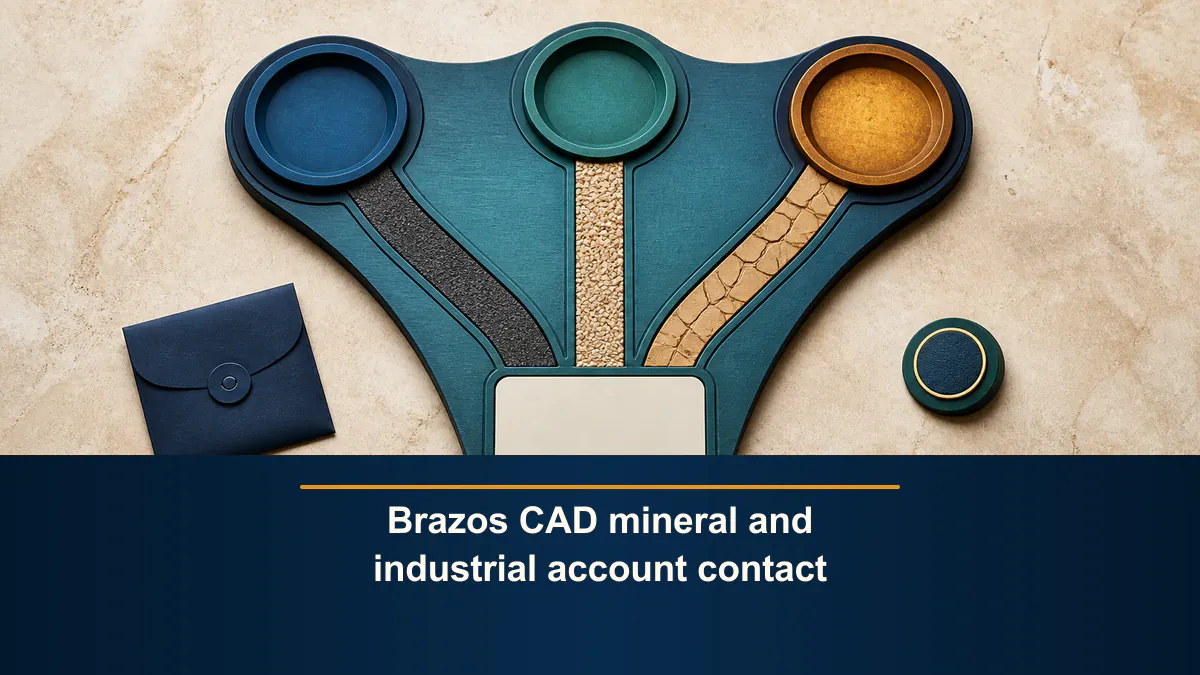
Pre-contact routing boundary. This blank worksheet organizes a single existing administrative question before any outreach. It does not search for an account; contact an office, contractor, or other person; submit a form or data request; create an account; sign in; upload a record; disclose private data; pay a fee; or interpret an appraisal, tax record, legal instrument, or professional conclusion. A source-displayed destination does not establish identity, ownership, title, acreage, legal-description accuracy, appraisal correctness, market value, tax liability, property-to-well connection, production, offer quality, buyer legitimacy, contractor independence, professional qualification, response time, outcome, legal effect, or transaction suitability. MRX provides educational information and resources only and does not buy mineral rights.
A Brazos CAD mineral and industrial account contact worksheet answers one narrow question: based on current source-displayed role and contact labels, where should a single existing administrative question be routed for a later authorized human review?
The output is not a sent message. It is a source-controlled routing record. Record the route, exact label, access time, controlled reference, neutral question, source limitation, and one of three states: routed, unresolved, or authorized-human-stop.
Use the six-step route
- Open one blank worksheet. Assign a neutral worksheet ID that contains no owner name, account number, or property detail.
- Describe a single existing question. Copy only the minimum neutral wording needed to classify it. Do not add facts or conclusions.
- Open the current source. Start from the official local district or the source-named contractor page and record the exact URL and access time.
- Capture the displayed role. Preserve the responsibility statement, destination label, and relevant source limitation exactly enough for a later reviewer to reproduce the routing decision.
- Store the private reference separately. Use a controlled pointer to the account notice, correspondence, or retained record. Do not paste private content into the public worksheet.
- Choose one bounded state. Mark
routed,unresolved, orauthorized-human-stop, then stop. A later authorized person decides whether contact is appropriate.
This workflow should end before a phone call, email, portal submission, registration, upload, payment, or appraisal discussion begins.
Record only the fields needed to reproduce the route
- Worksheet ID: Record a neutral internal label. Do not include an owner name, account number, or property clue.
- Existing question: Record one short administrative question. Do not insert a value opinion, legal position, or assumed answer.
- Source identity: Record the publisher, page title, URL, access date, and time zone. Do not infer a relationship the source does not display.
- Displayed route: Record the exact responsibility statement, role column, or contact label. Do not claim authority over every issue, acceptance, or response.
- Controlled reference: Record a nonpublic pointer to the retained notice or correspondence. Do not place the notice, identifier, private data, or screenshot in a public copy.
- Source limitation: Record the current disclaimer, login boundary, or unresolved scope. Do not claim completeness, accuracy, qualification, or legal effect.
- Routing state: Record
routed,unresolved, orauthorized-human-stop. Do not use resolved, verified, approved, correct, or complete. - Next authorized owner: Record the role permitted to review the route. Do not turn the field into an instruction to disclose data or contact someone automatically.
Use not displayed when a current source lacks a field. Do not fill the gap from memory, a search snippet, a prior-year notice, or another person’s account.
Separate source labels from conclusions
The current Capitol Appraisal Group mineral interface displays a mineral owner-relations route for value or ownership questions, concerns, and updates. It separately displays a corporate route for clients, appraisal, and software services. Preserve the exact label that supports the route. Do not convert a label into legal authority, professional endorsement, a promise to resolve the question, or an instruction to share a notice.
The current assignment table includes a Brazos row and separates industrial-appraiser, mineral-appraiser-value, and mineral-analyst-ownership columns. Those are source-displayed role categories. They do not prove that a named person is the correct destination for every account question, that the table is a title record, or that a reviewer has verified the account, owner, appraisal, or legal effect.
The current client page lists Brazos County Appraisal District. Preserve the page and access time if that relationship is part of the route. Do not infer contract duration, scope, exclusivity, independence, professional qualification, service level, response time, or outcome.
Keep the local district and contractor rows separate
Create one row for the local district source and another for the source-named contractor when both are relevant. Do not collapse them into a single implied organization.
The Brazos CAD Property Search identifies the local appraisal-district destination. It also states that displayed 2026 values are preliminary, that the information is for research, and that legal descriptions and acreage should be verified before legal use. Those limitations continue to apply when a search result or notice generates a later question.
This contact-routing worksheet does not perform the public search. The separate Brazos CAD mineral account search worksheet owns one no-login search attempt, one source-displayed mode, one known criterion, and located, not located, or unverified. This page begins only after an administrative question already exists and stops before contact.
The Texas Comptroller local-property directory distinguishes appraisal-district questions from tax assessor-collector questions. Use that as institutional context, not an owner-specific jurisdiction decision. A question about a tax bill, tax receipt, payment, or tax certificate is not automatically a mineral-appraisal-contractor question.
Write a neutral question, not a conclusion
A neutral question identifies the source field and the clarification needed without asserting the answer.
Use patterns such as:
Which current source-displayed route accepts an administrative question about the label on the retained notice?Does the current destination page display a route for this question category, or should the worksheet remain unresolved?Which authorized reviewer should decide whether the controlled reference may be disclosed?
Avoid statements such as:
This account belongs to the owner.The appraisal is wrong.The contractor must correct the value.This role confirms ownership.The route proves the property is connected to a well.The value shown is what the minerals are worth.
Those statements require evidence and professional judgment outside this routing job.
Use the three routing states precisely
Routed
Use routed only when a current source displays a destination label that matches the neutral administrative question category. Record the supporting source, exact label, access time, limitation, and controlled reference. Routed does not mean contacted, received, accepted, assigned, correct, complete, or resolved.
Unresolved
Use unresolved when the current sources are unavailable, stale, inconsistent, incomplete, or too broad to distinguish destinations. Preserve each conflicting label and access attempt. Do not pick the route that sounds most convenient or use an older page to conceal the conflict.
Authorized-human-stop
Use authorized-human-stop before any step that would expose private information, send a message, create an account, sign in, upload a file, submit a request, pay a fee, solve a CAPTCHA, interpret a notice, challenge an appraisal, or request owner-specific legal, tax, valuation, engineering, or transaction advice.
The stop state is a successful boundary, not a failed worksheet. It shows exactly where administrative routing ended and new authority or qualified judgment would begin.
Protect the underlying record
The public template should remain blank. In the controlled version, use a reference such as CONTROLLED-NOTICE-REF rather than copying an owner key, account number, property ID, geographic ID, notice image, owner name, address, email, phone number, legal description, acreage, interest, value, or tax amount.
Do not send the controlled record from this workflow. A later authorized human should verify the destination, decide whether disclosure is necessary, minimize the disclosed fields, use an approved channel, and preserve the resulting correspondence separately.
If the source requires registration or login, record authorized-human-stop. Do not create credentials, test an account, upload a notice, or try to reach private content merely to finish the routing worksheet.
Do not turn appraisal administration into mineral-sale value
The word value may appear in a source-displayed role label. That does not authorize a mineral-sale estimate. This worksheet does not analyze production, decline, commodity prices, operator plans, geology, acreage, royalty decimals, cash flow, comparable sales, offers, buyers, taxes, basis, or transaction terms.
An appraisal-system value serves a property-tax administration context. It is not automatically a market offer, owner-specific mineral appraisal, fair-price conclusion, or transaction recommendation. Keep the separate explanation in Why Doesn’t My Texas Mineral Tax Value Match a Sale Estimate? when that distinction is the actual question.
Run the release checklist before a routing record is complete
- a single existing administrative question is recorded without adding facts;
- one neutral worksheet ID contains no private clue;
- each source row includes publisher, page title, exact URL, access date, time, and time zone;
- the exact displayed responsibility statement, role category, or contact label is preserved;
- the private source record is referenced only by a controlled pointer;
- current source limitations and any login boundary are stated;
- district, contractor, tax-office, legal, tax, valuation, and transaction roles are not merged;
- the state is exactly routed, unresolved, or authorized-human-stop;
- no contact, submission, registration, login, upload, payment, bypass, scraping, or bulk collection occurred;
- no identity, ownership, title, acreage, legal-description, appraisal, tax, value, production, offer, professional, legal, or transaction conclusion appears.
If any item fails, keep the worksheet unresolved or stop for an authorized human.
Frequently asked questions
Does a contractor route prove who has authority over my mineral account?
No. It preserves a current source-displayed destination label for one neutral administrative question. It does not establish contractual scope, legal authority, professional qualification, ownership, title, appraisal correctness, or a promised response.
Should I place my owner key or account number in the public worksheet?
No. Keep identifiers, notices, screenshots, contact details, and completed routing records in an authorized controlled system. The reusable public worksheet and images remain blank.
Can this worksheet tell me whether a mineral appraisal is correct?
No. It does not evaluate appraisal methods, inputs, values, notices, protests, tax liability, mineral market value, or an owner-specific conclusion. It only preserves a pre-contact route and its source limits.
What if the current sources point to different destinations?
Preserve each source and access time, describe the conflict neutrally, and mark unresolved or authorized-human-stop. Do not select a destination by guessing or merge role labels into a conclusion.
Does routed mean the office or contractor received my question?
No. Routed means only that the worksheet identified a source-supported destination before contact. This workflow does not send a message, submit a form, create an account, upload a record, or predict a response or result.
Sources reviewed for this article
- Capitol Appraisal Group: Mineral Appraisal Interface
- Capitol Appraisal Group: Current Appraisal Assignments
- Capitol Appraisal Group: Appraisal Client Base
- Brazos CAD Property Search
- Texas Comptroller: Local Property Appraisal and Tax Information
This worksheet is educational and administrative. It is not a title search, appraisal review, tax analysis, legal opinion, professional endorsement, contact authorization, or transaction recommendation. Keep completed materials in an authorized controlled system and use the applicable official source or qualified professional for owner-specific questions.
Frequently asked questions
Does a contractor route prove who has authority over my mineral account?
No. It records only the current source-displayed destination label for one neutral administrative question. It does not establish contractual scope, legal authority, professional qualification, ownership, title, appraisal correctness, or a promised response.
Should I place my owner key or account number in the public worksheet?
No. Keep identifiers, notices, screenshots, contact details, and completed routing records in an authorized controlled system. The reusable public worksheet and images remain blank.
Can this worksheet tell me whether a mineral appraisal is correct?
No. It does not evaluate methods, inputs, values, notices, protests, tax liability, mineral market value, or an owner-specific appraisal. It only preserves a pre-contact route and its source limits.
What if the current sources point to different destinations?
Preserve each source and access time, describe the conflict neutrally, and mark unresolved or authorized-human-stop. Do not select a destination by guessing or merge role labels into a conclusion.
Does routed mean the office or contractor received my question?
No. Routed means only that the worksheet identified a source-supported destination before contact. This workflow does not send a message, submit a form, create an account, upload a record, or predict a response or result.
Sources reviewed for this article
- Capitol Appraisal Group, Mineral Appraisal Interface (accessed 2026-08-26)
- Capitol Appraisal Group, Current Appraisal Assignments (accessed 2026-08-26)
- Capitol Appraisal Group, Appraisal Client Base (accessed 2026-08-26)
- Brazos CAD Property Search (accessed 2026-08-26)
- Texas Comptroller, Local Property Appraisal and Tax Information (accessed 2026-08-26)
Related mineral-rights articles
Brazos CAD Mineral Account Search Retrieval Provenance Worksheet
Preserve one official Brazos CAD mineral account search attempt without turning a displayed account into ownership, title, appraisal, tax, value, or transaction proof.
Read the post →
Texas Comptroller County Tax Assessor-Collector Directory Retrieval Provenance Worksheet
Create one blank provenance record for one authorized manual attempt to preserve only the official Texas Comptroller county-page Tax Assessor/Collector directory section.
Read the post →
Texas Comptroller County Appraisal District Directory Retrieval Provenance Worksheet
Create one blank provenance record for one authorized manual attempt through the official Texas Comptroller county directory without expanding into property or tax-record research.
Read the post →
Why Doesn’t My Texas Mineral Tax Value Match a Sale Estimate?
A Texas mineral tax value and a voluntary sale estimate can differ because they may describe different interests, dates, purposes, data, assumptions, and exclusions.
Read the post →A practical next step
Put your mineral rights in context.
Every mineral interest, royalty history, and written offer is different. Start with a question, or share what you have for a free underwriter review.
- Free
- Confidential
- No obligation to sell
Ready for a closer look?
Review the Brazos CAD Search BoundaryGet a directional range with the assumptions clearly stated.
