
MRX Learning Center
Title Curative for Mineral Rights: What It Is and Why It Matters Before You Sell
A title-curative primer that explains why incomplete ownership files can slow or reshape a mineral-rights sale.
Direct answer for mineral owners
Title curative is the process of resolving gaps, inconsistencies, or missing support in the ownership file before a mineral-rights transaction closes. It matters because even a promising deal can slow down, be repriced, or fail if the deed chain, probate support, or other ownership records do not line up cleanly enough for the transfer.
Key takeaways for mineral owners
- Title curative is about repairing or clarifying the ownership file, not about adding sales spin.
- Curative issues can delay timing, change economics, or stop a transaction if they remain unresolved.
- The right response starts with identifying exactly what is missing from the chain of title.
- Owners should understand who is responsible for curative work under the written agreement before they commit.
Educational only. This article explains title-curative concepts in plain language and does not provide a title opinion or legal guidance for a specific ownership file.
Direct answer for mineral owners
Title curative is the process of resolving gaps, inconsistencies, or missing support in the ownership file before a mineral-rights transaction closes. It matters because even a promising deal can slow down, be repriced, or fail if the deed chain, probate support, or other ownership records do not line up cleanly enough for the transfer.What title curative is really solving
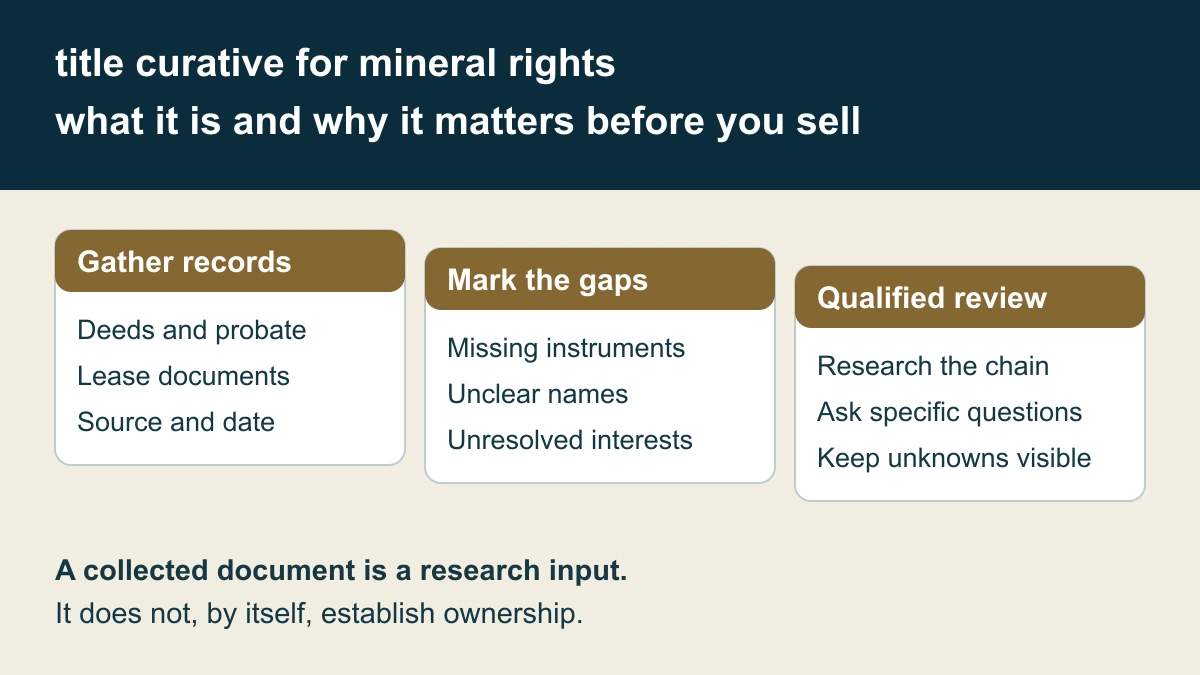
Title curative is not a vague legal formality. It is the practical process of identifying what the ownership file lacks and adding or clarifying the support needed to move the tract forward responsibly. That can involve probate support, affidavits, deed corrections, or other records depending on what the file is missing.
Why curative work matters before a sale
A buyer who cannot reconcile the ownership file may delay, discount, or decline the transaction. That is why title-curative issues often matter before any final decision about timing or economics can be trusted. Curative questions also interact with purchase-agreement terms, which is why owners should not treat them as a side issue.
How owners should approach the file
The useful approach is to identify the missing support precisely rather than using general language about “bad title.” Owners should ask what document, filing, or legal clarification is needed and who is responsible for obtaining it. Start with the title, lease, and ownership guide to distinguish the records involved. If you already have an ownership report, use the report-to-source checklist to organize its citations and unresolved questions. Finding a cited document does not, by itself, establish ownership or resolve a title issue.
Why sellers should slow down here
A rushed response to curative issues can create new confusion. Sellers are usually better served by understanding the exact ownership problem and the contract consequences before they agree to a path forward.
Questions this article helps you frame
- What is title curative in a mineral-rights sale?
- Why can curative issues change the timing or economics of a deal?
- What should sellers review before agreeing to title-curative obligations?
Source notes and retrieval context
- Texas Property Code § 13.001: Validity of Unrecorded Instrument (retrieved 2026-07-31; verified 200)
- Texas Property Code § 5.021: Instrument of Conveyance (retrieved 2026-07-31; verified 200)
- Texas Business & Commerce Code § 26.01: Promise or Agreement Must Be in Writing (retrieved 2026-07-31; verified 200)
- County clerk ownership records remain a required source-of-record class for tract-specific title verification even though this statewide article does not fabricate one county URL for every property.
- Retrieval window used for this remediation packet: 2026-07-31T23:07:24Z. Verified source statuses were carried forward from the Wave 2 primary-source packet.
For broader legal and tax context, visit the tax-and-legal hub. For the immediate ownership-file question, continue with the title, lease, and ownership guide, or book an educational conversation to organize your records and next questions. MRX does not provide a title opinion or buy mineral rights.
Frequently asked questions
What kinds of issues create title-curative work?
Common examples include missing probate support, unclear deed language, unresolved heirship questions, or gaps in the recorded ownership chain.
Does title curative always mean the seller did something wrong?
No. Curative issues can arise from older documents, inherited interests, or filing gaps that accumulated over time.
Can title curative affect price?
Yes. A buyer may delay closing, change assumptions, or revise the economics if the ownership file needs significant support.
Should the seller assume the buyer will handle curative work?
No. The agreement should be read carefully because responsibility can be allocated in different ways.
When is professional help important?
Professional help matters when the curative issue changes ownership conclusions, contract obligations, or how the transfer can close.
Sources reviewed for this article
- Texas Property Code § 13.001: Validity of Unrecorded Instrument (retrieved 2026-07-31; verified 200)
- Texas Property Code § 5.021: Instrument of Conveyance (retrieved 2026-07-31; verified 200)
- Texas Business & Commerce Code § 26.01: Promise or Agreement Must Be in Writing (retrieved 2026-07-31; verified 200)
Related mineral-rights articles
How Texas Mineral Rights Ownership Works: Deeds, Conveyances, and Title
A deed-and-title explainer for Texas mineral-rights owners that stays grounded in writing, recording, and verification mechanics.
Read the post →
Closing Costs and Fees When Selling Mineral Rights in Texas
A closing-cost explainer that separates common categories from tract-specific legal and tax consequences in Texas mineral-rights sales.
Read the post →
What Is a Mineral Rights Purchase Agreement and What Should It Include?
A purchase-agreement primer that focuses on written terms, title assumptions, and review questions before closing.
Read the post →
How to Retrieve a Recorded Mineral Deed Copy for a CPA Handoff
Retrieve a recorded mineral deed copy through the current county-clerk route, preserve the source and receipt, and hand the evidence to a CPA without turning it into a title or tax conclusion.
Read the post →A practical next step
Put your mineral rights in context.
Every mineral interest, royalty history, and written offer is different. Start with a question, or share what you have for a free underwriter review.
- Free
- Confidential
- No obligation to sell
Ready for a closer look?
Get the Free Mineral Rights GuideGet a directional range with the assumptions clearly stated.