
MRX Learning Center
Texas Probate Court Appointment Record Retrieval Provenance Worksheet
Create one blank provenance record for one authorized manual search through one official Texas court or county route without interpreting appointment, authority, or legal effect.
Direct answer for mineral owners
Use one blank worksheet for one authorized manual attempt through one official Texas court or county route. Record the exact route, court and county labels, access time, source-displayed search mode, controlled search reference, displayed record labels, retained evidence pointer, limitation, and only located, not located, or unverified. Keep private case data controlled and do not interpret identity, appointment, qualification, authority, title, ownership, mineral connection, or legal effect.
Key takeaways for mineral owners
- Use one worksheet ID for one official route, one controlled criterion, and one manual search attempt.
- Record only the court, county, search, case, docket, and document labels the source actually displays.
- Keep names, cause numbers, retrieved records, screenshots, and completed worksheets in an authorized controlled system.
- Treat located, not located, and unverified as attempt-level observations, not legal or identity conclusions.
- Stop when access requires login, clerk contact, payment, a certified-copy request, or another action outside the authorized attempt.
- Send authority, certification, legal-effect, title, ownership, and transaction questions to an appropriately qualified human.
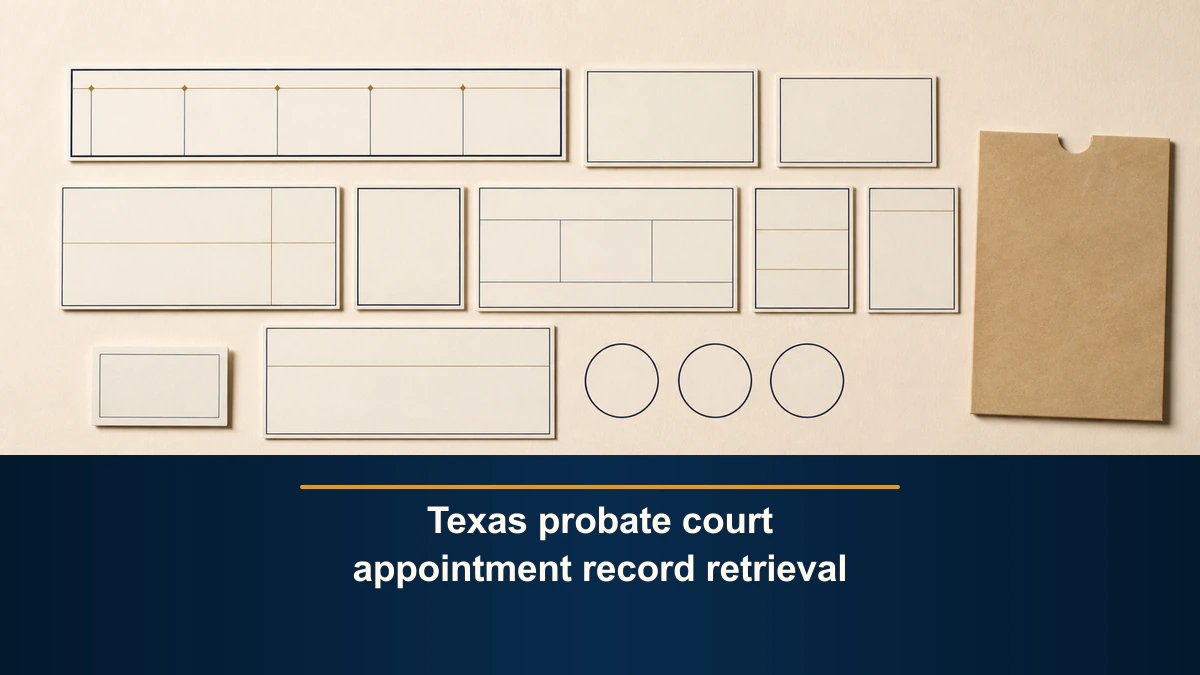
Single-attempt record-search boundary. This blank worksheet documents one authorized manual search through one official Texas court or county route. A displayed case, order, or letters label does not establish identity, authenticity, completeness, certification, currency, appointment, qualification, authority, title, ownership, mineral connection, or legal effect. Keep names, cause numbers, queries, retrieved records, screenshots, and completed worksheets in an authorized controlled system. MRX provides educational information and resources only and does not buy mineral rights.
A Texas probate court appointment record retrieval can preserve a useful source trail when every observation stays attached to one official route, one controlled criterion, and one access event. The worksheet records what the source displayed and what prevented a bounded result. It does not decide what the record means.
That separation matters when an inherited mineral-rights file refers to an executor, administrator, order, or letters. A family statement, buyer request, royalty account, or retained document is one source. A court or county search display is another. Neither source, by itself, authorizes this worksheet to identify a person, authenticate a record, or determine who may act for an estate.
Direct answer for mineral owners
Create one worksheet ID for one authorized manual search attempt. Use the Texas Judicial Branch directory to identify the applicable official court information, then follow the official court or county route that actually provides the permitted record-search interface.Record the exact starting and final HTTPS routes, source-displayed court and county labels, access timestamp and timezone, search mode, controlled criterion or cause reference, displayed case-style, cause, docket, and document labels when available, navigation and result state, retained-search pointer, source limitation, and one outcome: located, not located, or unverified.
Stop there. Do not interpret an appointment, order, letters, qualification, authority, fiduciary scope, title, ownership, mineral connection, or legal effect. Do not order, purchase, submit, contact, log in, create an account, or request a certified copy under this workflow.
Use one official route and one attempt
Texas does not have one identical probate-record interface for every county. The Texas Judicial Branch Trial Courts page explains that the state has several trial-court levels with some overlap. It also distinguishes constitutional county courts, county courts at law, district courts, and statutory probate courts.
That structure is a reason to preserve the route, not a reason to choose a court by inference. Use the current official directory and the actual court or county site. Record exactly what those sources call the court, county, search type, and destination.
Start a new worksheet ID or version when any of these changes:
- the official starting or final route;
- the court or county label;
- the search mode;
- the controlled criterion or cause reference;
- the access timestamp or timezone;
- the displayed case, docket, or document labels;
- the access or result state;
- the retained-search pointer; or
- the source limitation.
Do not merge searches across counties, courts, platforms, names, causes, dates, or document types. A later reviewer should be able to see which exact source state produced each observation.
Keep every reusable field blank
- Worksheet ID:
[controlled attempt ID] - Controlled input reference:
[private source pointer only] - Official directory route:
[exact HTTPS URL] - Official court or county route:
[exact HTTPS URL reached] - Source-displayed court label:
[exact source display] - Source-displayed county label:
[exact source display] - Access timestamp and timezone:
[authorized manual access time] - Search mode:
[exact source display] - Controlled criterion or cause reference:
[private pointer only] - Case-style label:
[exact source label, when shown] - Cause or docket label:
[exact source label, when shown] - Document-type label:
[exact source label, when shown] - Navigation or access state:
[exact source display] - Result-state reference:
[controlled record only] - Retained-search pointer:
[authorized locator] - Source limitation:
[exact display, not stated, or unresolved] - Controlled outcome:
[located, not located, or unverified] - Authorized-human handoff:
[role and bounded question]
The bracketed phrases are labels, not example values. Do not put a real or fictional decedent, executor, administrator, heir, beneficiary, attorney, court staff member, case style, cause number, docket number, document number, address, property, mineral interest, offer, result, or conclusion into the reusable public worksheet or images.
Result limitation: keep this beside the result and outcome fields. A displayed result proves only that the recorded official route displayed that bounded result during the recorded access event. It does not establish authenticity, completeness, certification, currency, identity, appointment, qualification, authority, fiduciary scope, title, ownership, mineral connection, or legal effect.
Start with the official Texas court directory
The Texas Judicial Branch Judicial Directory says its annual published information is current as of April 2026 unless otherwise noted and points to the live directory database for more current court information. The linked Texas Office of Court Administration public directory search identifies itself as the Court Activity Reporting and Directory System and exposes source-displayed court-search controls.
Use those sources only to preserve the official court-routing trail. The directory is not the probate case record. After identifying the court information, retain the official route that the relevant court or county actually provides for authorized public record access.
Do not substitute an advertisement, people-search site, document reseller, search snippet, social profile, buyer portal, or unofficial index for the official route. If the final route cannot be confirmed, record the attempt as unverified and stop.
Preserve record labels without interpreting them
The official Texas Estates Code PDF separates probate jurisdiction in Chapter 32 from the granting and issuance of letters in Chapter 306. Chapter 306 also distinguishes an order granting letters, issuance of original letters, the form and content of letters, and the statute’s stated effect of letters.
Those distinctions support exact label recording. If the official source displays order, letters testamentary, letters of administration, case style, cause, docket, or another document label, preserve the exact source wording. Do not collapse different document types into the generic word appointment.
This worksheet does not apply Chapter 32 to select the legally correct court. It does not apply Chapter 306 to decide whether an order or letters is effective, current, sufficient, certified, or related to a particular person or property. Those are separate legal and evidentiary questions.
Preserve three controlled outcomes
Use only these outcomes:
- Located: the recorded official route displayed the controlled result or retained result reference during the documented attempt.
- Not located: the recorded route did not display the controlled result during that attempt.
- Unverified: access, route identity, court or county labels, search mode, result state, missing fields, private-data controls, or retained evidence prevented either bounded observation.
Do not convert located into authentic, certified, current, same person, appointed, qualified, authorized, may lease, may sell, owns the minerals, or valid transaction party.
Do not convert not located into no probate, no order, no letters, no representative, no estate, no authority, or record does not exist. One route, search mode, spelling, date range, index, or access state may be incomplete.
Stop when access changes the task
An authorized public search can reach a boundary that requires a login, account, clerk contact, order form, payment, certified-copy request, identity verification, subscription, or another submission. Record the route, access time, displayed requirement, and limitation. Use unverified and stop.
This workflow does not authorize:
- creating an account or signing in;
- paying a search, access, document, or certification fee;
- submitting a request or order;
- contacting a clerk, court, vendor, party, or attorney;
- downloading restricted or bulk records;
- bypassing a CAPTCHA, rate limit, access control, or terms;
- scraping or automating a search; or
- representing that a non-certified display is a certified record.
A later authorized process can decide whether contact, purchase, certification, or legal review is appropriate. Keep that decision outside the retrieval worksheet.
Keep private case data controlled
The reusable public template needs no completed name, cause number, docket number, filing date, document number, address, attorney, court staff contact, estate detail, family relationship, will term, property description, mineral interest, lease, royalty amount, offer, signature, screenshot, or result.
Use one controlled input pointer for the reason the search was performed. Use a separate controlled retained-search pointer for the evidence preserved from the official source. Do not merge the two into an identity profile or publish either pointer’s private contents.
If an authorized reviewer needs to compare names, dates, or record details, create a separate purpose, access rule, evidence standard, and human review. This worksheet is not an identity-matching or record-authentication process.
Exclude title, mineral, and transaction conclusions
A probate search display does not connect an estate to a tract, survey, abstract, section, block, acreage, depth, formation, lease, unit, well, royalty account, payor, or offer. Do not add those fields to this worksheet.
Use the broader probate process for mineral interests article for educational context about estate, title, inventory, and mineral administration. Use the retained evidence source-scope worksheet to document the source scope of an artifact that has already been retained. This article owns the earlier, narrower job of documenting one official probate record-search attempt.
Do not use the outcome to decide who owns mineral rights, who may sign, whether title is clear, whether a lease or sale is valid, whether an offer is fair, or whether a transaction should proceed.
Stop at authorized-human review
Close the worksheet with the controlled outcome, limitation, unresolved question, and next authorized role. Do not answer the later question inside this retrieval record.
Questions about the correct court, record certification, document meaning, appointment, qualification, present authority, fiduciary scope, legal effect, title, ownership, heirship, mineral connection, lease or sale power, or transaction conduct require the court or clerk, qualified Texas probate or oil-and-gas counsel, or another appropriately qualified professional.
This worksheet documents one manual official-route search attempt. It does not provide legal, probate, tax, title, appraisal, valuation, investment, financial, identity-verification, record-authentication, offer, closing, or transaction advice.
Frequently asked questions
Does a directory listing prove where a probate record is filed?
No. The directory helps preserve official court information and routing. It does not establish venue, jurisdiction for a particular matter, filing location, case existence, record completeness, or legal effect.
Can I record a screenshot instead of the route and search state?
A controlled screenshot may be part of retained evidence when authorized, but it does not replace the route, access time, search mode, exact displayed labels, limitation, and outcome. Keep the screenshot out of the public template.
Does this worksheet verify an executor or administrator?
No. It documents a source retrieval attempt only. Identity, appointment, qualification, current authority, fiduciary scope, and power to act require separate evidence and qualified review.
What if the official site is unavailable?
Record the attempted route, access time, unavailable or error state, and limitation. Use unverified. Do not switch silently to an unofficial source or treat the outage as evidence about the case or record.
Can the same worksheet be reused after the source changes?
Use a new version or worksheet ID. A changed route, court label, search mode, criterion, date range, displayed fields, access state, or result state is a new source event.
Sources reviewed for this article
- Texas Judicial Branch: Trial Courts
- Texas Judicial Branch: Judicial Directory
- Texas Office of Court Administration: Public Directory Search
- Texas Estates Code: official full-code PDF
Frequently asked questions
Does a located result prove that someone can sign a mineral lease or sale agreement?
No. Located means only that one official route displayed the bounded result during the recorded attempt. This worksheet does not establish identity, appointment, qualification, current authority, fiduciary scope, title, ownership, mineral connection, or power to lease or sell.
What does not located mean on this worksheet?
It means only that one documented attempt through one route did not locate a result. It is not evidence that no case, order, letters, appointment, representative, estate, or record exists.
Can one worksheet combine several counties or courts?
No. Use one worksheet for one official route and one attempt. A different county, court, route, search mode, criterion, access time, or result state requires a separate worksheet ID or version.
Should the public template contain a decedent name or cause number?
No. Keep actual search criteria and case data in an authorized controlled record. The reusable public template and images should contain only blank fields and controlled-reference placeholders.
What if a record requires payment, login, clerk contact, or a certified-copy request?
Record the access state and use unverified, then stop. This workflow does not authorize a purchase, account creation, submission, contact, certified-copy request, access bypass, scraping, or bulk collection.
Sources reviewed for this article
- Texas Judicial Branch, Trial Courts (accessed 2026-08-26)
- Texas Judicial Branch, Judicial Directory (accessed 2026-08-26)
- Texas Office of Court Administration, Public Directory Search (accessed 2026-08-26)
- Texas Estates Code, official full-code PDF, Chapters 32 and 306 (rendered 2026-04-10; accessed 2026-08-26)
Related mineral-rights articles
Understanding the Probate Process for Mineral Interests
Probate mineral work connects estate authority, title, inventory, lease and production administration, payor records, and the final recorded distribution.
Read the post →
What Happens to Mineral Rights in Probate?
Texas mineral interests do not disappear at death; heirs and fiduciaries must connect the governing estate path to county title, leases, payors, income, and basis records.
Read the post →
Mineral Rights Inheritance in Texas: What Heirs Need to Know Before Selling
Texas heirs should verify authority, title, the exact inherited interest, co-owners, payor records, tax support, and written offer terms before selling.
Read the post →
Mineral Rights Retained Evidence Source-Scope Worksheet
Build one blank source-scope record for one already-retained artifact without retrieving, interpreting, comparing, or deciding anything.
Read the post →A practical next step
Put your mineral rights in context.
Every mineral interest, royalty history, and written offer is different. Start with a question, or share what you have for a free underwriter review.
- Free
- Confidential
- No obligation to sell
Ready for a closer look?
Review Related Inheritance GuidesGet a directional range with the assumptions clearly stated.
