
MRX Learning Center
How to Spot Predatory Mineral Rights Offers
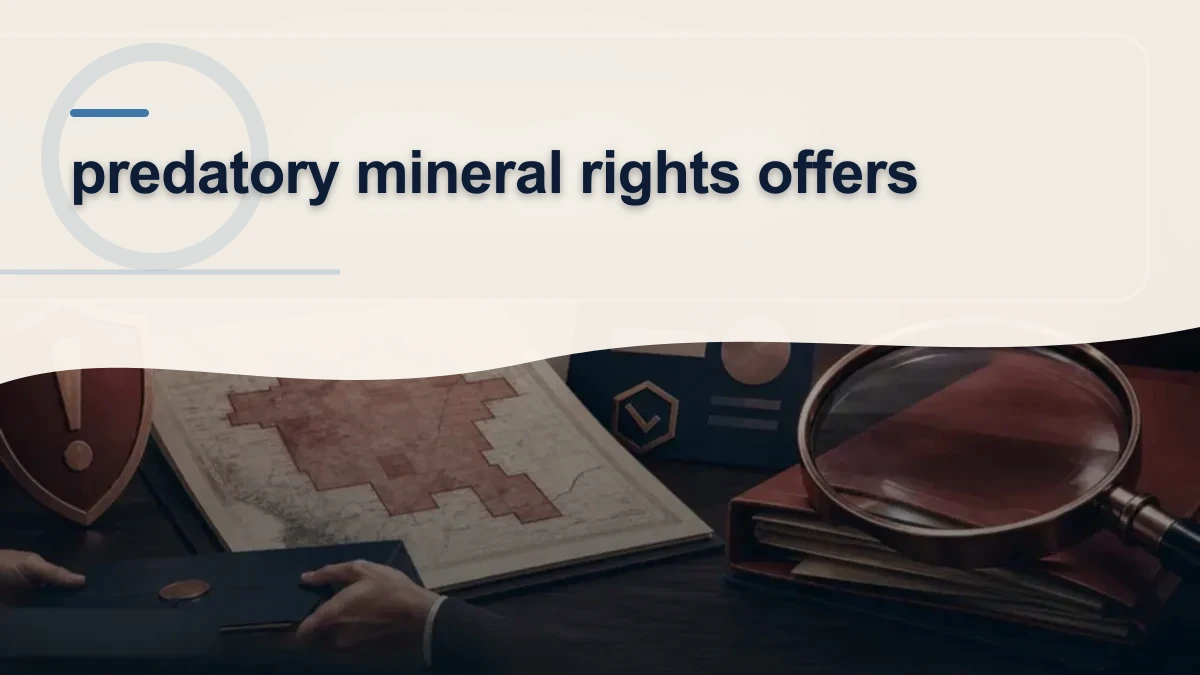
A low or unsolicited mineral offer is not automatically fraudulent. Screen the buyer, communication, property description, pricing terms, deed, information requests, and closing sequence before signing.

Direct answer for mineral owners
No single feature proves that a mineral-rights offer is predatory or fraudulent. Pause and verify when the sender's identity is hard to confirm, pressure replaces explanation, the property or deed is broader than the owner expected, the price can change without defined limits, sensitive information or unusual payment methods are requested, or the recording and payment sequence exposes the owner.
Key takeaways for mineral owners
- An unattractive price, an unsolicited letter, and fraud are different issues and require different evidence.
- Verify the person, company, contact channel, and property knowledge independently before sharing sensitive records.
- Compare the offer letter, purchase agreement, deed, exhibits, and closing instructions as one transaction.
- Stop when a material term changes and obtain qualified legal help before signing or recording a conveyance.
This article provides general fraud-awareness and transaction-organizing education. It does not determine that any person or company acted unlawfully, and it is not legal, title, tax, cybersecurity, or law-enforcement advice.
Direct answer for mineral owners
A mineral-rights offer deserves a pause when the sender cannot be independently verified, pressure replaces explanation, the documents convey more than expected, the price can change without defined limits, or the payment and recording sequence exposes the owner. None of those facts alone proves fraud or predatory conduct. Together, they tell an owner to stop, preserve the evidence, and investigate.Separate three questions: Is the price attractive? Are the contract terms acceptable? Is the interaction authentic and safe? A real buyer can make a poor offer, and a polished offer can still contain unacceptable terms.
Verify the sender outside the message
Record the representative’s name, company, address, phone number, email domain, website, and proposed acquiring entity. Then locate independent contact information rather than relying only on a link or number in the letter, text, or email.
Texas Secretary of State business resources can help locate official entity-search options and explain that formation or registration is not a state endorsement. A company record does not verify a contact person’s authority to act for that entity or the soundness of the transaction.
Call through a number you independently found. Ask the company to confirm the representative, acquiring entity, property, and offer. Be cautious when the sender resists a basic identity check or moves the conversation to a new account without explanation.
Look for pressure and control tactics
The Federal Trade Commission advises consumers to recognize impersonation, urgency, and unusual payment demands in its guidance on avoiding scams and signs of a scam. Apply those general safeguards to a mineral transaction without assuming that ordinary negotiation is criminal.
Pause when someone:
- insists that you sign before you can consult family or an adviser;
- claims a deadline but will not explain the event causing it;
- tells you to ignore a lawyer, co-owner, executor, trustee, or title professional;
- changes email addresses, entities, wiring instructions, or documents without a clear reason;
- asks for secrecy that prevents normal verification; or
- threatens unsupported consequences if you request time or clarification.
A legitimate deadline can exist. Ask for the reason and the term in writing.
Confirm the property before discussing price
Write down the county, tract, legal description, net interest, depths, formations, leases, wells, and receivables you believe are under discussion. Compare that list with the offer, purchase agreement, deed or assignment, and every exhibit.
The headline may mention one well while the conveyance covers all minerals in a county, after-acquired title, additional depths, or future proceeds. The Texas Property Code’s conveyance chapter provides statutory context, but a qualified Texas attorney should explain the effect of the actual document.
Do not sign a deed because a cover letter appears narrow. The operative instrument controls legal rights.
Track versions and price-adjustment rights
Save each document with the received date and a version identifier. Compare the parties, property, consideration, effective date, title standard, adjustment rights, warranties, indemnities, closing date, and termination terms.
A price change is not automatically improper; title review can reveal that the owner holds less or different property than expected. The important questions are whether the adjustment basis is defined, supported by evidence, limited to the relevant issue, communicated before closing, and subject to a clear owner response or cancellation right.
Treat a material late change as a new decision. Do not rely on a phone assurance that contradicts the contract or deed.
Limit sensitive information
A buyer may reasonably request ownership, lease, division-order, royalty, tax, and estate records. Confirm the recipient, purpose, and secure transmission method first. Redact unrelated account numbers, Social Security numbers, passwords, one-time codes, and other data not needed for the review.
Do not pay a stranger by gift card, cryptocurrency, cash shipment, or other unusual method because they claim it is required to release sale proceeds. Do not give remote access to your device or email. Independently verify any wiring instruction and any later change through a trusted channel.
Make the closing sequence explicit
Before signing, identify who holds the documents and money, when title review occurs, when the price becomes final, when the owner receives collected funds, and when the conveyance can be recorded. Ask what happens if the transaction does not close.
An owner should understand whether a signed deed can be recorded before payment, whether documents are held by an independent closing agent, and how fraud checks or wire verification work. Ask qualified counsel to review the proposed sequence.
Verify property facts without treating them as title
The RRC’s research queries can help confirm public well, operator, permit, field, and production identifiers associated with Texas property. Those records do not prove the sender’s identity, the owner’s title, payment accuracy, or the fairness of an offer.
Use public data to test whether the proposal describes a plausible property, then verify ownership and legal scope through the applicable instruments and advisers.
Respond to a serious concern
Stop communicating through the questionable channel. Preserve emails, texts, envelopes, caller information, document versions, and payment instructions. Contact the real company through an independently verified channel if impersonation is possible. Contact the financial institution promptly if money or account information may be at risk.
Appropriate legal counsel, consumer-protection authorities, or law enforcement can advise on reporting. Describe observable facts rather than publicly accusing a person or company without evidence.
MRX provides educational information and resources only and does not buy mineral rights. Owners can use independent legal, tax, valuation, cybersecurity, or brokerage help when appropriate.
Source notes and research limitations
- FTC guidance on avoiding scams and common scam signs supports the general identity, urgency, and payment-safety framework.
- Texas Secretary of State business resources support independent entity-research routing, not endorsement of a buyer.
- RRC research queries support bounded property and regulatory context, not title or buyer verification.
- Texas Property Code Chapter 5 supplies statutory conveyance context; it is not a substitute for advice on a specific instrument.
Review hidden offer terms or organize every transaction document before signing.
Frequently asked questions
Is every unsolicited mineral-rights offer a scam?
No. Legitimate buyers use direct outreach, and an unsolicited or low offer is not proof of fraud. Verify the sender, property, terms, documents, and closing process before deciding.
Should I send my deed or royalty statements to a buyer?
Those records may support a review, but confirm the recipient and purpose first, redact unrelated sensitive information, use a secure channel, and do not send passwords, one-time codes, or unnecessary banking credentials.
What if the purchase agreement lets the buyer change the price?
Ask for the adjustment standard, evidence, calculation, notice, timing, and your cancellation rights in writing. Broad or unclear adjustment power deserves legal review before signing.
Can I rely on the company name printed on the letter?
Treat the name as a lead, not verification. Independently locate the entity and contact information, then confirm the representative and transaction through a trusted channel.
Who should review a mineral deed before I sign?
A qualified attorney familiar with oil-and-gas and real-property transactions in the relevant state can assess legal effect, warranties, scope, reservations, and remedies.
Sources reviewed for this article
- Federal Trade Commission, How To Avoid a Scam (accessed 2026-08-06)
- Federal Trade Commission, What are the signs of a scam? (accessed 2026-08-06)
- Railroad Commission of Texas online research queries (accessed 2026-08-06)
- Texas Secretary of State business resources (accessed 2026-08-06)
- Texas Property Code Chapter 5, Conveyances (accessed 2026-08-06)
Related mineral-rights articles
How to Identify Predatory Mineral Buyers
Evaluate mineral buyers by verifying identity, authority, written terms, deed scope, closing controls, and pressure tactics rather than relying on a label.
Read the post →
How to Compare Mineral Rights Buyers in Texas
How to compare Texas mineral rights buyers and their offers beyond the headline number. Plain-language questions, what to look for, and how a free underwriter review helps.
Read the post →
Identifying Red Flags in Mineral Rights Transactions
Red flags are signals to verify identity, records, contract scope, adjustment rights, payment conditions, and privacy, not automatic proof of wrongdoing.
Read the post →
Navigating Competing Offers: What to Do Before Your Mineral Rights Assessment Call
A useful assessment call begins with complete offer documents, a normalized comparison table, and a short list of unresolved title, price, and closing questions.
Read the post →A practical next step
Put your mineral rights in context.
Every mineral interest, royalty history, and written offer is different. Start with a question, or share what you have for a free underwriter review.
- Free
- Confidential
- No obligation to sell
Ready for a closer look?
Organize an Offer Safety ReviewGet a directional range with the assumptions clearly stated.